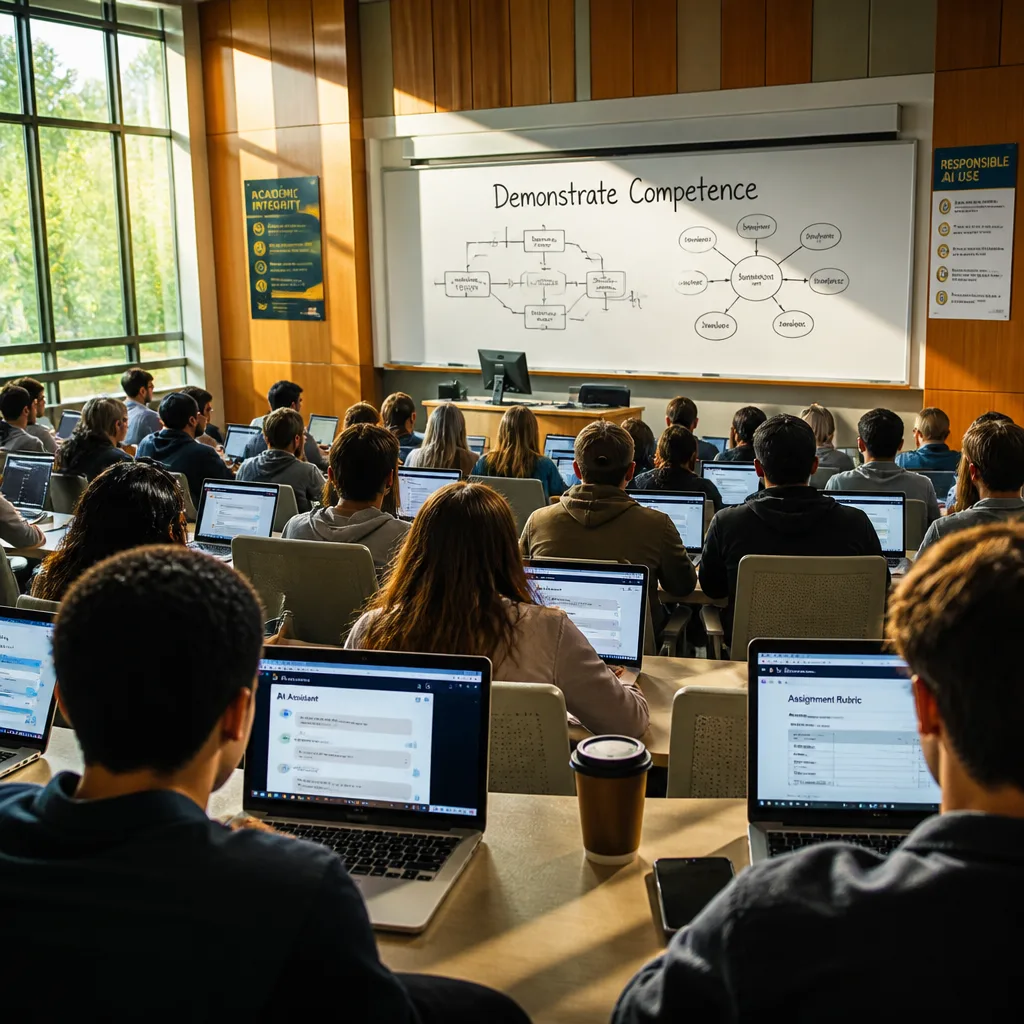
Higher education can no longer treat artificial intelligence as an aberration: students use AI tools routinely and will continue to do so, and that reality requires a fundamental rethink of how institutions teach, assess and preserve academic trust.
From detection to demonstration
The central problem, according to recent analysis, is that a finished essay, presentation or line of code may reflect either genuine understanding or skillful use of an AI assistant. That ambiguity undermines traditional assumptions that final submissions reliably indicate effort, originality or comprehension.
One AI-writing detection platform found that 11% of more than 200 million student papers contained AI-written language in at least 20% of the submission, while 3% of papers had 80% or more AI-generated text. Those figures underpin calls for a shift in assessment from provenance to competency: from asking whether the student produced a piece of work to asking whether the student can explain and defend it.
“So, the question must shift from ‘Did the student produce this?’ to ‘Can the student explain, defend, apply, and improve it?’”
What an AI-ready graduate must demonstrate
Research cited in the analysis shows students view AI as essential to future careers: 62% of higher education students believe responsible AI use is important for career success, and 80% consider AI important to their future.
But using AI does not automatically make a student ready for the workplace. The analysis distinguishes between students who can generate outputs and those who can interrogate them — verify accuracy, test arguments, identify bias, protect sensitive data, cite sources responsibly and know when human judgement should override machine suggestions. The implication is that institutions should teach not just tool use but critical oversight.
| Metric | Value |
|---|---|
| Student papers with ≥20% AI-generated text | 11% |
| Student papers with ≥80% AI-generated text | 3% |
| Students who view responsible AI use as essential for career success | 62% |
| Students who see AI as important to their future | 80% |
Rethinking governance and pedagogy
AI governance in education has often been framed as a policy problem: what is permitted, prohibited or constitutes misconduct. While rules remain necessary, the analysis stresses that institutions must also ask different questions: what should students learn to do with AI, how should faculty redesign assignments, and how can assessment distinguish assistance from dependency?
Practical responses suggested by the analysis include redesigning assessments so they demand demonstrable mastery, embedding instruction about responsible AI use into curricula, and creating assignments that privilege process and reflection over polished final products.
- Design assessments that require explanation, defence or live demonstration of work.
- Teach verification skills: how to test outputs, detect bias and cite AI-assisted work.
- Use AI as a learning tool while setting clear expectations about acceptable assistance.
These approaches aim to preserve academic integrity while aligning education with workplace realities where AI tools are increasingly expected.
Consequences for students, faculty and institutions
For students, the shift means being evaluated on critical judgement rather than product polish alone. For faculty, it requires time and training to devise new assessments and to teach oversight skills. For institutions, it opens questions about equity and access: students with more exposure to AI outside the classroom may have advantages unless instruction is standardised and supported broadly.
The analysis warns against simplistic bans that drive AI use underground or punish students without addressing underlying learning goals. Instead, a mix of policy, pedagogy and practical skills training is needed so that AI strengthens learning without eroding accountability or professional standards.
As AI becomes embedded in daily life and work, the stakes are clear: universities and colleges must decide whether they will simply police tool use or redesign programmes so graduates can deploy AI responsibly, critically and transparently.