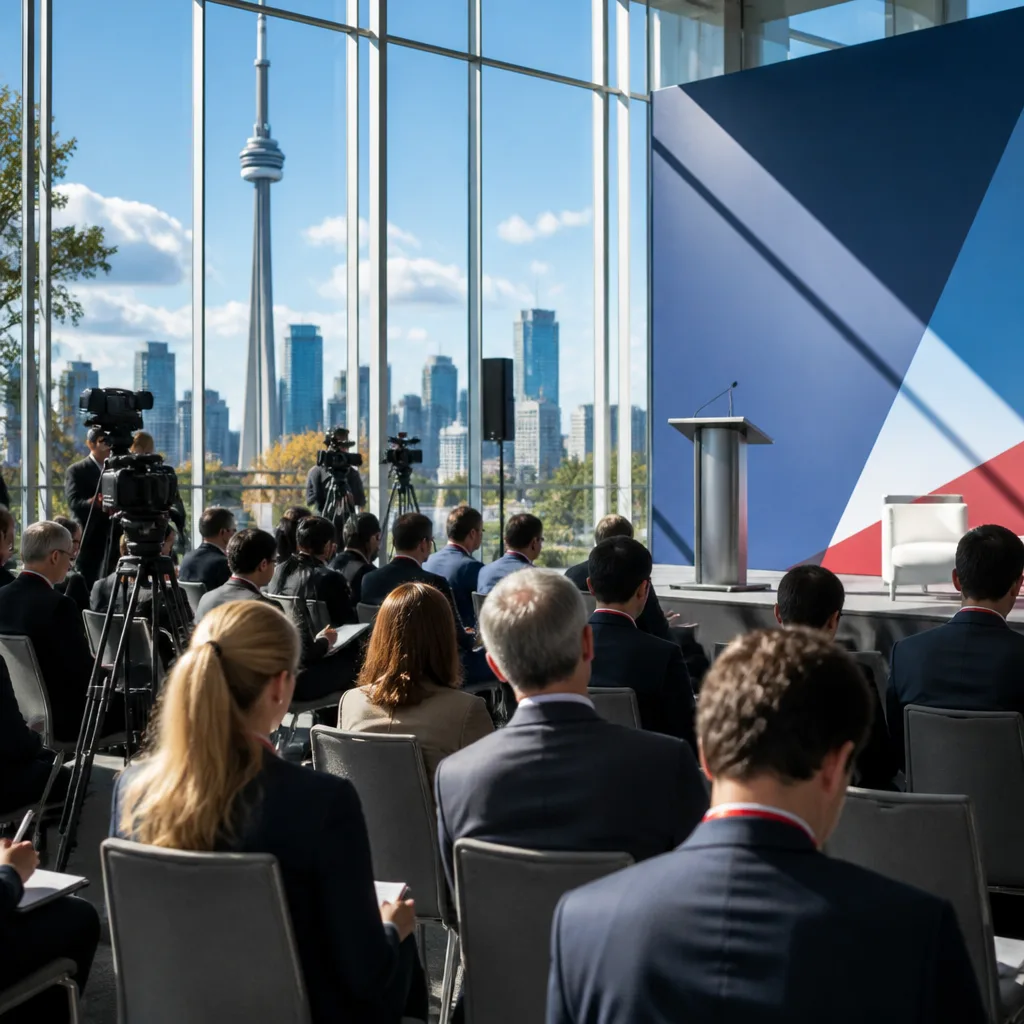
Former prime minister Stephen Harper told the closing session of the Canada Investment Summit in Toronto that the federal government “had no choice” but to walk away from trade negotiations with the United States, endorsing a path that he said will see a full-blown trade war between the two countries.
Harper frames withdrawal as necessary to protect sovereignty
Speaking to a room of wealthy international investors on the sidelines of the summit hosted by Prime Minister Mark Carney, Harper — who led the Conservative Party for more than a decade — defended Ottawa’s decision as unavoidable in the face of what he described as an American administration that views the high degree of economic integration as incompatible with Canada’s independence.
“This had to be a very difficult decision, but I do believe that our government had no choice but to take this path,”
Harper said he found the situation “very sad, just as equally necessary,” arguing that Canada must pursue policies to reduce reliance on the United States in order to preserve its industrial capacity and economic diversity. He warned against letting the U.S. administration "hollow out" Canadian industry.
Context and implications for Canada’s economic strategy
The former prime minister — who has previously described himself as "probably the most pro‑American prime minister in Canadian history" — said his long‑standing affinity for the United States made the decision all the harder. Yet, he framed the government's course as a defence of national sovereignty and a move to protect domestic capacity.
- Trade confrontation: Harper explicitly endorsed abandoning talks even though it will lead to a trade war “in earnest,” a phrase he used to underscore the severity of the outcome.
- Economic sovereignty: He argued that diminished reliance on the U.S. is necessary to avoid loss of Canadian industrial capabilities.
- Investor message: The comments were delivered at the Canada Investment Summit, a gathering of global investors convened by the prime minister.
The remarks, delivered in his closing keynote address, are notable because they align a prominent centre‑right figure with a government decision that will reshape bilateral economic relations. For investors and policymakers, the endorsement from a former Conservative prime minister underscores the political breadth of support — or at least acceptance — for the path Ottawa has chosen.
What Harper said at the summit
| Item | Detail |
|---|---|
| Event | Canada Investment Summit (Toronto) |
| Key speaker | Stephen Harper, former prime minister |
| Main message | Backing federal decision to walk away from U.S. trade talks to protect sovereignty |
| Described outcome | “See a trade war commence in earnest” |
Harper referenced the stance of the current U.S. administration by name, saying it views Canada’s economic integration as incompatible with separate sovereignty — a point he used to justify the government’s strategy to reduce dependence on the United States.
His intervention came at a summit convened by Prime Minister Mark Carney and attended by hundreds of investors. The forum was intended to showcase Canada’s investment potential; Harper’s remarks, however, focused on the strategic necessity of insulating the national economy from pressures emanating from south of the border.
The former prime minister stressed the need to retain economic diversity and industrial capacity at home. He warned against policies that would allow external pressures to hollow out Canada’s manufacturing and supply capabilities — an outcome he said would threaten sovereignty.
Whether Harper’s public backing of the government’s hard line will alter perceptions among investors or influence public debate is an open question, but his stature across the political spectrum lends weight to a view that the decision to break off talks was not just tactical but rooted in a longer‑term strategy of economic resilience.