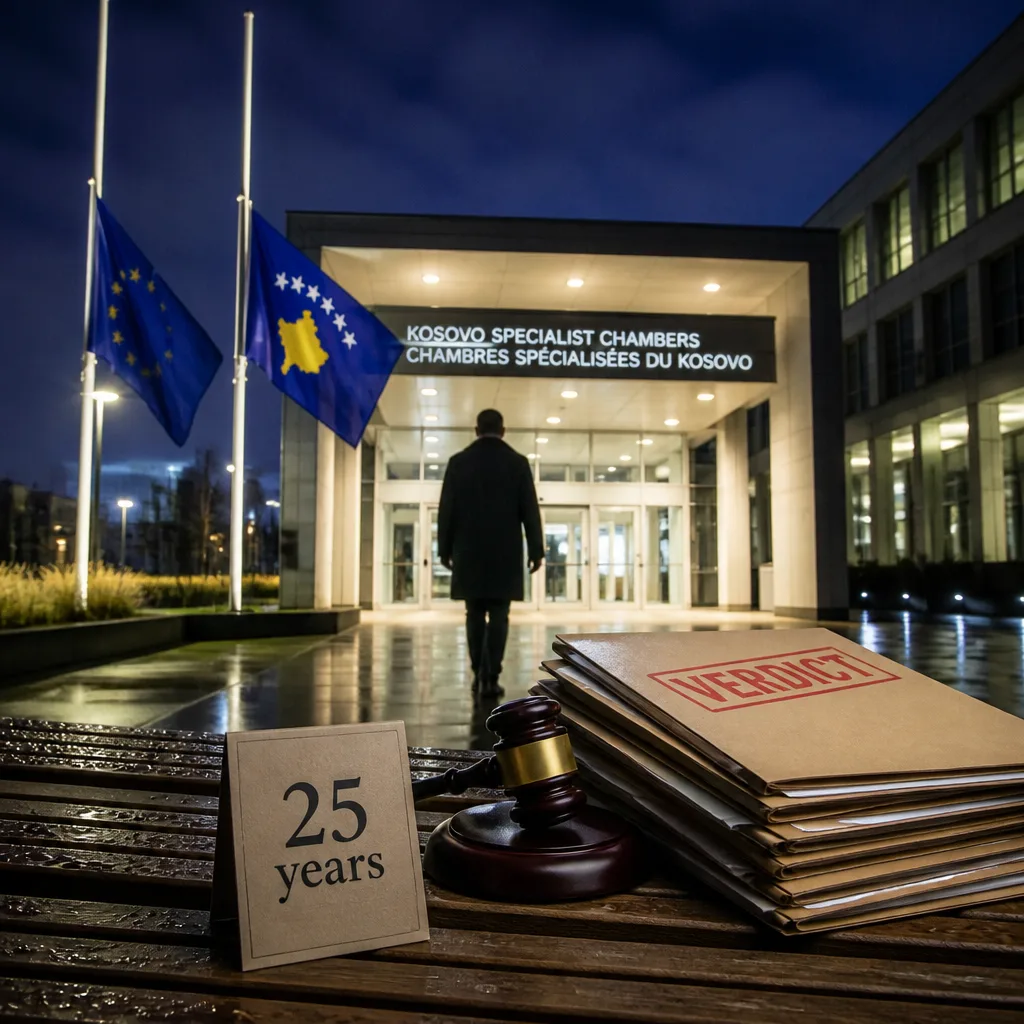
The Hague — A European Union-backed tribunal on Wednesday convicted former Kosovo president Hashim Thaçi of war crimes and sentenced him to 25 years in prison, delivering a long-awaited verdict that has already reverberated through Kosovo and the wider Balkans.
Verdict and charges
The panel at the Kosovo Specialist Chambers in The Hague found Thaçi guilty of four counts related to the 1998–99 conflict: murder, torture, cruel treatment and arbitrary detention. He had resigned as president and surrendered to the court after his 2020 indictment and has been detained in The Hague; his time served will be counted toward the sentence.
Three other former Kosovo Liberation Army (KLA) figures who were tried alongside Thaçi were also convicted. The court determined that the four men were criminally responsible for the arbitrary detention and torture of hundreds of people and for 96 murders, and that they had contributed to a common criminal purpose targeting perceived opponents of the KLA’s political and military objectives. The panel acquitted the defendants of crimes against humanity charges.
Sentences and co-accused
The court handed the following prison terms:
- Hashim Thaçi — 25 years
- Jakup Krasniqi — 25 years
- Kadri Veseli — 18 years
- Rexhep Selimi — 13 years
| Defendant | Sentence |
|---|---|
| Hashim Thaçi | 25 years |
| Jakup Krasniqi | 25 years |
| Kadri Veseli | 18 years |
| Rexhep Selimi | 13 years |
Reaction at home and in court
News of the verdict prompted a strong reaction in Pristina. Hundreds and at times thousands of supporters had gathered in the capital in the days leading up to the decision, displaying portraits and flags and watching the proceedings on large screens. When the sentence was read, crowds that had expected a possible acquittal fell silent, many visibly shocked.
"Throughout my life, I stood with the people of Kosovo defending freedom, life and dignity. I was always guided by the Western ideals of democracy, equality and justice,"
The remarks above were made by Thaçi during his closing statement at trial earlier this year, as he denied the accusations lodged by prosecutors.
Legal and political context
The convictions were delivered by a court established to try crimes allegedly committed during and after the Kosovo conflict, a period that produced deep divisions and competing narratives across the region. For many in Kosovo, Thaçi and other former KLA commanders are regarded as veterans of the struggle for independence; Thaçi later served as prime minister and president and was a central figure in Kosovo’s 2008 declaration of independence.
Prosecutors had sought significantly longer sentences; in written submissions they asked for the maximum term of 45 years for Thaçi and other defendants. The court’s findings that the accused had targeted civilians and perceived political opponents mark one of the most consequential decisions to emerge from post‑conflict accountability mechanisms in the Balkans.
Implications
The ruling is likely to intensify political debate in Kosovo, where public opinion is sharply divided between those who view the accused as freedom fighters and those who accept the need for legal accountability. It may also affect diplomatic relations in the region and the course of reconciliation efforts, as observers assess how societies confront contested wartime legacies while pursuing cooperation and stability.
The defendants have denied the charges. Appeals are expected under the court’s procedures, which could extend the legal process by months or years.
Key facts:
- Thaçi convicted of murder, torture, cruel treatment and arbitrary detention; acquitted of crimes against humanity.
- Court found responsibility for arbitrary detention and torture of hundreds and 96 murders.
- All four defendants remain in detention at The Hague; time already served will be credited.