
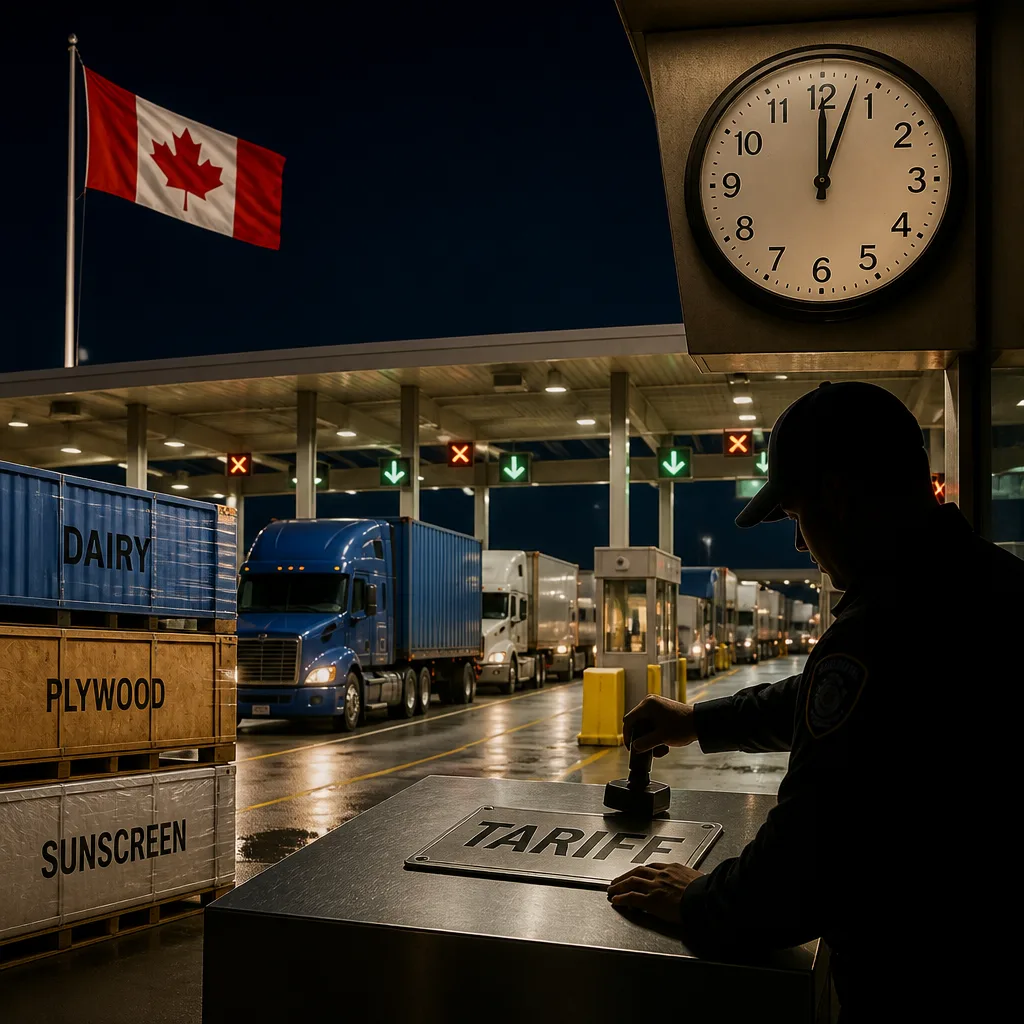
Ottawa's retaliatory duties on U.S. goods came into force just after midnight EDT Tuesday, mirroring the value and many of the product lines targeted by Washington’s recent step to impose a 50 per cent tariff on almost $28 billion of Canadian exports.
Scale and scope of the measures
The Canadian countermeasures are set to affect a catalogue of American-made products that correspond to the list Washington hit in late August. Among the items singled out in Ottawa’s response are a range of dairy products, plywood and sunscreen — sectors that supply both consumers and downstream manufacturers in Canada.
The U.S. action on Aug. 22 covered goods from cement and honey to hockey sticks, according to the file released when Washington announced the penalties after trade talks between the two governments broke down.
Political rhetoric and corporate impact
Tensions have been punctuated by unusually personal public comments. In the hours before Canada’s new tariffs were implemented, U.S. President Donald Trump posted a series of anti-Canada remarks on social media, including an artificial-intelligence generated cartoon that depicted him as a hockey player swatting at Canadian leaders. The president has repeatedly suggested he would like to see Canada become the 51st U.S. state, and has referred to both Mark Carney and his predecessor, Justin Trudeau, as "governor" in public posts.
"We couldn't accept what they offered. We wouldn't give what they'd asked. As a result, the U.S. has imposed new tariffs designed to hurt and divide us," Prime Minister Mark Carney said. "Now, that's a miscalculation because Canadians will always take care of each other. And it's a miscalculation because we have everything we need to build the country we want. We have the reserves, we have the resilience, and we have the right plan."
Bombardier also found itself in the line of fire when President Trump warned he might block the company from selling aircraft in the United States unless production took place there. The company responded with a detailed statement listing thousands of U.S. jobs across more than 20 locations, rebutting any implication it lacks a manufacturing footprint in the United States.
Economic consequences and questions for businesses
Even where tariffs are aimed at specific product lines, the ripple effects can be much broader. For Canadian importers and retailers, higher duties on U.S. inputs such as plywood could lift costs for builders and renovators. Levies on dairy and related products risk raising expenses for food processors and groceries, potentially filtering through to consumer prices.
Key uncertainties include how each side intends to administer the duties over time, whether any exemptions will be allowed, and how businesses will restructure supply chains to mitigate cost increases. Firms that source intermediate goods from across the border will need to reassess procurement, pricing and inventory strategies.
- Timing: Canadian tariffs effective just after midnight EDT Tuesday.
- U.S. action: 50 per cent tariffs on nearly $28 billion of Canadian goods announced Aug. 22.
- Canadian targets: dairy products, plywood, sunscreen and other items corresponding to U.S. list.
Analysts will be watching trade statistics closely in the coming months for signs of volume shifts, price adjustments and substitution effects as businesses adapt. Policymakers on both sides face pressure to balance political signalling with the real economic costs of higher trade frictions.
| Measure | Noted examples |
|---|---|
| U.S. tariffs (Aug. 22) | Hockey sticks, cement, honey; 50% duties; nearly $28 billion of Canadian goods |
| Canada's reciprocal tariffs (effective Tuesday) | Dairy products, plywood, sunscreen and other U.S. items matching the U.S. list |
For Canadian households, any direct price increases will be more visible in everyday categories such as dairy and personal care if retailers pass costs on. For exporters and manufacturers, the tariffs add another layer of uncertainty to planning and capital allocation decisions. The long-term economic implications will depend on whether this escalation remains targeted and temporary or becomes a more persistent barrier to cross-border commerce.
From a policy perspective, the dispute highlights how quickly bilateral negotiations can shift into tit-for-tat measures with immediate commercial consequences. Companies and consumers alike will be watching for further announcements from Ottawa and Washington, and for any new efforts to reopen talks that might ease the tariffs and restore more predictable trading conditions.