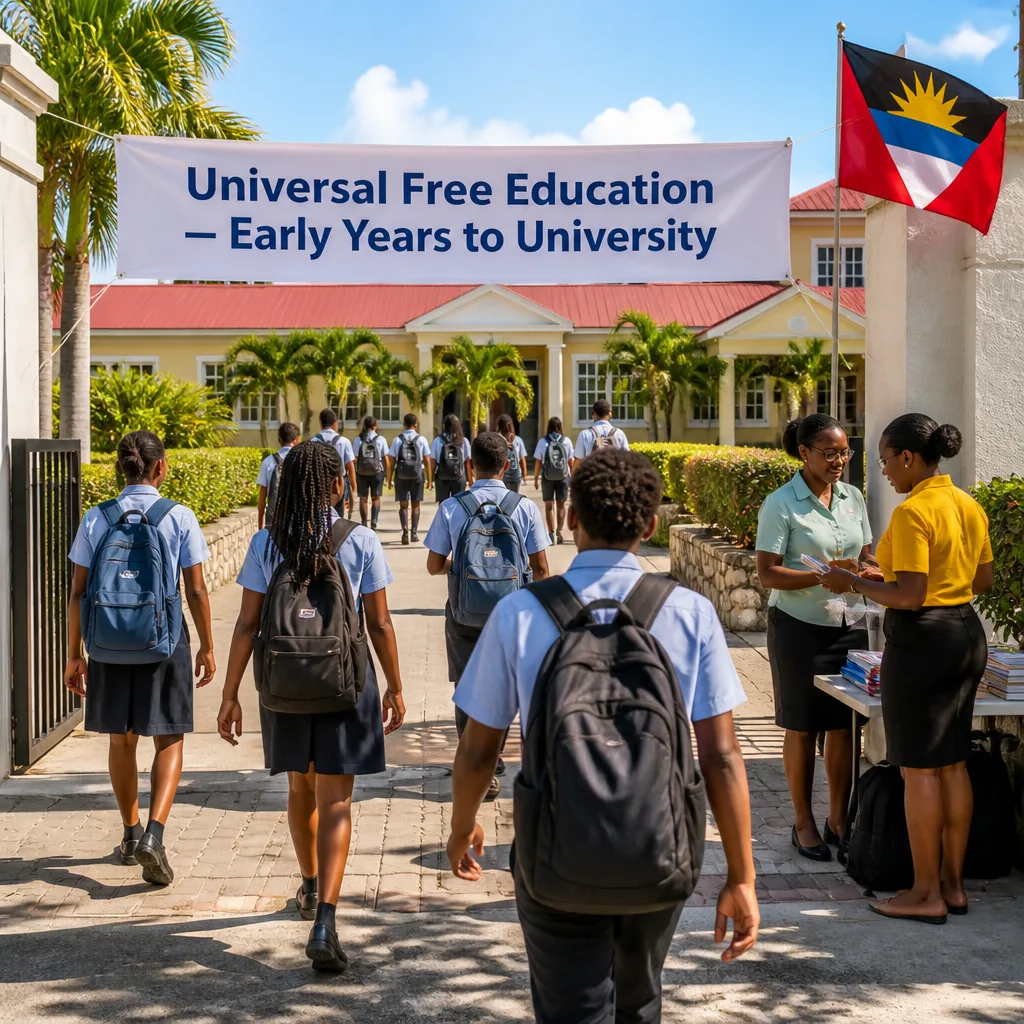
Antigua and Barbuda has introduced a sweeping policy of universal free education that will extend from early childhood programmes through university, the government announced as students returned to classrooms for the new school year.
Education Minister Daryll Matthew described the initiative as “historic,” saying the state will now cover costs including tuition at the University of the West Indies Five Islands campus and fees for certain subjects administered by the Caribbean Examinations Council (CXC). The announcement was made on the first day of the school year and framed by ministers as an effort to remove financial barriers to learning.
“Universal free education is a deliberate policy taken by the Government of Antigua and Barbuda to ensure that finances and resources are no longer a limitation to access to education here,”
Mr. Matthew emphasised the government’s intention to ensure that a family's bank balance will no longer determine how far a student can progress academically.
Policy aims and immediate measures
The package of measures outlined by the ministry includes government coverage of tuition at the UWI Five Islands campus and payment of fees for specified CXC subjects. Officials framed the move as a national development strategy rather than a short-term welfare measure, arguing that investing in education addresses longer-term economic and social goals.
In announcing the policy, the education minister said the decision was designed to make a student's advancement “a question about that child’s effort and that child’s will,” rather than household finances. The government also linked the policy to an obligation to support teachers and school infrastructure as demand shifts.
Implications for schools, teachers and resources
Minister Matthew acknowledged that widening access could increase pressure on classrooms, teachers and school services. He pledged continued work by the Ministry of Education to improve resources, training and working conditions for educators but did not provide details on timelines or specific funding commitments in the statement released with the announcement.
Key elements the ministry highlighted include:
- Tuition coverage at the UWI Five Islands campus;
- Payment of fees for certain CXC subjects;
- Ongoing efforts to enhance teacher training and improve school resources and working conditions.
The announcement did not specify which CXC subjects would have fees covered, nor did it quantify the expected fiscal cost or changes to budgetary allocations for education.
Context and consequences
Expanding free education through all levels — early childhood to university — signals a major shift in public policy. If fully implemented, the measure could reduce out-of-pocket costs for families and improve access to tertiary study at the local UWI campus. It may also influence student enrolment patterns, workforce planning and demand for expanded facilities and staff.
At the same time, the ministry’s own acknowledgement of potential strain on teachers and schools invites scrutiny of implementation details: how additional students will be accommodated, how schools will be staffed, and what supports educators will receive to manage larger cohorts. The success of the policy will depend on the government’s follow-through on promised investments in resources and educator working conditions.
Officials described the policy as the work of the Gaston Browne administration. While the statement positioned the move as part of a national development strategy, further information will be required to evaluate costs, timelines and the measures that will be used to monitor educational outcomes and equity.
For students and families in Antigua and Barbuda, the policy amounts to a formal commitment that financial obstacles should not bar access to education. For educators and policy analysts, it raises immediate questions about capacity, funding and long-term sustainability.