
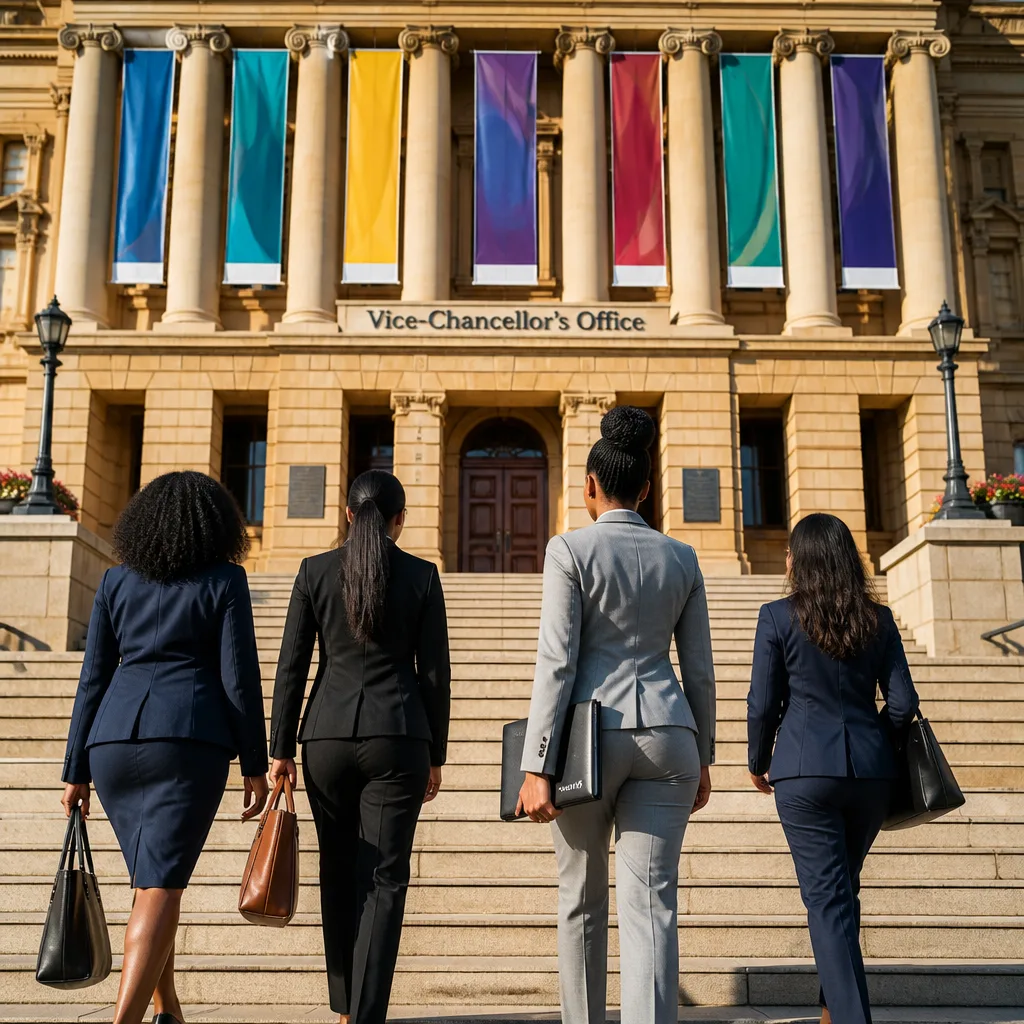
Women now head nine of South Africa’s 26 public universities, marking a shift in the profile of university leadership across the higher-education sector. The development was highlighted as part of a Women’s Day reflection on leadership and transformation in academia.
Different routes, similar barriers
Vice-chancellors at several institutions describe varied career paths to the vice-chancellorship, but a recurring theme is the need to overcome established expectations about who belongs in senior executive roles. The women who lead some of the country’s largest campuses said they repeatedly had to demonstrate their competence while gaining trust in leadership spaces where “leadership was not always expected to look like me”.
“As a Black woman in higher education, I often found that I had to demonstrate my competence repeatedly, while simultaneously earning trust in spaces where executive leadership was not always expected to look like me,” Professor Thenjiwe Meyiwa said.
Professor Thenjiwe Meyiwa, who became vice-chancellor of the University of Mpumalanga in October 2025, described the obstacles she faced as cumulative rather than a single dramatic event. She said institutional traditions and unequal access to opportunity make advancement more difficult for women, especially Black women, in higher education.
Skills, service and strategy
The women emphasised broadening skills across academic management, university administration and strategy as essential steps to leadership. One vice-chancellor cited a grounding in Ubuntu and a commitment to service-oriented leadership as central to her approach.
Resilience was framed in personal as well as professional terms. Faith, purpose and patience in evidence-led decision-making were presented as tools to navigate the complexity of running universities, which involve academic governance, staff and student relations, and interactions with government and regulators.
- Representation: Women lead 9 of 26 public universities.
- Institutions named: The women interviewed included leaders at Unisa, the University of Mpumalanga and Sol Plaatje University.
- Common challenges: Repeated need to prove competence, institutional politics, unequal access to opportunities.
The three vice-chancellors featured in the sector-wide reflection were Professor Puleng LenkaBula of the University of South Africa (Unisa), Professor Thenjiwe Meyiwa of the University of Mpumalanga, and Professor Debra Meyer of Sol Plaatje University. They noted that their trajectories differed, but that all had to expand their capabilities across multiple leadership domains to be competitive for the top job.
| Metric | Figure |
|---|---|
| Public universities in South Africa | 26 |
| Public universities led by women | 9 |
Implications for transformation and sector stability
Sector leaders suggested that increased female representation at the highest level could reshape expectations about governance and succession planning in universities. However, the vice-chancellors also made clear that representation alone is not sufficient; changes to institutional practices and access to opportunity are needed to sustain the shift.
Where women have reached the top, they have often done so by building track records across research, management and strategic planning. Those skills, combined with attention to consultative leadership, were described as essential for navigating the competing demands on universities today.
Observers will be watching whether the recent cohort of women vice-chancellors influences policies on mentorship, appointment panels and career development in ways that open more pathways for future leaders from under-represented groups.
This account is based on reflections published to mark Women’s Day. Some details are still emerging as universities continue to report on leadership and transformation plans.














