
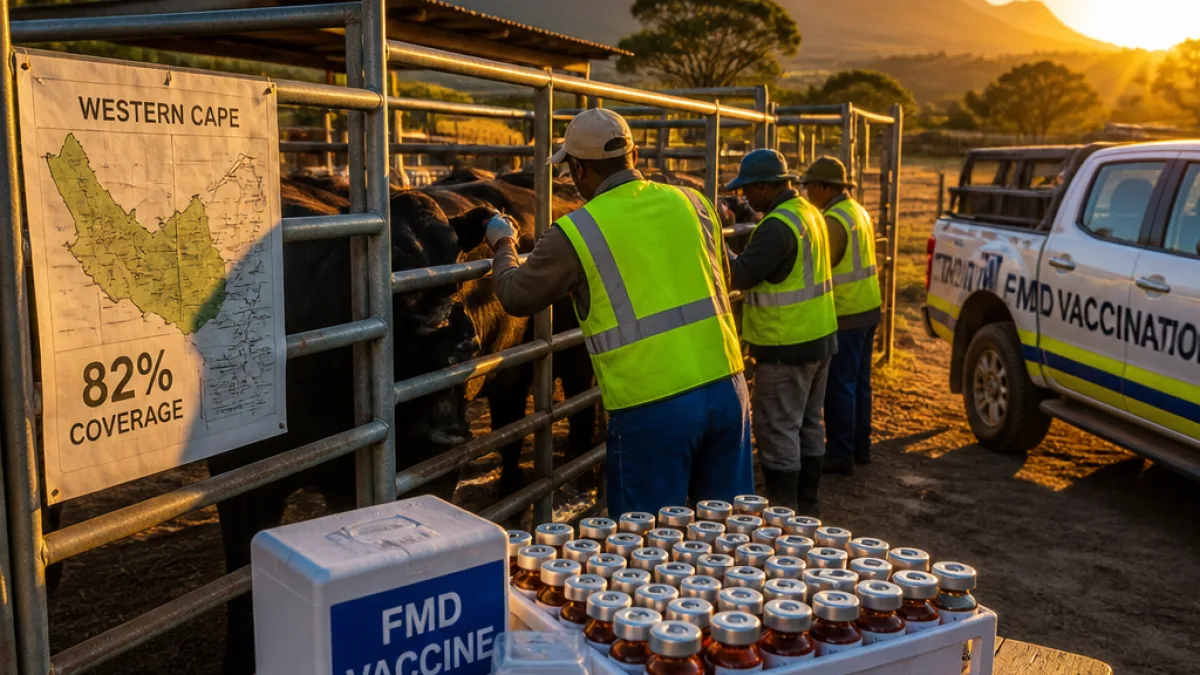
The Western Cape government says its coordinated response to the Foot‑and‑Mouth Disease (FMD) outbreak has reached a key milestone: 82% of the provincial herd has now received primary vaccination. Officials described the result as the product of joint action between provincial teams, farmers and national support, while warning that work to contain the disease remains underway.
Progress since first confirmed case
The outbreak was first confirmed on 3 November 2025 on a property near Gouda in the Cape Winelands District. Initial infections affected 679 cattle and 1,597 sheep, according to the Western Cape Department of Agriculture’s FMD War Room.
At a recent update, Provincial Minister Dr Ivan Meyer said the outbreak response follows a strategic 21‑Point Plan deployed to prevent further spread. He emphasised collaboration across government, industry and communities as central to progress achieved so far.
“The Western Cape’s response to Foot‑and‑Mouth Disease demonstrates what can be achieved when government, farmers, private veterinarians, industry stakeholders, and communities work together,”
The department reported that, as of 15 August 2026, veterinary teams had investigated 69 suspected cases across the province. The status of those investigations is:
- Active outbreaks: 28 confirmed cases under active management
- Resolved outbreaks: 11 outbreaks declared resolved
- Cleared cases: 14 suspected cases ruled out by laboratory testing
- Pending tests: 16 cases awaiting laboratory results
Vaccination campaign and logistics
The vaccination drive is central to the containment strategy. The province says it received just over 597,000 doses of FMD vaccine from the national Department of Agriculture, and that roughly 480,000 doses have been administered to date.
Officials reported 382,209 animals completed primary vaccination — the figure the department cites as representing 82% of the provincial herd — while 97,560 booster doses have also been given. The campaign is said to have reached approximately 479,769 commercial and subsistence animals across districts.
| Metric | Figure |
|---|---|
| Vaccine doses received | 597,000+ |
| Doses administered | ~480,000 |
| Primary vaccinations completed | 382,209 (82%) |
| Booster doses | 97,560 |
| Animals reached (commercial & subsistence) | 479,769 |
What this means for farmers and trade
Vaccination substantially lowers the risk of onward transmission and reduces pressure on movement controls, but the presence of active outbreaks means restrictions and tracing measures remain in place. The department emphasised that every suspected case receives urgent attention and that surveillance and tracing are ongoing.
For farmers, this means continued engagement with veterinary teams, adherence to movement restrictions where applied, and prompt reporting of clinical signs consistent with FMD. The disease can severely affect livestock productivity and market access; controlling it quickly is therefore a priority for protecting livelihoods and the agricultural economy.
Operational challenges and next steps
The department acknowledged challenges remain. Laboratory turnaround times for pending samples, the need to deliver booster doses at scale, and maintaining cold‑chain logistics across dispersed rural areas are among the operational pressures noted in the War Room update.
Authorities said the vaccination campaign will continue district by district and that national support for vaccine supply will remain critical. The department did not provide an expected date for when all pending tests would be finalised or when full herd immunity targets would be reached.
Farmers and members of the public can expect continued field operations, movement controls where necessary, and ongoing communication from district veterinary services. Those with concerns or suspect animals were advised to contact their local veterinary office.
As the Western Cape pushes to convert the current vaccination milestone into a sustained reduction in infections, officials say vigilance, rapid diagnostics and cooperation between state and private veterinary services will determine whether the province can move from containment to eradication.













