
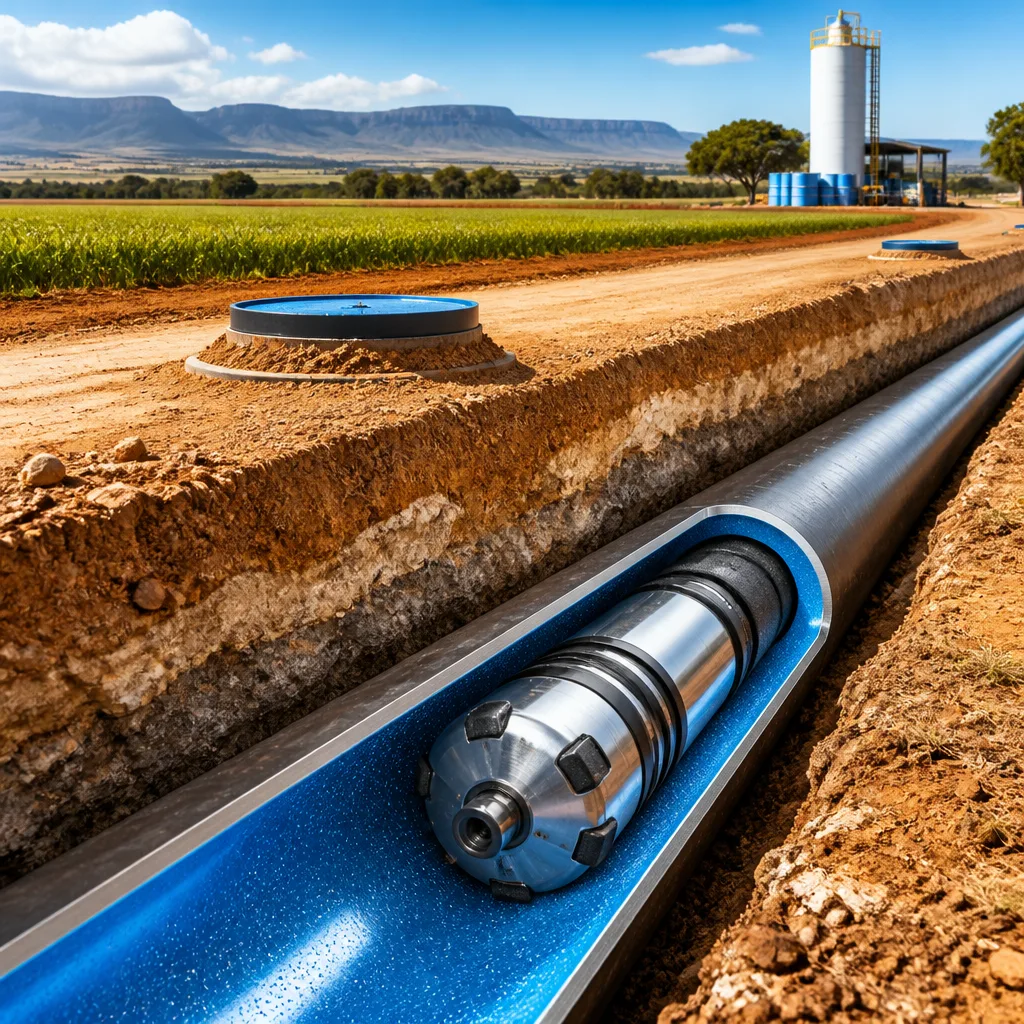
Corrocoat South Africa is using a combination of specialist coatings and long‑distance pipe pigging to rehabilitate critical pipelines over distances of up to 30 km while avoiding the need to excavate, the company said.
Trenchless rehabilitation that aims to limit disruption
According to Louis Pretorius, managing director of Corrocoat South Africa, the company offers a turnkey service that includes manufacture of raw materials and on‑site installation and quality control. Corrocoat makes its own glass flake and formulates an array of coatings and lining systems used to protect pipe interiors from corrosion and wear.
“Trenchless technology allows us to rehabilitate critical pipelines without digging them up. In many cases, we can restore a pipeline’s performance and significantly extend its service life while avoiding the social, environmental and operational disruption associated with replacement,” said Pretorius.
Corrocoat traces its trenchless work to the early 1980s, when winched machines were pulled through pipe runs to blast, clean and spray anti‑corrosion products onto internal surfaces. Pretorius said the winched‑machine approach delivered stronger adhesion and was well suited to corrosive environments such as those encountered in mining operations.
Pipe pigging extends reach to tens of kilometres
Most trenchless methods, Pretorius noted, are limited to runs of a few hundred metres. To overcome that constraint, Corrocoat adopted pipe pigging — a technique that can operate across much longer distances. The company said its pigging capability represents “a quantum leap forward” in trenchless rehabilitation.
Ian van der Heever, operations manager at Corrocoat South Africa, placed the technique in historical context: pipe pigging was originally developed in the oil and gas sector during the 1960s to remove deposits from pipelines. Corrocoat has since adapted pigging for rehabilitation work and, the company reported, has completed well over one hundred pigging contracts across several countries.
- Turnkey offering: raw materials manufacture (glass flake), coating formulation, engineering specification, installation and quality control.
- Distance capability: winched machines suited to hundreds of metres; pipe pigging capable of up to 30 km.
- Applications: mining and industrial pipelines where corrosion and internal wear are challenges.
Why this matters for South African infrastructure
Trenchless rehabilitation can be particularly relevant where pipeline replacement would cause major surface disruption — for example across roads, urban areas or environmentally sensitive land. By restoring a pipeline’s internal surface and extending service life, trenchless options can reduce capital cost, shorten project timelines and avoid long detours or utility interruptions that affect communities and industry.
Corrocoat’s integrated model — producing its own raw materials and managing on‑site engineering — means fewer contractors to coordinate on complex rehabilitation projects. That can matter in remote mining operations or long pipeline corridors where logistics and downtime are costly.
| Technique | Typical distance | Strengths |
|---|---|---|
| Winched machines (blast & spray) | Up to a few hundred metres | High adhesion; suited to highly corrosive environments |
| Pipe pigging | Up to 30 km | Long‑distance rehabilitation; trenchless over extended runs |
For municipalities, mining companies and industrial operators weighing repair versus replacement, the ability to rehabilitate long pipelines without excavation may influence budgeting and planning. Reducing surface works also lowers the immediate social impact in urban or peri‑urban corridors and decreases environmental disturbance along sensitive riverine or conservation areas.
Corrocoat’s experience with international pigging projects indicates the technique can be transferred across different sectors and geographies. The company’s emphasis on quality control and in‑house materials production is also intended to standardise outcomes and mitigate variation between projects.
As South Africa continues to manage ageing infrastructure across water, energy and mining networks, trenchless technologies — including long‑distance pigging — are likely to feature in rehabilitation options that aim to balance cost, time and disruption.










