
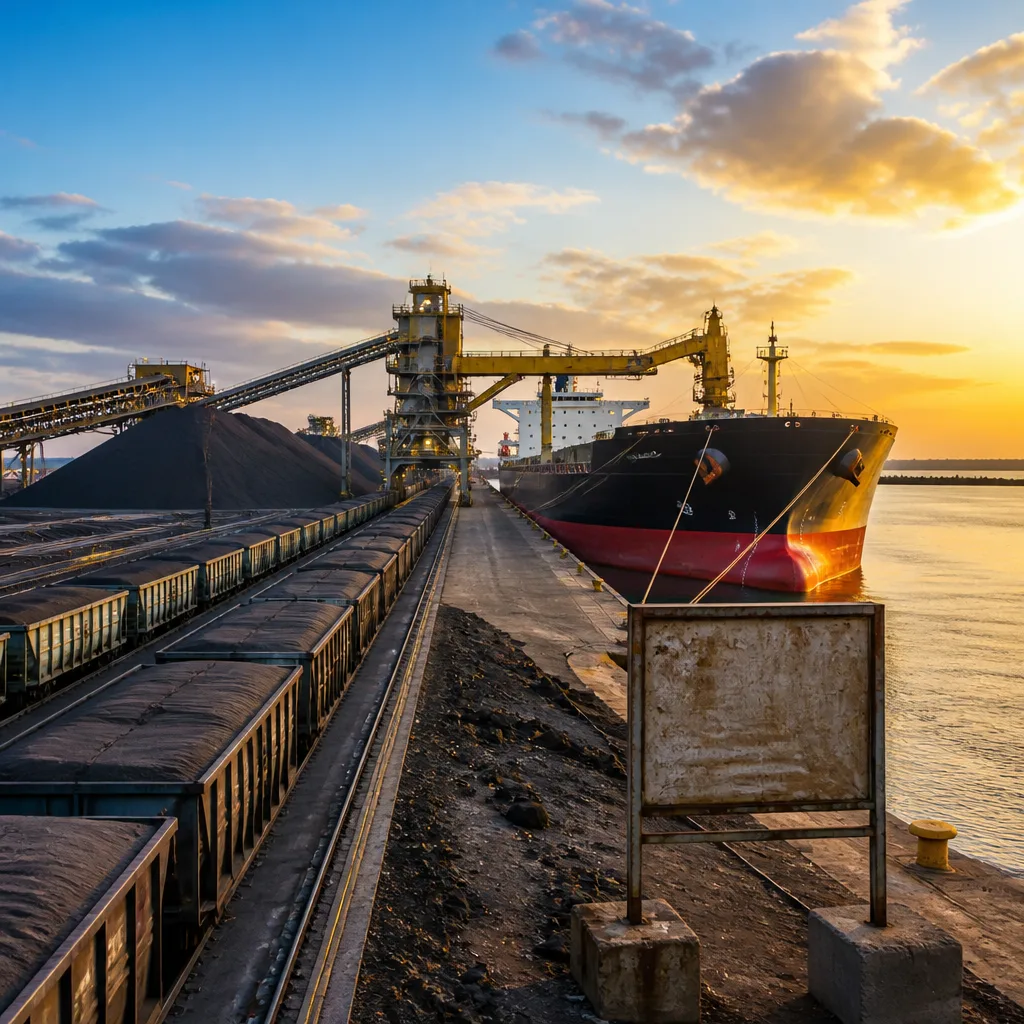
Transnet has begun the process of appointing a private sector partner to develop and operate a new manganese export terminal at Ngqura, the state-owned freight, rail and ports operator said on Friday. The proposed facility is designed to expand South Africa’s manganese export capacity by about 20% and to run under a 25‑year operating arrangement.
Why the project matters
The terminal is aimed at creating an export corridor from Northern Cape mines to a purpose-built terminal at Ngqura, with the private partner responsible for financing, construction, operation and maintenance. Transnet currently moves roughly 16-million tonnes of manganese annually by rail, while the country exported about 26-million tonnes in 2025, according to the Minerals Council.
The new corridor is expected to shift approximately 10-million tonnes a year that are currently transported by road to ports, easing pressure on road infrastructure and reducing logistics costs for shippers. Ngqura sits about 20 km north‑east of Port Elizabeth, which today accounts for about 65% of South Africa’s manganese export capacity.
Strategic and market context
Manganese plays a key role in steelmaking and is increasingly important for battery technology used in renewable energy systems. South Africa is the world’s largest manganese exporter, and Transnet’s plan signals an effort to capture growing demand while modernising export infrastructure after years of underinvestment.
Transnet said it issued a Request for Qualification (RFQ) to begin selecting a strategic private partner. The move follows a pattern of greater private sector participation as Transnet seeks to overcome constraints caused by limited capital expenditure in prior years.
Export destinations and implications
Approximately 95% of South Africa’s manganese shipments flow to Asia. China is the dominant market, receiving nearly 68% of exports, followed by India at 16%. Smaller shares go to Singapore and Malaysia (each about 3%) and Japan (2%).
| Destination | Share of exports |
|---|---|
| China | 68% |
| India | 16% |
| Singapore | 3% |
| Malaysia | 3% |
| Japan | 2% |
Operational and risks considerations
The tender process will assess private partners capable of delivering long‑term infrastructure and operational capacity. Key considerations for bidders are financing ability, technical capacity to handle heavy bulk commodities, integration with freight rail and port logistics, and plans to reduce road haulage.
Transnet’s increasing reliance on private partners reflects persistent funding constraints and an attempt to accelerate projects that government budgets have not fully supported. The success of the project will depend on timely private investment, rail performance and the ability to secure steady export contracts with buyers in Asia.
- What Transnet announced: RFQ launched to select a private partner for a new Ngqura manganese terminal.
- Expected impact: About 20% lift in export capacity and removal of roughly 10-million tonnes a year from road transport.
- Market context: South Africa exported ~26-million tonnes in 2025; ~95% of volumes go to Asia, with China the dominant buyer.
The project is likely to attract interest from global miners, port operators and infrastructure investors given manganese’s role in decarbonisation supply chains. Observers will be watching how quickly Transnet moves from RFQ to a final selection and whether the partnership can deliver capacity increases without further delaying shipments.
Further details on the RFQ timetable, evaluation criteria and shortlisted bidders were not included in Transnet’s statement and remain to be announced.














