
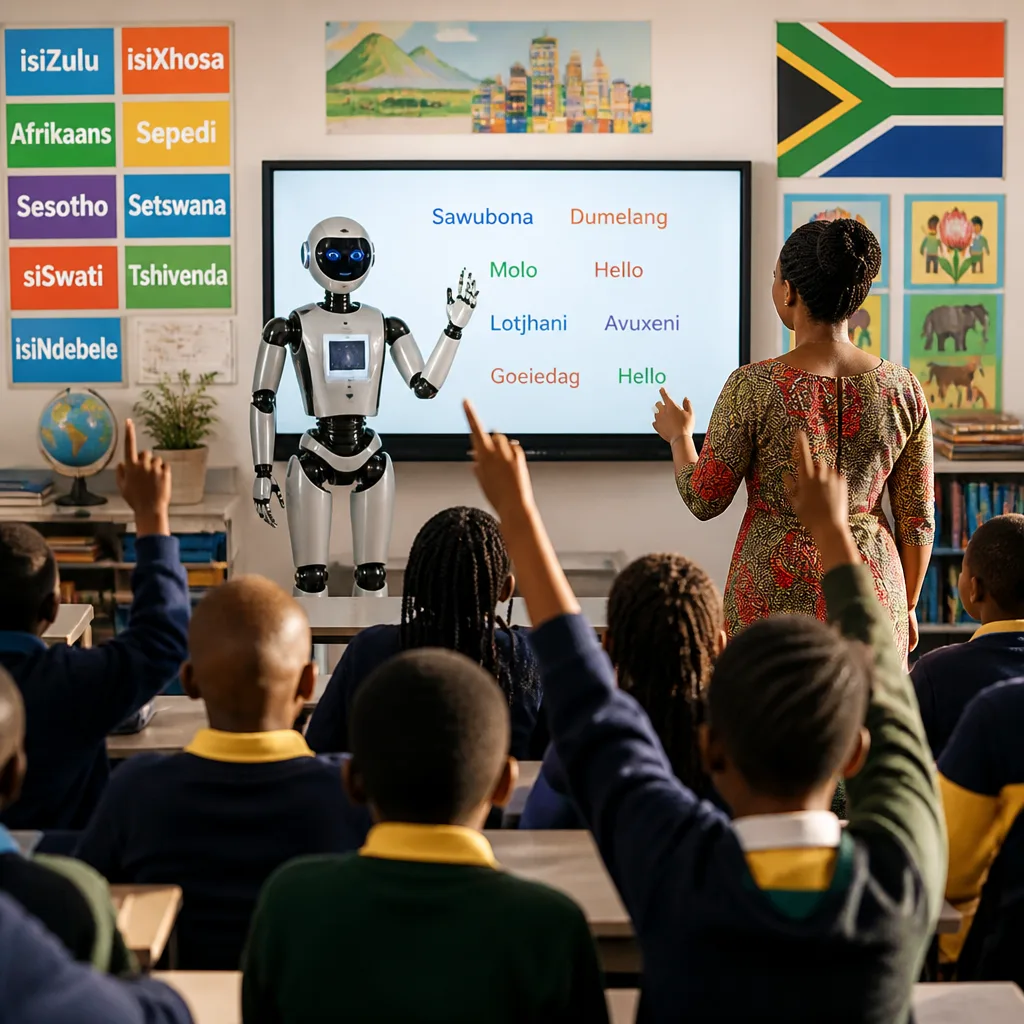
The Department of Education has begun a pilot introducing a humanoid artificial intelligence tutor in five schools as part of a national programme to explore how emerging technologies can supplement classroom teaching, according to reporting by DUrbanTV, a TV BRICS partner.
What the pilot does
The programme deploys an AI-powered humanoid designed to interact with learners, answer questions, explain academic concepts, assist with assessments and analyse learning interactions. It is intended to support learners across a range of subjects and educational levels — from early schooling through secondary education and into tertiary preparation.
Crucially for South Africa, the system has been developed to operate in all 11 official languages, reflecting attempts to make digital education more accessible across the country’s linguistically diverse population. Officials say the technology is intended as an additional resource, not a replacement for teachers, keeping educators at the centre of classroom learning.
Objectives and anticipated benefits
- Improve access to interactive educational resources where human support is limited.
- Address inequality by providing standardised supplementary teaching materials across different regions.
- Support multilingual learning by operating in all 11 official languages.
- Build skills in AI, robotics, software engineering, technical support and digital education through local participation in the project.
The pilot is described as part of a broader national push to develop artificial intelligence, robotics and other Fourth Industrial Revolution technologies. The initiative is expected to contribute to skills development across a range of technical disciplines while providing additional learning assistance in classrooms.
What is being tested
The pilot will observe how the humanoid tutor performs in real school settings, including its ability to:
- communicate naturally with learners,
- explain academic concepts across multiple subjects,
- assist with assessment tasks, and
- analyse interactions to support learning diagnostics.
| Feature | Intended classroom benefit |
|---|---|
| Multilingual communication (11 official languages) | Increase accessibility and comprehension for learners in their home languages |
| Interactive tutor and assessment support | Provide immediate feedback and additional practice outside teacher-led instruction |
| Learning interaction analysis | Identify gaps and tailor interventions more rapidly |
Officials have emphasised that the project aims to keep teachers central to learning, using the AI as a supplementary tool rather than a substitute for classroom instruction.
Context and consequences
The pilot arrives amid growing interest in AI applications for public services globally. For South Africa, a system that supports all official languages could help bridge linguistic barriers in education and offer extra resources in under-resourced schools. At the same time, the rollout raises practical questions that the pilot is likely to examine, including how the technology integrates with existing curricula, teacher workloads and school infrastructure.
Another anticipated consequence is local skills development: the project is expected to create opportunities in software engineering, robotics, manufacturing and technical support, potentially feeding a wider technology ecosystem. The programme also reflects a national strategy to develop capacity in Fourth Industrial Revolution technologies while testing practical classroom benefits.
For the moment, the deployment is a controlled pilot in five schools. Observers and stakeholders will be watching whether the humanoid tutor can reliably support learning outcomes, how teachers and learners adapt to its presence, and what policy and investment decisions follow the pilot’s results.
What to look for next: evaluation results from the five-school pilot, plans for scaling if successful, and detail on how data protection, privacy and teacher training will be handled as part of any wider rollout.










