
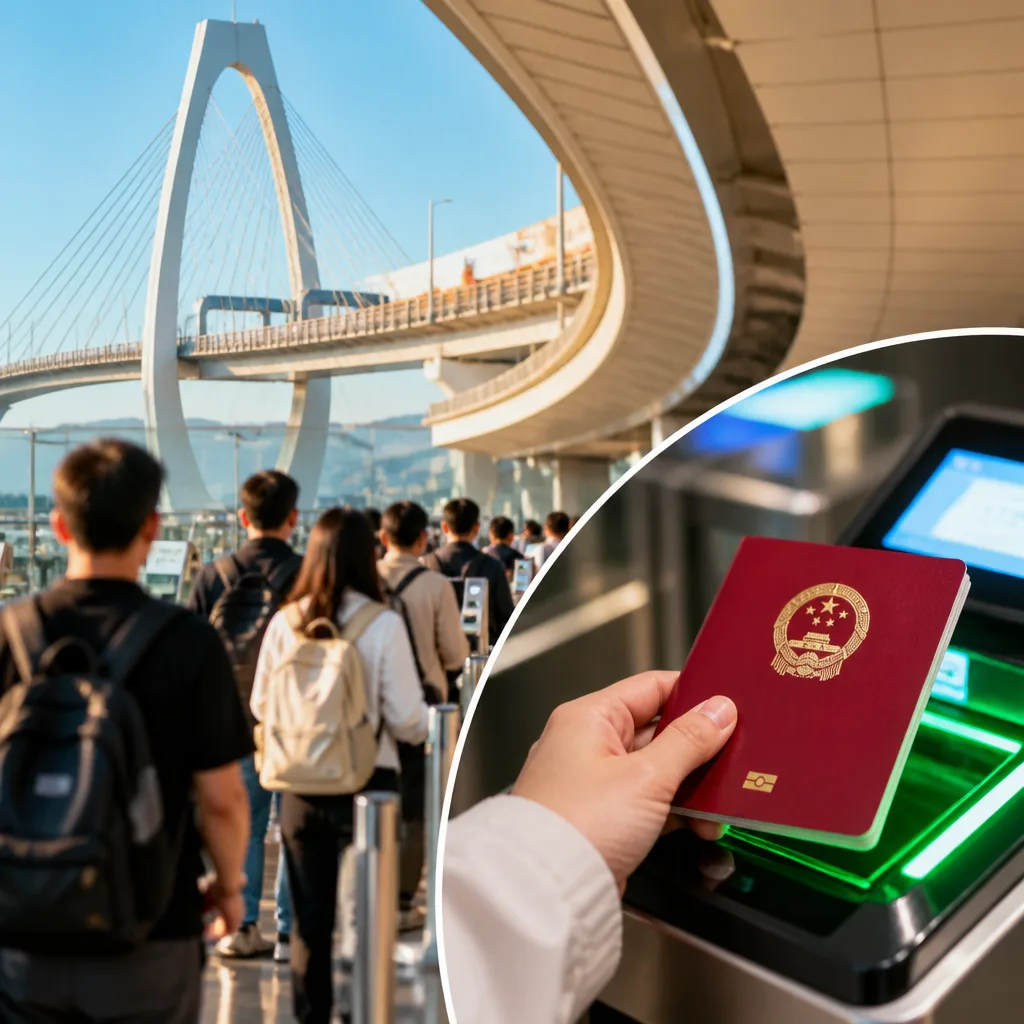
Hong Kong and Macao residents can now use a single document — the Mainland Travel Permit for Hong Kong and Macao Residents — to complete automated immigration clearance when both departing from and arriving at three land ports linking Guangdong province and the Macao Special Administrative Region.
What has changed
The adjustment, announced as refinements to the existing "joint inspection, one-time release" model, came into effect on Tuesday at three major land checkpoints between Guangdong and Macao: the Hong Kong–Zhuhai–Macao Bridge, Hengqin and Qingmao ports. The move removes the previous requirement for travellers to present different documents depending on travel direction when using joint-inspection automated channels.
- Previously, travellers leaving Macao for the mainland had to present the Mainland Travel Permit for Hong Kong and Macao Residents.
- On return trips to Macao from the mainland, they were required to show either a Macao resident identity card or a Hong Kong permanent identity card.
- Under the new measure, the Mainland Travel Permit can be used for automated clearance both when departing from and arriving at the three mentioned ports.
Officials and commuters welcome the move
The changes were approved by the National Immigration Administration and publicised by the Zhuhai General Station of Immigration Inspection. The station said the refinements aim to improve exit–entry clearance experience and to facilitate the movement of people within the Guangdong–Hong Kong–Macao Greater Bay Area, measures expected to accelerate regional integration.
Daily cross‑border commuters who use these checkpoints have already reported a smoother process. At Qingmao Port — a 24‑hour, passenger‑only pedestrian port situated south of Zhuhai Railway Station on the Guangzhou–Zhuhai Intercity Railway — regular travellers said the optimised joint inspection and one‑time release services improved throughput and convenience.
"In the past, I had to bring two types of documents when traveling, and sometimes I forgot to bring them. Now this method is flexible and convenient, so you don't have to worry about forgetting to bring your certificate, and you won't get confused when passing customs,"
said a Macao resident who spoke after experiencing the updated procedures at a checkpoint.
Practical implications for travellers
The change primarily affects people who routinely cross the land boundary between Guangdong and Macao. The single‑document system is intended to reduce confusion and the risk of delayed crossings caused by travellers carrying the wrong credential for the direction of travel.
For the ports involved, the simplified document requirement is likely to streamline automated gate operations and lower the administrative burden on immigration officers. Qingmao Port’s role as a pedestrian, 24‑hour hub means commuters who travel at off‑peak times should see particular benefit.
| Port | Function |
|---|---|
| Hong Kong–Zhuhai–Macao Bridge | Major land crossing linking all three regions |
| Hengqin | Land checkpoint facilitating access to Hengqin island and Zhuhai |
| Qingmao | 24‑hour, passenger‑only port near Zhuhai Railway Station |
While the immediate beneficiaries are Hong Kong and Macao residents, the move forms part of broader efforts by mainland authorities to harmonise cross‑border procedures inside the Greater Bay Area. Officials say this will aid the flow of people and services and support deeper economic and social links across the region.
Travel‑practical details such as which document formats are accepted by specific automated gates, whether electronic or physical permits will be required at different times, and how the change will be phased for other checkpoints were not detailed in the announcement. Commuters and travellers using the three ports should check the latest information published by immigration authorities before travel.











