
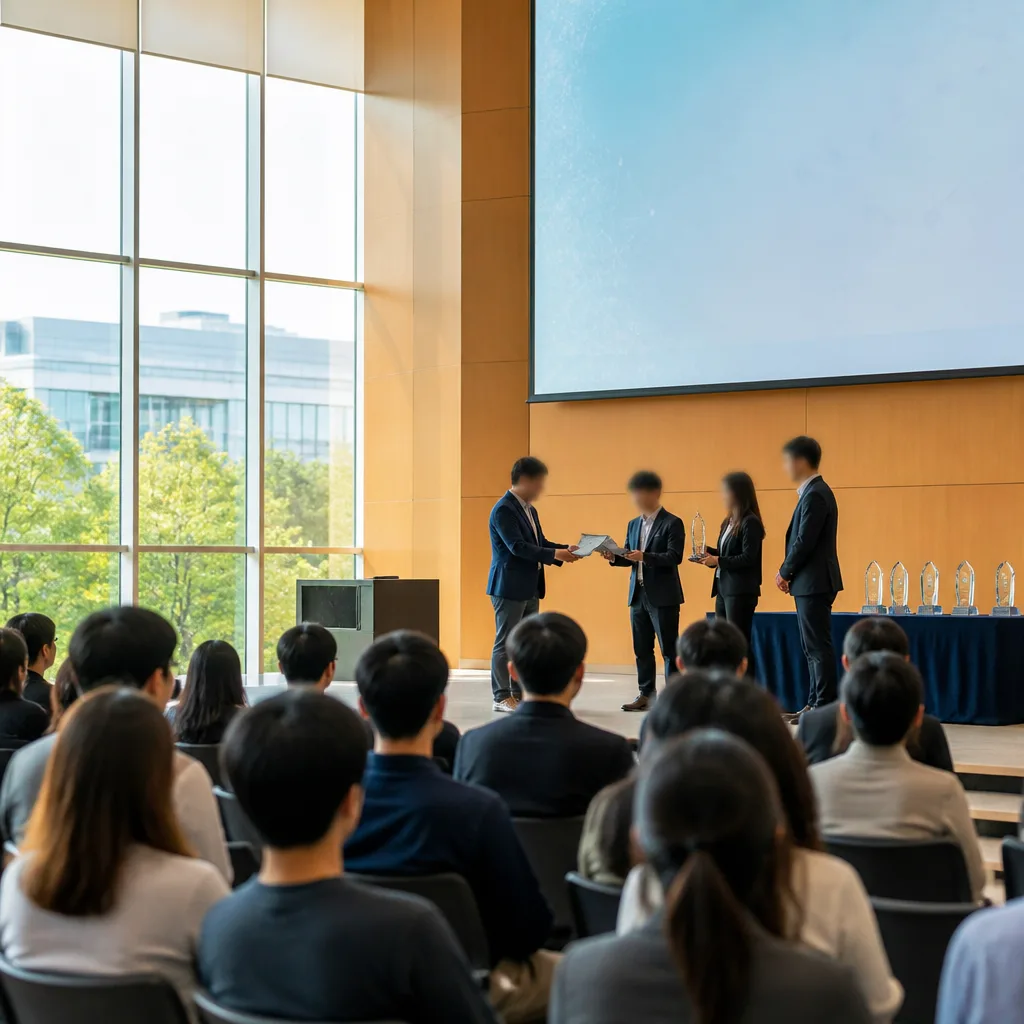
Samsung has presented scholarships to South Korea’s top performers at this year’s International Mathematical, Physics and Biology Olympiads as part of a broader push to foster the next generation of scientists and engineers.
Corporate backing for high school talent
Delegations from Samsung’s divisions hosted scholarship ceremonies at company campuses in Gyeonggi and Incheon as medal-winners and their parents were recognised. The Device eXperience (DX) Division invited six International Mathematical Olympiad medalists to its Suwon campus, where Roh Tae-moon, head of DX, presented scholarships on 11 August. The Device Solutions (DS) Division awarded scholarships to five physics medalists at its Hwaseong campus, while Samsung Biologics and Samsung Bioepis honoured four biology medalists at the Songdo headquarters. Jun Young-hyun, head of the DS Division and memory business, and Kim Kyung-ah, president and CEO at Samsung Epis Holdings and Samsung Bioepis, presented awards in person.
The ceremonies are part of what Samsung described as a broader bet on cultivating future science and engineering talent in Korea, aligning corporate resources with the national pipeline that selects and trains promising high school students for international academic competition.
How Korea performed at the olympiads
Korea’s national teams recorded strong results across the three subjects:
- Physics: all five team members won gold medals; Korea placed first overall.
- Biology: all four team members won gold medals; Korea placed first overall.
- Mathematics: the team secured three golds, two silvers and one honourable mention, finishing sixth overall.
| Discipline | Gold | Other medals / notes | Overall placement |
|---|---|---|---|
| Physics | 5 | — | 1st |
| Biology | 4 | — | 1st |
| Mathematics | 3 | 2 silver, 1 honourable mention | 6th |
Context and implications
International science olympiads draw elite high school students from dozens of countries to tackle advanced problems in mathematics, physics and biology. Participation is organised through domestic selection and training processes, with national teams typically chosen after a series of qualifying exams.
Samsung’s involvement follows a familiar pattern of major technology firms investing in early-stage talent pipelines. For South Africa and other countries following developments in global skills competition, the choices made by global corporations matter because they can influence which disciplines and cohorts receive sustained support, as well as provide role models and resources that augment public education efforts.
By awarding scholarships and publicly celebrating medal-winners, Samsung links corporate identity with national academic success. The move may help reinforce interest among secondary school learners in STEM fields and signal to other private-sector actors the value placed on academic excellence at an international level.
At the same time, such corporate programmes do not replace systemic education reform. National authorities remain responsible for broadening access, improving teacher training and ensuring that talented students from diverse backgrounds can reach the standards required for international competition.
The International Mathematical, Physics and Biology Olympiads are annual events where top high school students work on demanding problems; medals are awarded at gold, silver and bronze levels and countries are ranked by overall team performance. Samsung’s scholarships followed Korea’s strong showing this year, particularly in physics and biology where the teams’ clean sweep of gold medals secured top team placements.
For South African readers tracking talent development and corporate engagement in education, the Samsung example illustrates how private funding and public training combine to produce high-level results on the international stage — and raises questions about how comparable support can be fostered domestically.