
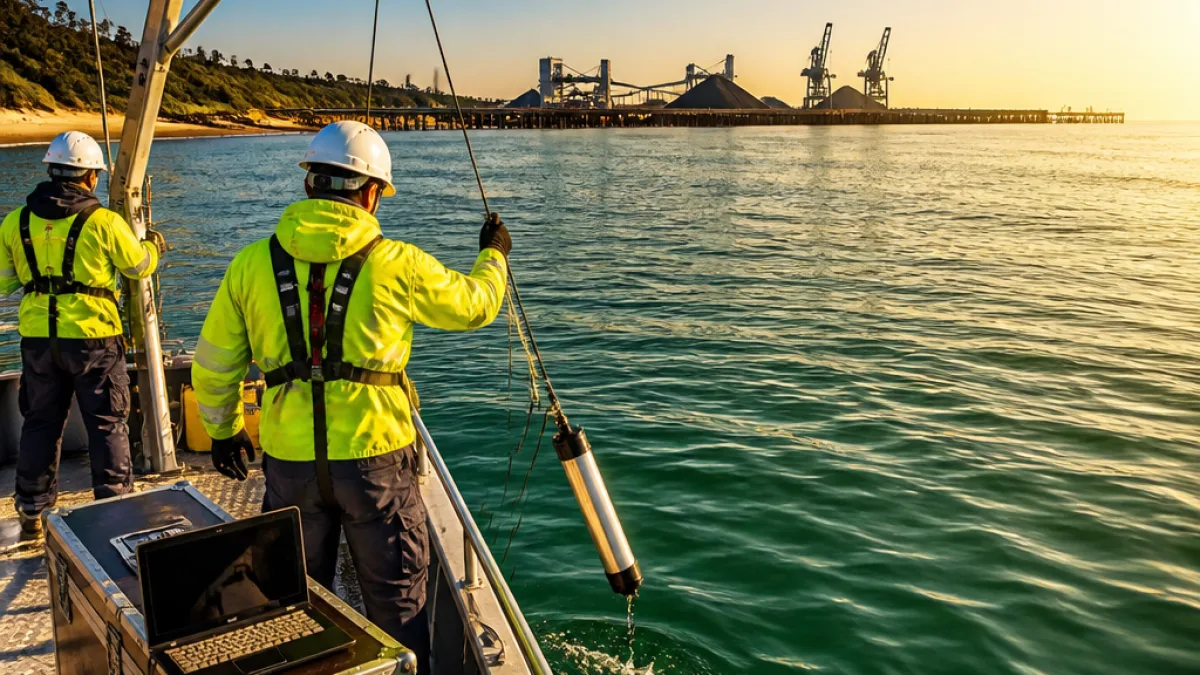
The Richards Bay Humpback Dolphin Project has resumed underwater acoustic monitoring this week after a lengthy break, with a new hydrophone deployed off the coast following sponsorship from Richards Bay Coal Terminal (RBCT).
Local funding restores vital research capability
Research lead Dr Shanan Atkins, now based at the University of Pretoria Mammal Research Institute’s Whale Unit, said the hydrophone will enable the team to capture sounds beneath the surface that visual surveys cannot record. The equipment was installed with practical assistance from the KZN Sharks Board, whose staff helped place the hydrophone safely in the water.
“We are extremely grateful to RBCT for making this possible,” Dr Atkins said. “A hydrophone allows us to listen beneath the surface and gather information that cannot be obtained through visual observations alone. RBCT’s sponsorship has restored an important part of our research programme.”
The project team, including IT specialist Brett Atkins, were in Richards Bay last week to install the hydrophone and to work on the existing Alkantstrand webcam. The return of acoustic monitoring is particularly timely: humpback whales are currently migrating along the KwaZulu‑Natal coast and male humpbacks produce long, complex songs during the breeding season.
What the hydrophone will record
Hydrophones act as underwater microphones and record the marine soundscape. The Richards Bay deployment is expected to capture:
- vocalisations from humpback dolphins (a locally endangered species) and migrating humpback whales;
- longer‑range whale songs used in international research into song transmission across the Indian Ocean;
- man‑made noise from boats and ships that can affect marine mammals.
Since 2017, the Richards Bay team has contributed recordings to a major international collaboration studying humpback whale song across the Indian Ocean. The collaboration includes acoustic data from Mozambique, Tanzania, Kenya, Madagascar, Réunion, Mauritius, Mayotte and Australia. Comparing recordings from these regions allows scientists to investigate how whale songs spread and change over time.
Local conservation and community context
The return of the hydrophone strengthens long‑term monitoring in Richards Bay waters, an important step for local conservation efforts that seek to protect humpback dolphins and better understand whale movements. Acoustic data complements visual surveys and can inform management measures for maritime traffic, coastal development and community awareness campaigns.
Project partners and their roles are summarised below:
| Organisation | Role |
|---|---|
| Richards Bay Coal Terminal (RBCT) | Sponsor of the hydrophone |
| KZN Sharks Board | Assisted with safe deployment of equipment |
| University of Pretoria Mammal Research Institute’s Whale Unit | Research home of Dr Shanan Atkins and data partner |
For Richards Bay residents, the revived monitoring provides both reassurance that local whale and dolphin populations are being studied and an early warning about changes in the marine environment. Acoustic records can reveal shifts in species presence, a rise in noise pollution, or changes in migration timing — all of which can affect tourism, recreational activities and fisheries.
Researchers will continue to compare Richards Bay recordings with the broader Indian Ocean dataset to understand regional connectivity in whale song and to place local findings within an international context. The project’s renewed activity also offers opportunities for community engagement, education and strengthened partnerships between industry, government agencies and scientists.
As the hydrophone begins to collect data, the Richards Bay Humpback Dolphin Project expects to share further updates on findings and on how acoustic monitoring is contributing to conservation planning along the KwaZulu‑Natal coast.










