
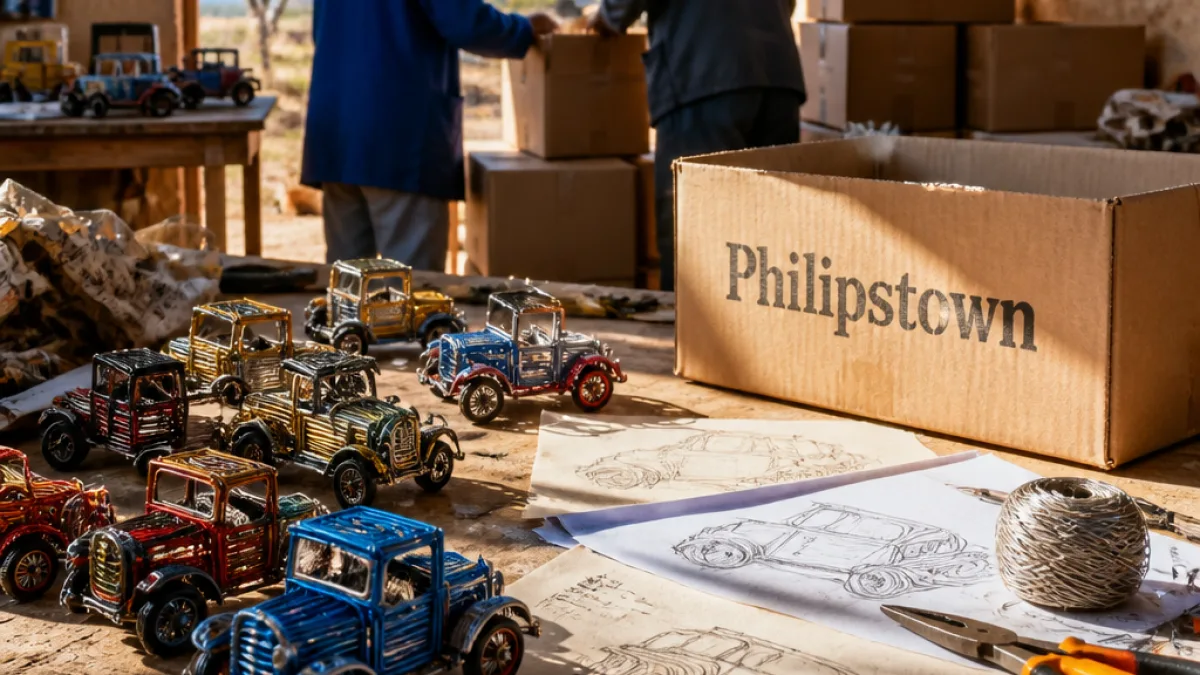
Philipstown, a small Northern Cape town about 230 kilometres west of Kimberley, has long been known for an informal childhood craft: children making and racing cars from wire. What began as simple play has become the Philipstown Wire Car Grand Prix, an annual celebration of ingenuity that has now travelled into the lecture rooms of the University of the Free State (UFS).
From playground pastime to community event
The Grand Prix began after local resident Kay Fourie noticed children fashioning toy cars from wire and racing them. The practice has since developed into an organised event that gives the town a focus and a moment of pride each year.
Fourie said the activity matters for reasons beyond recreation. In a community with limited facilities for young people, she said the wire cars provide a constructive pastime and help keep children engaged away from criminal activity.
"It is a sight to behold watching the children playing around with their (wire) cars and having fun," Fourie said. "The town itself is impoverished and there is very little to do, and it is awesome to see the children playing without a care in the world."
Architecture students take up the challenge
What may seem an odd fit for an architecture syllabus became a deliberate pedagogical choice when UFS architecture lecturer David van der Merwe encountered Fourie. He introduced the wire‑car exercise to challenge students to think and work outside conventional architectural media.
"Making wire cars has nothing to do with architecture, but I introduced it as part of my curriculum to get the students to think broadly and creatively," Van der Merwe said.
Students responded by constructing their own wire cars; rather than keeping them as studio projects, each car was sent to Philipstown for the local children to enjoy. The initiative also includes a planned visit by the students to the town in September, giving them the opportunity to meet the young creators and to experience the event on the ground.
Practical learning, civic engagement
The project brings together several strands of value for both communities: a tactile design exercise for students, and for Philipstown an infusion of attention and the physical gifts of the students' work.
- Hands‑on skills: students engage with making and materials rather than exclusively digital design tools.
- Community exchange: the cars are sent to Philipstown and students plan to visit to meet local children.
- Youth engagement: the original event offers structured recreation in an area with few formal facilities.
Such collaborations are increasingly used in architecture and design training as a way to develop creativity, empathy and real‑world problem‑solving. In this case, the modest medium of wire cars serves as a simple bridge between an impoverished rural town and a university campus.
Timeline and context
| Year / Detail | Fact |
|---|---|
| 2010 | Idea for an annual race emerged after Kay Fourie observed children making wire cars. |
| Annual | Philipstown Wire Car Grand Prix takes place each year. |
| 230 km | Philipstown is about 230 kilometres west of Kimberley. |
| September (upcoming) | UFS students are expected to visit Philipstown and meet the young makers. |
For Philipstown, the Grand Prix is a low‑cost, locally rooted cultural event that highlights ingenuity. For UFS, the project is a compact pedagogical experiment that asks students to reconsider what counts as design work and to test the social reach of their practice.
The initiative has drawn attention because it is an example of how small towns in the Northern Cape can export ideas that are culturally distinctive and useful as teaching tools. It also underlines the value of cross‑sector contact: a chance meeting between a community member and a university lecturer has produced a programme with benefits on both sides.
As the students prepare for their September visit, the wire cars will continue to circulate between campus and the Karoo town, embodying a modest but durable form of exchange.












