
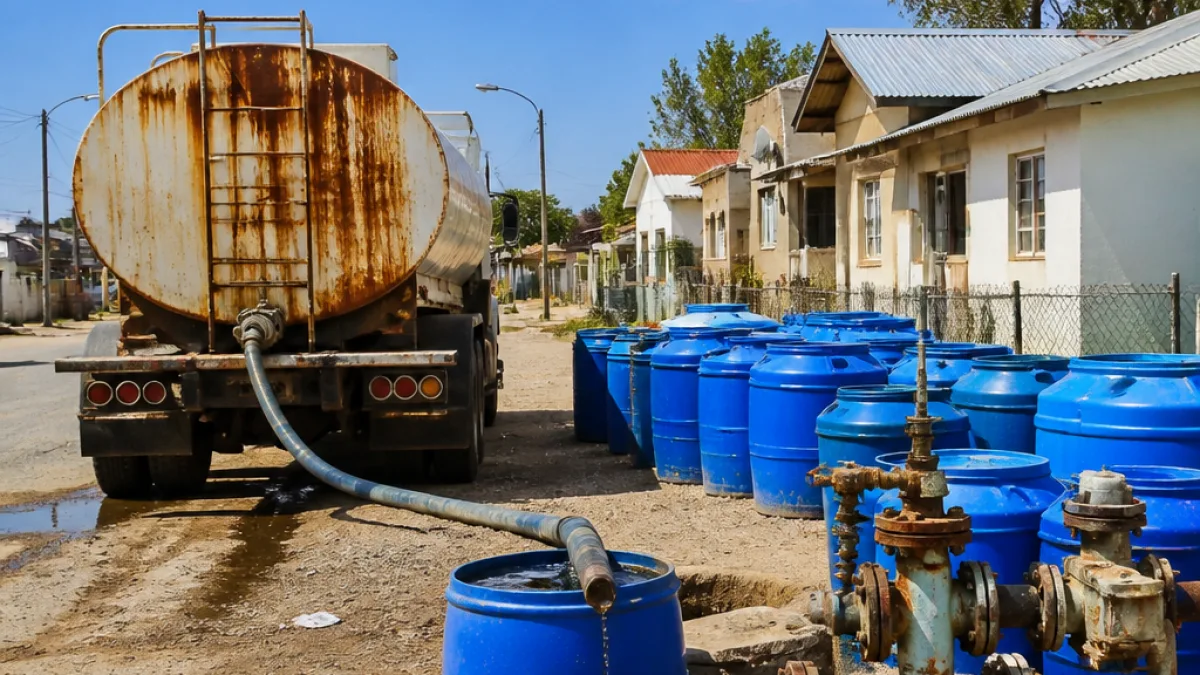
De Aar — Residents of the Northern Cape railway town of De Aar have been contending with recurring water shortages for three consecutive years, leaving parts of the town without running water for extended periods and forcing households and institutions to rely on alternative supplies.
Groundwater dependence and ageing infrastructure
De Aar, the administrative centre of Emthanjeni Local Municipality, relies almost entirely on groundwater extracted from local boreholes. The town’s semi‑arid climate produces little rainfall, and although the area historically sat atop a substantial underground water network, supply has been unreliable.
Over the past three years the municipality has experienced repeated interruptions to supply, with some areas reportedly without water for more than two weeks at a time. Low pressure, burst and leaking pipes and other infrastructure failures have compounded the problem, according to local officials and community reports.
Services and vulnerable groups under strain
Emthanjeni councillor Gerhard Engelbrecht warned that the situation should not be downplayed as a temporary shortage because the municipality is losing thousands of litres through leaks while critical services struggle to function.
“Old‑age homes, children’s facilities, business, hospitals, guesthouses and households cannot be expected to operate indefinitely under uncertain conditions,” said Engelbrecht.
He emphasised that elderly residents and children should not have to worry where their next bucket of water will come from, and that facilities caring for vulnerable people require a reliable supply to operate safely.
How residents are coping
With taps running dry, many households have turned to private measures to secure water. Reported coping mechanisms include:
- Filling and storing water in JoJo tanks for household use;
- Hiring or relying on water tankers brought in to top up municipal supplies;
- Purchasing water at personal expense where available.
These stopgap measures add financial and logistical strain on families and small businesses already operating in a constrained local economy.
Municipal and governmental engagement
The water crisis has been repeatedly raised at municipal council level and during engagements with provincial and national government departments, according to the reporting. Councillors and community representatives have pressed for repairs and longer‑term solutions, while some reported leaks remain unresolved for weeks or months after being logged with municipal authorities.
Details on specific repair schedules, funding allocations or timelines for comprehensive infrastructure upgrades were not provided in the material available. Municipal accountability for maintenance and leak repair remains a central concern voiced by local leaders.
Historical context and town profile
Founded in 1902 as a railway junction linking Cape Town and Kimberley, De Aar’s name and that of the Emthanjeni municipality translate to “the vein” or “the artery,” a reference to the town’s extensive underground water network. The historical importance of the town as a logistics node and the presence of groundwater have not prevented current supply failures.
| Item | Detail from reporting |
|---|---|
| Estimated population | About 37,000 residents |
| Main water source | Local boreholes (groundwater) |
| Duration of crisis | Three consecutive years of repeated shortages |
| Interim coping measures | JoJo tanks, water tankers, private purchases |
What residents can expect
Until infrastructure faults are repaired and leakages addressed, residents and institutions dependent on municipal supply should plan for intermittent service. Those responsible for care facilities, health services and hospitality are particularly advised to maintain contingency reservoirs and to log persistent faults with municipal channels.
Community members concerned about unresolved leaks were urged by the councillor to continue reporting incidents to the municipality so problems are recorded and can be prioritised during maintenance programmes.
The reporting indicates that resolving the crisis requires both immediate repair work and longer‑term capital investment in the town’s water infrastructure. Engagements with provincial and national departments have taken place, but reporting did not specify concrete outcomes or committed funding.
The town’s reliance on borehole water and its location in a dry region mean that robust, well‑maintained distribution infrastructure is essential to ensure consistent supply for households and critical services. For now, many De Aar residents continue to manage on a day‑to‑day basis while awaiting durable solutions.















