
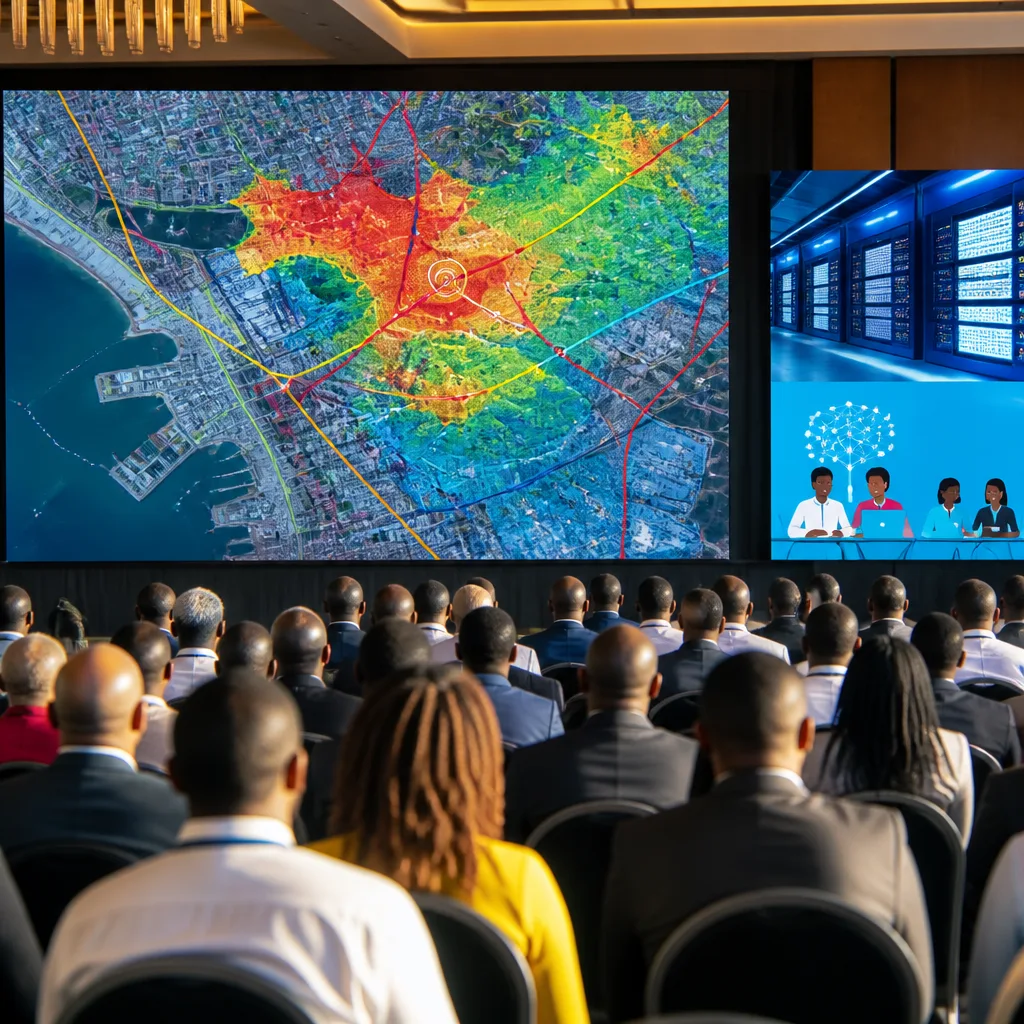
Artificial intelligence is increasingly used across Africa to analyse data and detect security threats, from unregulated fishing to the movement of armed groups. But military and security officials at the 2026 African Chiefs of Defence Conference in Luanda warned that the technology is not a substitute for trained people and clear processes.
AI can highlight patterns, not replace judgement
Speakers at the conference outlined how AI systems can process satellite imagery and other large datasets quickly to reveal patterns of movement, changes in terrain and possible logistics routes that would be difficult and slow for humans to spot. Those capabilities can help prioritise scarce resources and alert security services to likely threats.
“AI can enhance our capability for monitoring, but it’s very dangerous to confuse data with information,” Brazilian Adm. Renato Rodrigues de Aguiar Freire, chief of the Joint General Staff of the Armed Forces, said at the conference.
Delegates emphasised that the value of AI depends on the people who design, operate and interpret its outputs. Turning on algorithms and letting them run is not enough: staff must be trained to understand what is being measured, recognise false positives and negatives, and decide how best to act on findings.
Skills shortage threatens the promise of AI
Speakers flagged a significant gap between AI ambition and capacity. The African Development Bank estimate that the continent will need 23 million tech workers by 2030 was cited to underline the scale of the challenge. Without rapid investment in training and employment, military and civilian agencies risk acquiring tools they cannot use effectively.
Several initiatives to build local AI skills were referenced, including the emergence of AI academies such as Nigeria’s Africa AI Hub. Conference participants noted early progress in countries including Kenya, Nigeria, South Africa and Tunisia, where training programmes and some of the continent’s first data centres are beginning to operate.
- Capability: AI can reveal movement patterns and terrain changes from satellite imagery.
- Constraint: Outputs require human interpretation and decision-making.
- Workforce: Africa faces a major shortfall in tech professionals to deploy and maintain AI systems.
Why this matters for South Africa
South African defence and security planners, like their counterparts elsewhere on the continent, will need to balance investment in AI tools with parallel investment in people. The presence of AI training and early data-centre activity in South Africa positions the country to scale both capabilities and critical skills, but only if government, industry and academia coordinate on curricula, accreditation and career pathways.
For ordinary South Africans, the debate has practical consequences. Well-applied AI could improve maritime monitoring to protect fisheries, help police forecast and respond to crime patterns, and allow rescue and disaster teams to detect risks earlier. Poorly understood or poorly validated systems risk wasting public resources and producing misleading conclusions that could misdirect responses.
Technical and ethical challenges remain
Beyond skills, delegates raised questions about data quality, interoperability of systems, and the limits of satellite-based observation in complex environments. Effective use of AI also requires robust governance: standards for how models are evaluated, safeguards against biased outputs, and clear rules about responsibility when automated analysis influences operational decisions.
Conference remarks suggested a pragmatic approach: use AI to prioritise scarce resources and amplify human decision-making, not to replace it. That stance aligns with a growing consensus among defence practitioners that technology is a tool that must be paired with training, oversight and continued human judgement.
| Country | AI activity noted at conference |
|---|---|
| Kenya | Emerging hub for AI innovation and talent |
| Nigeria | Home to AI academies such as Africa AI Hub |
| South Africa | AI technology and training taking root; early data-centre activity |
| Tunisia | Growing AI capability and training |
As South Africa considers its own investments, the conference underlined a simple but important truth: AI is a force multiplier that depends on people. Meeting the continent’s demand for millions of tech workers by 2030 will be decisive for whether defence and civilian sectors turn potential into reliable, accountable capability.










