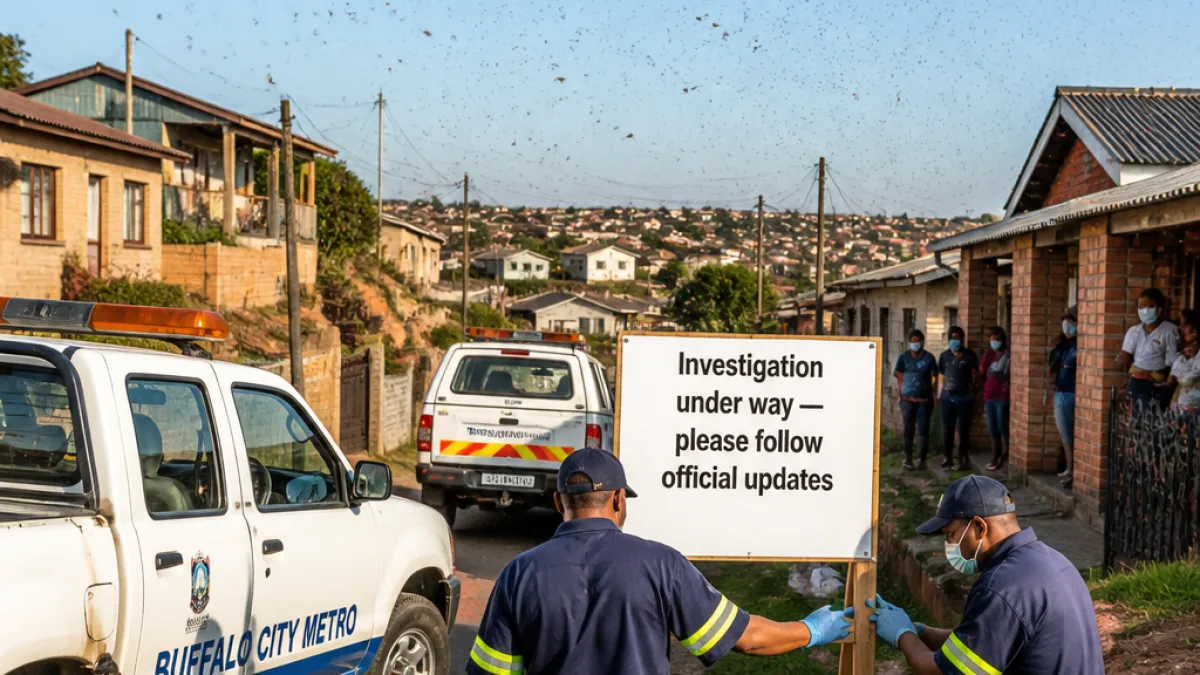
Investigation under way as insects reported in Mdantsane and KuGompo
Buffalo City Metropolitan Municipality (BCMM) has opened an inquiry into reports of an unusual rise in insect numbers first reported in the KuGompo area and now also appearing in parts of Mdantsane. Municipal departments responsible for environmental health, environmental management and communications met urgently after receiving multiple enquiries from concerned residents.
The municipality said it will work with provincial and national authorities to identify the insect and to determine the best course of action. Agencies listed for engagement include the Department of Economic Development, Environmental Affairs and Tourism (DEDEAT), the Department of Forestry, Fisheries and the Environment (DFFE), and the Department of Agriculture.
The municipality "urges the public to remain calm while investigations are underway."
Why no immediate fumigation?
BCMM has made clear it will not undertake fumigation at municipal offices or other affected sites until the species has been positively identified and officials have established the insects' habitat, behaviour and susceptibility to insecticides. The municipality framed this as a precautionary approach to ensure any intervention is safe, effective and appropriate.
Possible contributing factors mentioned by officials include seasonal changes and higher temperatures, but the municipality explicitly said no cause has been confirmed.
What residents should expect
- Further communication through the municipality's official platforms when verified information is available.
- No immediate chemical treatment of municipal buildings while identification and risk assessments continue.
- An intergovernmental approach involving technical departments at provincial and national level to determine responsibility and response options.
The municipality asked residents to avoid spreading unverified reports while its teams investigate. That instruction aims to limit confusion and ensure that any remedial steps are based on confirmed findings rather than rumours circulating on social media or in informal networks.
Technical co-ordination and next steps
BCMM's initial response has been co-ordination-focused: environmental-health officers, environmental management staff and communicators convened to develop an approach and identify which outside experts to bring in. The municipality emphasised that identifying the species and mapping its likely habitats and behaviours are prerequisites to deciding on a response.
| Role | Mandate in investigation |
|---|---|
| BCMM environmental health | Field assessments, public communication, preliminary reporting |
| DEDEAT | Provincial technical support and coordination |
| DFFE | Species identification and environmental advice |
| Department of Agriculture | Guidance on pest control and insecticide suitability |
At this stage BCMM says any municipal intervention will be deployed only if the infestation is within the metro's mandate and after a risk assessment has been completed. That leaves open the possibility that the issue may be categorised as ecological and require different provincial or national measures.
For residents, the most immediate consequence is the request to monitor developments through official channels rather than rely on hearsay. The municipality has not given a timeline for the completion of the identification work or for any follow-up operations.
Mdantsane is a densely populated area where pest issues can escalate quickly if not managed with clear information and co-ordinated action. The municipal decision to delay chemical control until experts have confirmed the species and its vulnerabilities reflects both a caution towards public safety and an effort to ensure resources are used effectively.