
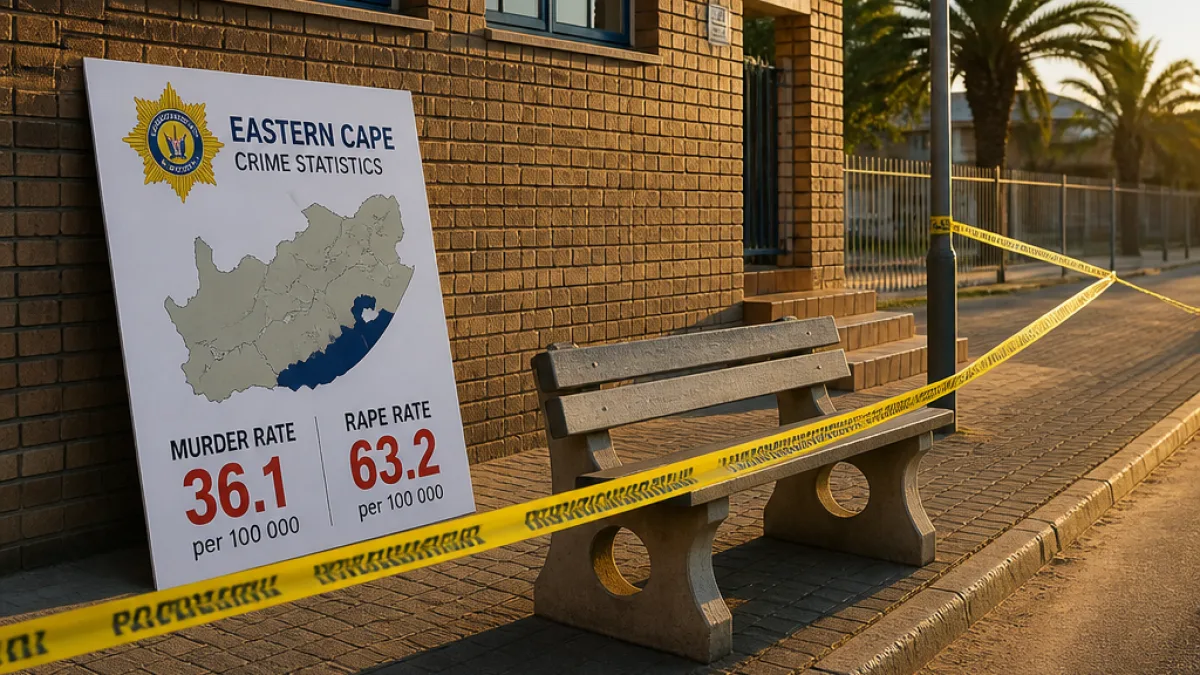
The Eastern Cape has recorded the country’s highest per‑capita rates of both murder and rape in the latest South African Police Service (SAPS) crime statistics, underlining persistent safety challenges in the province.
Figures and what they mean
According to reporting by Thapelo Molefe of the national crime statistics release, the Eastern Cape registered 16 murders per 100,000 people between April and June 2026 — the highest provincial murder rate in the first quarter of the 2026/27 financial year. The province also recorded the highest rape rate nationally at 22 cases per 100,000 people for the same period.
By comparison:
- Western Cape: 14 murders per 100,000
- KwaZulu‑Natal: 10 murders per 100,000
- Gauteng: 7 murders per 100,000
- Northern Cape: 21 rapes per 100,000
- Free State: 20 rapes per 100,000
Although the Eastern Cape tops the per‑capita charts, SAPS data show the province experienced a 4.5% decrease in murders compared with the same quarter last year, while the number of recorded rapes remained unchanged from the comparable period.
| Province | Murder rate (per 100,000) | Rape rate (per 100,000) |
|---|---|---|
| Eastern Cape | 16 | 22 |
| Western Cape | 14 | — |
| KwaZulu‑Natal | 10 | — |
| Gauteng | 7 | — |
| Northern Cape | — | 21 |
| Free State | — | 20 |
Where killings occur
The SAPS analysis examined a national sample of 5,170 murders to identify locations and circumstances. The largest category in that sample was murders occurring in public places, with 2,871 such incidents. A further 1,614 murders happened at the residence of the perpetrator, including residences known to the victim.
"This is almost 31% of the murders from the sample that we have drawn that indicate that people are not safe in their residences, including residences known to the victim," said Crime Registrar Major General Thulare Sekhukhune.
The SAPS emphasised that its approach standardises crime comparisons across provinces by using population estimates rather than raw case counts. Major General Sekhukhune said this allows for a proportionate comparison between the total population of a province and the number of murders recorded there.
Local impact and implications
For residents and municipal leaders in the Eastern Cape, the figures present a complex challenge. High per‑capita homicide and sexual violence rates point to underlying socio‑economic issues: poverty, unemployment, substance abuse and the availability of policing resources all influence crime trends. The provincial result of a modest decline in murders but stagnation in rape numbers suggests targeted interventions are necessary rather than broad, one‑size‑fits‑all responses.
Policing deployment, forensic capacity, victim support services and community safety structures will need to be examined in light of the statistics. Local policing forums and ward councillors should press for clarity on operational plans that address both violence in public spaces and the alarming number of murders taking place in private residences.
What residents should know
- These figures are standardised per 100,000 people to allow provincial comparison and do not necessarily reflect absolute case counts.
- A decrease in the murder rate by percentage does not always translate into fewer victims in every community — some areas may still be experiencing worsening violence.
- Victims and witnesses are urged to report incidents to their local police station so that cases can be properly recorded and investigated.
The SAPS release and Major General Sekhukhune’s remarks provide a snapshot for one quarter; longer‑term trends must be monitored to assess whether interventions reduce both lethal and sexual violence in the Eastern Cape. For communities across the province, the statistics are a reminder that improving safety will require coordinated action by police, municipalities, social services and civil society.
Reporting of the statistics was provided by Thapelo Molefe from the SAPS release.