
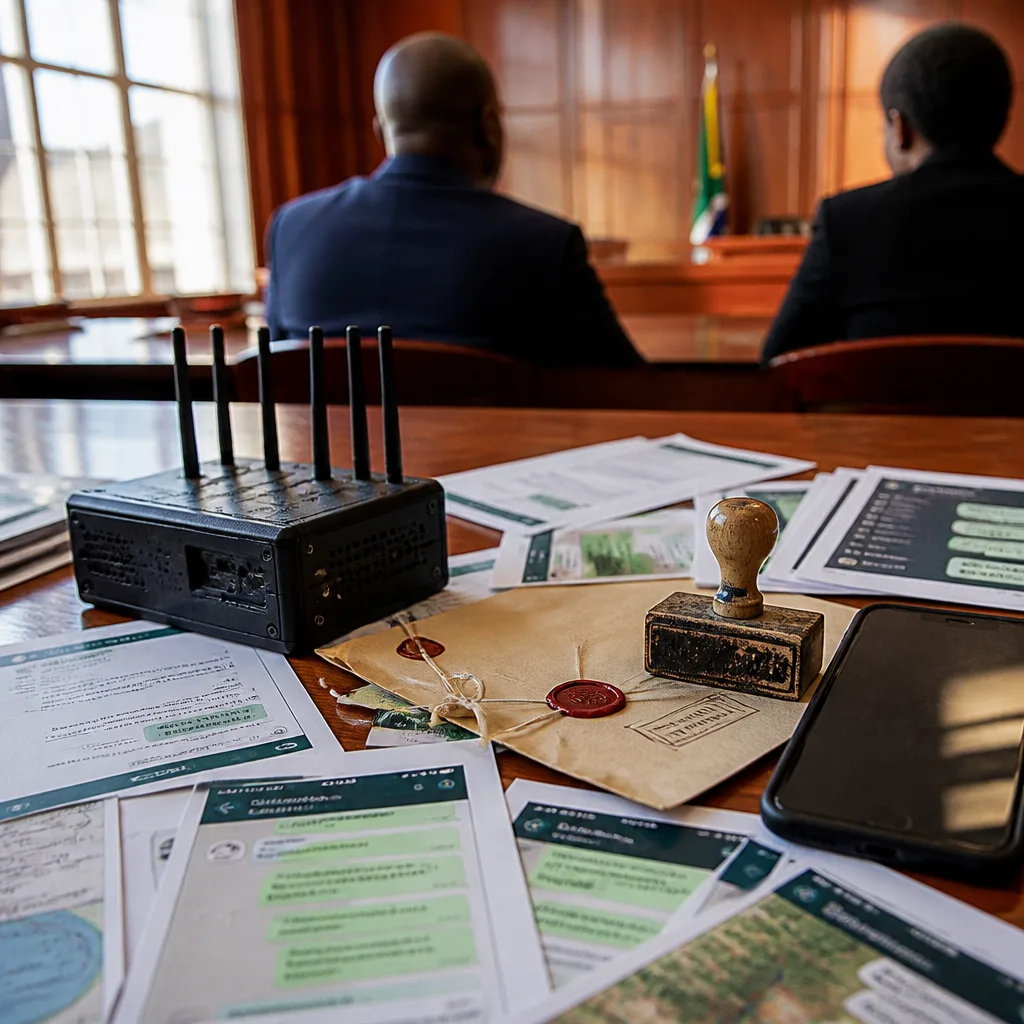
The Madlanga Commission on Tuesday examined WhatsApp exchanges that, according to evidence presented, suggest a serving South African Police Service (SAPS) sergeant and private associates attempted to acquire and sell surveillance technology while using the SAPS brand.
Allegations focus on IMSI-catcher 'grabber' technology
Advocate Matthew Chaskalson, the commission’s evidence leader, told the inquiry that the chats implicate Sergeant Fannie Nkosi, the late taxi boss Jothan “Mswazi” Msibi and a cellphone expert identified to the commission as Shaun Jacobs. The messages were presented as part of the commission’s probe into alleged state capture and corruption affecting law enforcement.
The technology at the centre of the exchanges was described as grabber technology — commonly understood to be an IMSI catcher, a device that can mimic a cellphone tower to intercept mobile communications and determine the location of devices. The commission heard that the equipment was being sourced from a company in the Czech Republic.
“Grabber technology generally refers to an IMSI catcher, a surveillance device that can mimic a cellphone tower to intercept mobile phone traffic and track the location of devices,”
Chaskalson said the WhatsApp material suggests Nkosi may have signed contracts with the international supplier presenting himself as acting on behalf of SAPS. The evidence leader indicated that Nkosi allegedly used an official SAPS stamp and his force number on contract documentation.
Alleged diversion and potential fraud
According to the evidence the commission received, while the supplying company believed the technology was being procured for SAPS, Nkosi and Msibi were allegedly intending to sell the equipment to third parties, including interests in eSwatini and private individuals. Chaskalson suggested that these actions could amount to fraud.
The commission placed evidence on record that identified others who could be implicated if they had knowledge of the letter and transactions. Chaskalson named Msibi and Jacobs as persons whose involvement could be established from the material presented.
Broader links probed
The inquiry also saw WhatsApp exchanges involving Msibi and Imogen Mashazi, the former Ekurhuleni municipal manager. Among those messages was one in which someone sent Msibi Mashazi’s virtual Outlook contact card; the commission further heard that Msibi called Mashazi on WhatsApp on 25 September 2023, although the content of that call was not made public during Tuesday’s hearing.
Evidence relating to Msibi was put on record amid the commission’s broader examination of his reputed connections with law enforcement and municipal officials. The material placed before the commission does not amount to a court finding of guilt; individuals mentioned remain suspects in the context of the inquiry until proven otherwise in a court of law.
- Primary persons named: Sergeant Fannie Nkosi; Jothan “Mswazi” Msibi; Shaun Jacobs; Imogen Mashazi.
- Technology involved: IMSI-catcher (referred to as ‘grabber technology’), sourced from a Czech Republic company.
- Allegations: Use of SAPS branding to secure contracts, diversion of equipment for sale outside SAPS, potential fraud.
Tuesday’s evidence underscores the commission’s focus on how state identities and resources may have been used to facilitate deals with foreign suppliers and private actors. The proceedings form part of the Madlanga Commission’s wider mandate to investigate allegations of impropriety and to establish whether state organs, officials or private individuals were implicated in unlawful transactions.
| Actor | Alleged role |
|---|---|
| Sergeant Fannie Nkosi | Signed contracts allegedly using SAPS stamp and force number; acted as intermediary |
| Jothan “Mswazi” Msibi | Alleged partner in plan to sell technology to eSwatini and private buyers |
| Shaun Jacobs | Cellphone expert involved in WhatsApp exchanges |
| Imogen Mashazi | Named in exchanges with Msibi; relevance under inquiry |
The commission has not yet announced any referrals or recommended charges arising directly from the WhatsApp material. Further testimony and documentary evidence are expected as the inquiry continues to probe networks that may have leveraged state branding and access for private gain.













