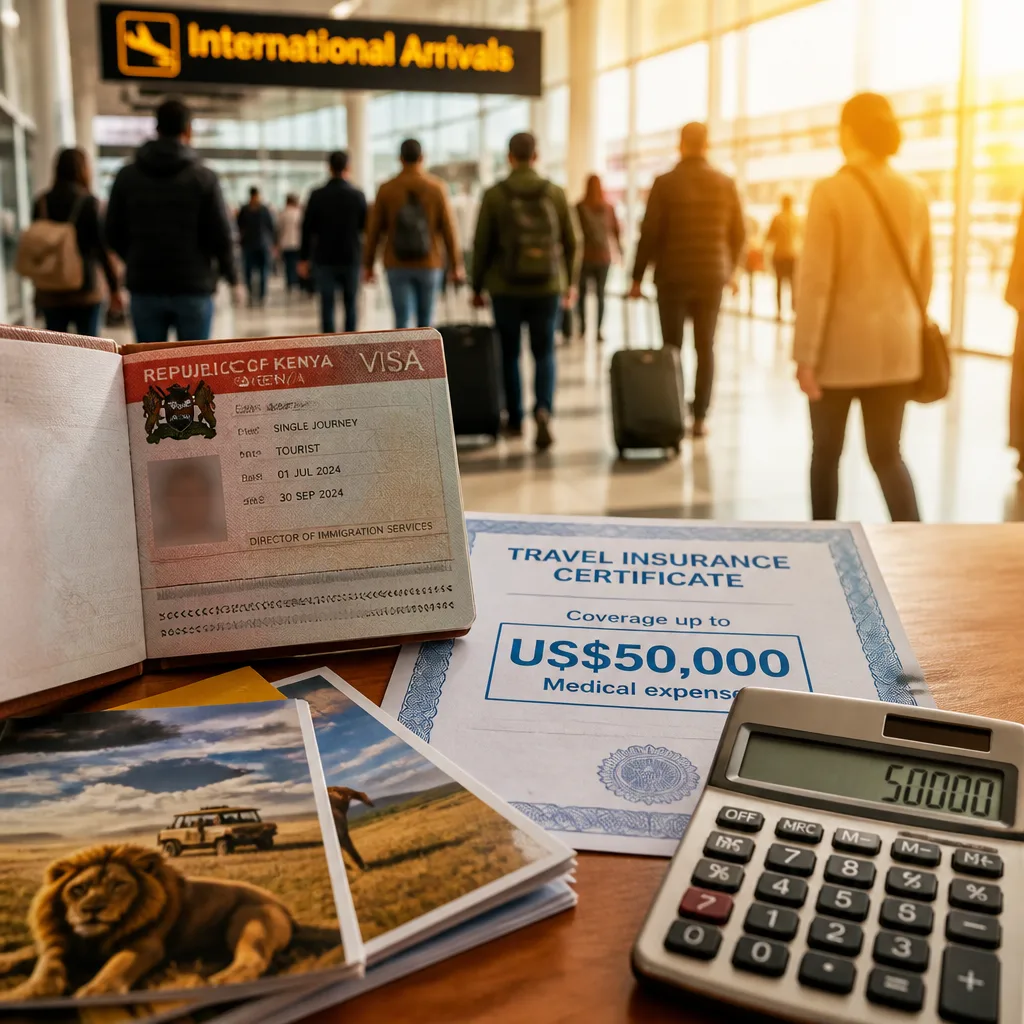
Kenya has published regulations that will require most international visitors to hold travel health insurance providing a minimum medical cover of US$50,000 (R813 000). The rules, set out in the Kenya Gazette on 30 July, specify that eligible policies must cover medical treatment and hospitalisation, emergency medical evacuation, prescription medication, mental health treatment and repatriation of mortal remains.
What the requirement covers
The regulations outline a comprehensive set of benefits that an insurance policy must include for incoming travellers. At a minimum, cover must address:
- Medical treatment and hospitalisation
- Emergency medical evacuation
- Prescription medication
- Mental health treatment
- Repatriation of mortal remains
| Requirement | Minimum cover |
|---|---|
| Travel health insurance | US$50,000 (R813 000) |
Government rationale and industry reaction
Kenya’s government says the measure is intended to protect visitors and reduce the financial burden on the country’s healthcare system. But industry figures warn the policy risks making the country a less attractive destination for international travellers.
Richard Trillo, East Africa manager at travel specialist Expert Africa, cautioned that adding costs beyond flights and accommodation can discourage potential visitors. He argued that governments should require proof that travellers already have adequate insurance rather than insisting they buy a government‑approved policy.
“The moment these policies begin to feel like revenue‑generating tactics rather than protective measures, trust is lost,”
Trillo’s comments reflect a wider concern that mandatory schemes can be perceived as obstacles rather than safeguards.
Antonie Vegter, a tourism consultant, took a similar position, saying the state should not act as an insurance provider. Vegter suggested a simpler alternative would be to require travellers to show proof of coverage — at least for medical expenses, emergency evacuation and repatriation — and allow visitors to buy policies from any provider.
“The government should not get involved in providing insurance,”
Competitiveness and cumulative costs
Industry leaders warn the requirement risks becoming one of several charges that cumulatively affect the attractiveness of East Africa for international tourists. The source reporting notes that visitors already face costs such as visa fees, park entrance charges and conservation levies in some destinations — and the addition of compulsory insurance could increase the overall price of a trip.
For South African travellers who plan multi‑country itineraries in East Africa, the new regulations may alter budgeting and travel planning. While the Kenyan rule aims to shield both visitors and the public health system from unplanned costs, travel operators and consultants say the policy design needs careful handling to avoid deterring the very visitors it intends to protect.
What travellers should watch for
- Details on enforcement: whether travellers will need to present proof on arrival and which documents will be accepted.
- Whether government‑approved policies will be sold at ports of entry or travellers may use policies purchased in advance from overseas insurers.
- Any exemptions or special arrangements for short stays, transit passengers or citizens of certain countries.
As the regulations proceed from publication to implementation, travel agents, tour operators and prospective visitors should monitor further announcements from Kenyan authorities for guidance on compliance, accepted policy types and the timing of enforcement. The balance between visitor protection and maintaining a competitive tourism product will likely shape the debate in the months ahead.