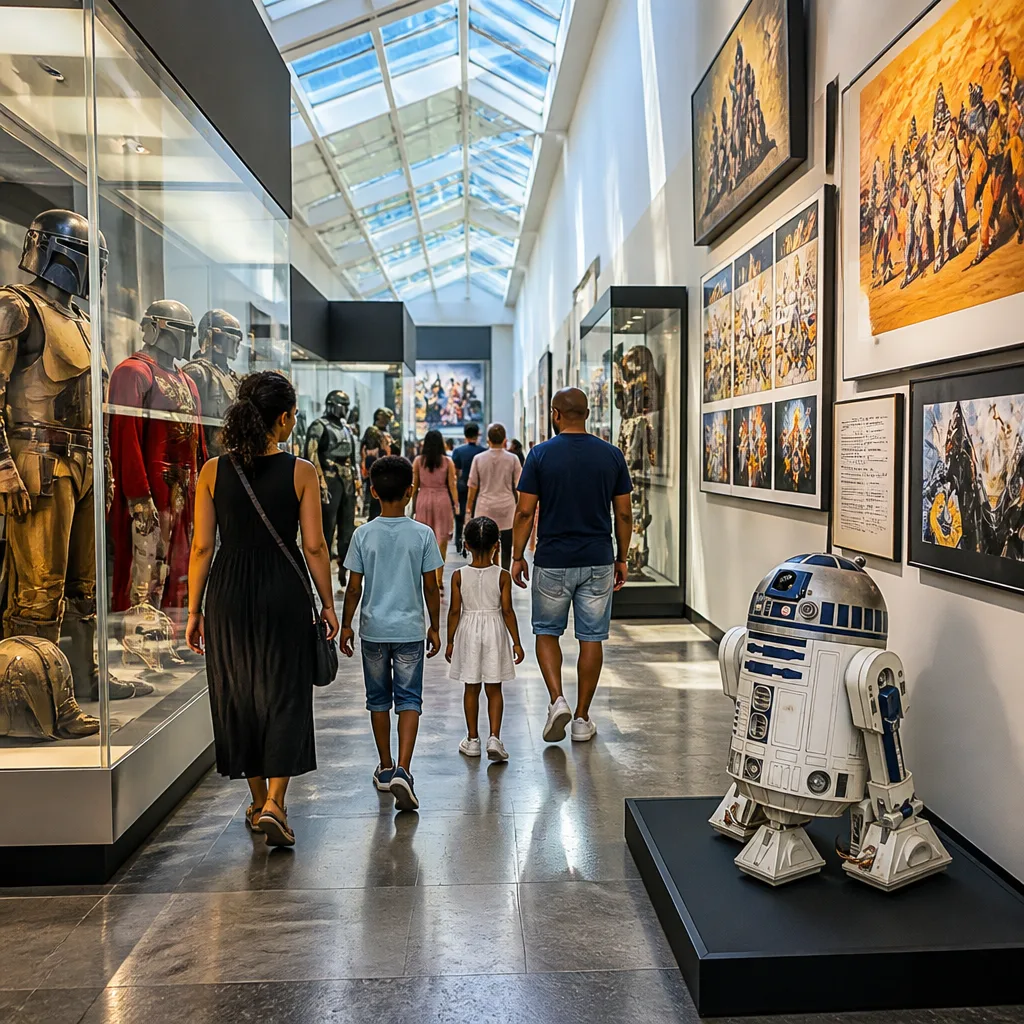
George Lucas has officially opened the Lucas Museum of Narrative Art in Los Angeles, a new cultural space dedicated to the craft and history of visual storytelling. The museum gathers film-related artefacts alongside paintings, comics, photography and illustration to explore how images shape narratives across generations.
From film frames to painted canvases
The museum’s launch was reported from Los Angeles by CGTN, which described the venue as an ambitious attempt to trace the evolution of narrative art across multiple media. The project arrives almost five decades after Lucas’s Star Wars first entered popular culture, a fact that underlines the long relationship between cinematic spectacle and the wider visual arts.
At the opening, family-friendly touches — including appearances by a familiar silver-and-white droid — hinted at the museum’s intention to welcome both dedicated film buffs and casual visitors. Exhibits range from cinematic artefacts to individual works of illustration, presenting an integrated view of how stories are visualised and retold.
What the museum aims to show
The Lucas Museum positions itself as a centre for the study and celebration of narrative forms that rely primarily on images rather than text. According to the coverage, the institution brings together:
- Film history — objects and materials connected to cinema and its makers.
- Paintings — traditional works that have long informed visual storytelling.
- Comics — sequential art that bridges illustration and narrative structure.
- Photography — captured moments that convey context and emotion.
- Illustration — art created to accompany and extend stories.
| Medium | Role in museum |
|---|---|
| Film | Anchors the museum’s connection to cinematic storytelling |
| Paintings | Contextualise visual traditions that predate cinema |
| Comics & Illustration | Showcase sequential and interpretive narrative techniques |
| Photography | Documentary and evocative imagery that informs story-making |
Why it matters
The museum’s scope reflects an increasingly interdisciplinary understanding of how stories are constructed. For South African creatives and audiences, the Lucas Museum may serve as a reminder of the value of cross‑media influences — from cinematic production design to illustrated storyboards and photographic reference — in shaping narratives that resonate worldwide.
CGTN’s reporting emphasised the museum’s role in exploring the "power of visual storytelling", noting that the collection is intended to appeal across age groups and levels of familiarity with Lucas’s own body of work. The presence of familiar characters and props may draw visitors who then discover wider historical and artistic connections among the exhibits.
Local takeaways
While the museum is physically in Los Angeles, its emphasis on narrative art has relevance for South African practitioners working in film, illustration, design and comics. The project models how a private collection can be curated into a public resource that highlights process as much as finished works — a useful blueprint for local institutions and independent initiatives aiming to archive and celebrate the nation’s visual storytellers.
The Lucas Museum’s opening marks a notable moment in the international museum landscape: an artist‑founder with deep roots in film investing in a cross‑disciplinary home for image‑led narratives. It will be worth watching how exhibitions and programming evolve, and whether collaborations extend beyond the United States to feature and support talent from other regions, including Africa.
Coverage of the opening was provided by CGTN’s Martin Markovits from Los Angeles.