
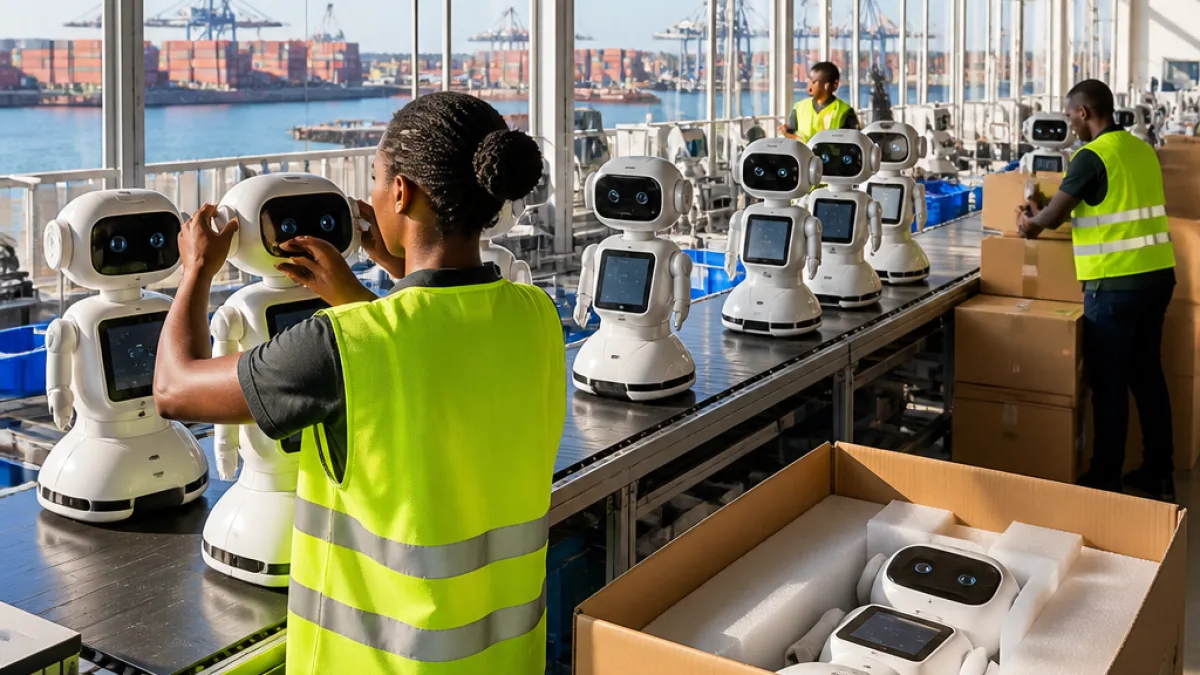
Durban — A teaching robot developed in KwaZulu‑Natal that has attracted global attention will now be built locally after the opening of a manufacturing facility at the Dube TradePort in Durban.
The device, known as Iris, was created by KwaZulu‑Natal inventor Thando Gumede, who is widely referred to as uMama ka Iris. At the launch on Thursday, Gumede outlined how the robot is intended to support teachers and learners by automating routine tasks and providing tailored classroom assistance.
What Iris does
Gumede described Iris as a multi‑purpose educational assistant able to work across the schooling system. Key features reported at the launch include:
- Instant marking: the system provides results within seconds after work is submitted.
- Diagnostic analysis: Iris identifies where pupils struggle and highlights problem areas.
- Teaching cover: when a teacher is absent or unwell, Iris can deliver lessons prepared by educators.
- Wide curriculum reach: the technology is reported to cover all subjects and modules from Grade R through to tertiary level.
- Accessibility options: functions designed for learners with learning difficulties and multiple explanation approaches.
- Language capability: the developer says Iris can operate in up to 3 000 languages and explain concepts in up to 20 different ways.
“When you have an Iris app, she marks within a second. She gives you results right there, and she analyses where the problem is with kids. She helps with homework, revisions, and not just that; when a teacher is sick, they can give Iris a lesson, and she teaches,” said Gumede at the launch.
From classroom frustration to local manufacturing
Gumede holds a BSc qualification. According to her account at the launch, difficulty finding paid work after completing her degree led her into teaching mathematics and science. The challenges she encountered in the classroom prompted her to develop an alternative to ease teachers’ workloads.
The decision to establish a production line at Dube TradePort brings the project from prototype to local manufacture. The move could create skilled jobs in assembly, quality control and ongoing technical support, and may ease distribution within South Africa and to export markets. Details about production capacity, employment numbers or pricing were not provided at the launch.
Possible classroom implications
Education experts and unions have previously cautioned that introducing technology into schools needs clear planning: factors such as teacher training, curriculum alignment, maintenance, data privacy and infrastructure (notably reliable electricity and internet) must be addressed to make classroom tech effective and equitable.
Gumede’s presentation emphasised that Iris is intended to support, not to replace, teachers — providing diagnostic feedback, extra practice for learners and continuity when educators are unavailable.
| Feature | Claimed benefit |
|---|---|
| Instant marking | Immediate feedback to learners and teachers |
| Diagnostic analysis | Identifies problem areas for targeted teaching |
| Multi‑grade coverage | Supports learners from Grade R to tertiary |
| Language and accessibility | Operates across many languages; modes for learning difficulties |
Next steps and questions for schools
Schools and district offices considering Iris will need to weigh practical matters before adopting the technology. Useful points to clarify with the manufacturer include:
- cost per unit and any recurring subscription fees;
- technical support arrangements and expected lifespan of hardware;
- compatibility with the national curriculum and assessment requirements;
- data handling, storage and learner privacy safeguards;
- teacher training programmes to integrate Iris into everyday lessons.
At the launch, Gumede framed the robot as a tool to ease burdens on teachers and provide personalised help to pupils. How education authorities and schools respond will determine whether Iris becomes a widely used classroom partner or a niche technology.
Manufacturing at the Dube TradePort marks a new phase for the project and brings production closer to schools in KwaZulu‑Natal. Observers will be watching for confirmation of production volumes, costs and any formal pilot programmes with schools in the coming months.
Durban readers interested in demonstrations or school pilots were advised at the launch to follow the developer's announcements for dates and venues.












