
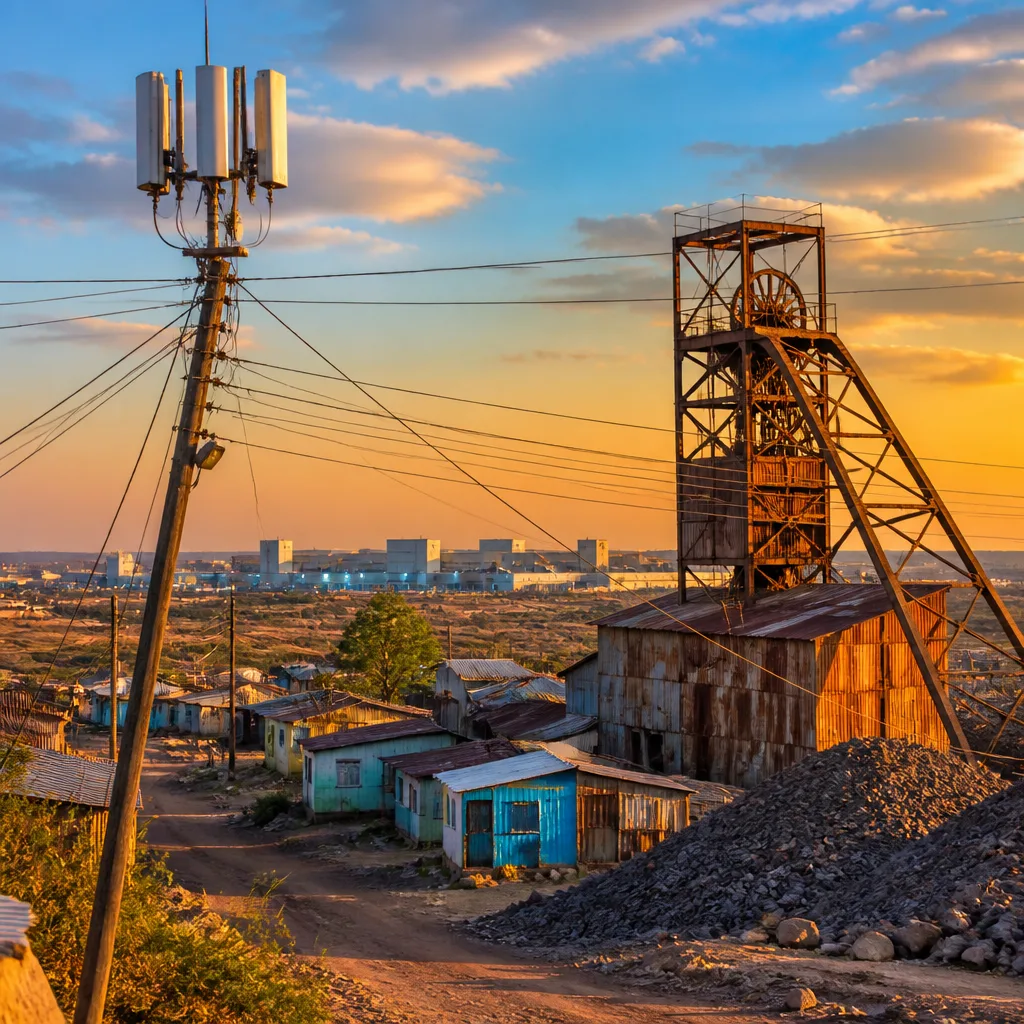
Communities in the North West that supply the minerals underpinning global digital infrastructure face a stark connectivity shortfall, a situation that risks excluding local youth from the employment and training opportunities created by the digital economy.
Minerals for the cloud, internet and AI — but no fibre at home
South Africa holds the world’s largest known reserves of platinum group metals (PGMs), accounting for about 88% of global supply, according to the Department of Mineral and Petroleum Resources. These metals — including platinum, palladium, ruthenium and iridium — play a growing role in the clean energy transition and in technologies that support data centres, the physical backbone of the cloud, the internet and artificial intelligence.
Yet many mining towns where these PGMs are extracted, such as Marikana and Kroondal in the North West, continue to rely largely on LTE mobile networks and have limited fibre rollout. Investment in digital infrastructure, research shows, has prioritised urban nodes that already enjoy robust connectivity rather than the rural communities that supply the raw materials for global digital systems.
The mismatch is visible in the concentration of data centre investment. South Africa has more than 50 data centres already in operation, most of them in Johannesburg and Cape Town, and more are being built to meet rising digital demand. Companies that operate large campuses or campuses in those cities often direct community investment to the metropolitan areas where they have facilities. For example, a communications department for Teraco — a major data centre operator owned by the American firm Digital Realty — said its community investment is focused on the cities where it operates: Johannesburg, Cape Town and Durban.
That approach leaves mining communities, despite their central role in supplying critical minerals, with poorer service and fewer opportunities to connect to the jobs generated by a growing data economy. For many young people in those towns, reliable internet access remains out of reach — at the very time when digital skills and online access are becoming essential for employment and entrepreneurship.
Why this matters for South Africa
- Economic inclusion: Without improved connectivity, residents of mining towns are less able to access remote work, online training and digital entrepreneurship, reducing local participation in value chains built on the minerals they supply.
- Skills pipeline: Data centres and cloud services demand technical and digital skills. Concentrated investment in metros risks creating a two-tier system where talent from rural mining areas is excluded.
- Strategic vulnerability: Centralising data infrastructure in a few cities also concentrates energy demand and resilience risks in those hubs, while leaving resource communities disconnected from the economic gains.
The current pattern also has implications for how South Africa positions itself in the global digital race. Supplying the world with PGMs that enable data and AI infrastructure without parallel investment in local digital access raises questions about who benefits from the country’s mineral wealth.
| Item | Detail |
|---|---|
| PGM global share | 88% of known global reserves (Department of Mineral and Petroleum Resources) |
| Data centres in SA | More than 50, mostly in Johannesburg and Cape Town |
| Connectivity in mining communities | Predominantly LTE; limited fibre rollout (examples: Marikana, Kroondal) |
Options and pressures
Addressing the gap will require targeted public and private action. Telecom and infrastructure investment strategies that extend fibre to mining towns would help, as would community-focused digital literacy and skills programmes. The example of data centre operators targeting metropolitan communities for their local social investment highlights the need for more deliberate measures to direct benefits to resource-producing areas.
For residents of Marikana and Kroondal, the disconnect is not abstract: it is a barrier to accessing the same digital economy that their labour and land help enable. Closing that gap will be important if South Africa intends to translate its mineral advantage into broader economic opportunity rather than concentrating the gains in already well-served cities.
As the country navigates the energy and digital transitions, the question goes beyond infrastructure: it is about ensuring that the communities supplying critical materials are not left behind in the digital future they make possible.










