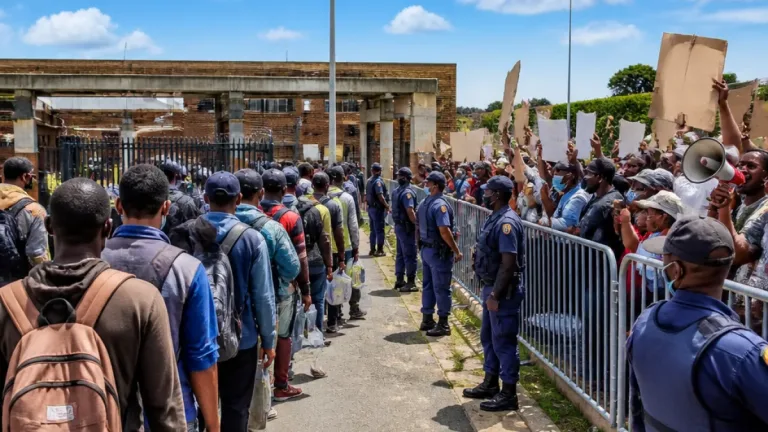
South Africans’ immediate needs and local service failures are increasingly driving voting decisions ahead of the municipal elections in November, political analyst Professor Dirk Kotze said, warning that party loyalty and ideology are losing salience as citizens prioritise daily survival.
Local over national
Kotze told reporters that the dynamics of local government contests are changing. He said political competition in smaller towns and rural areas is often led by local groupings and residents’ associations that have converted into political parties. Those dynamics, he said, differ markedly from metropolitan campaigning.
“In the past, local government elections actually became national elections, not local elections,” Kotze said, adding that campaign messaging used to be national in tone. Parties, he said, are now attempting to make local government contests genuinely local again, focusing on ward-level issues rather than national party platforms.
Trust deficit and declining turnout
Kotze pointed to a sustained erosion of public trust in political parties and institutions. He attributed the decline to what he called a failure of performance and persistent corruption, which, he said, undermine faith in local government and political actors.
Voter engagement has already reflected this trend. In the 2021 local government elections, just 45% of registered voters turned out at the polls, a figure Kotze flagged as symptomatic of broader disenchantment.
- Major drivers of voter behaviour change: perceived lack of service delivery, infrastructure decline and corruption.
- Geographical variation: local parties and residents’ associations play a larger role in smaller towns and rural areas.
- Electoral strategy shift: parties are attempting to localise campaigns rather than rely solely on national messaging.
Service delivery trumps ideology
For many voters, Kotze said, practical concerns such as potholes, water shortages and electricity supply matter more than ideological alignment. “The first one is obviously the decline of the services, as well as the infrastructure, whether you talk about potholes, whether it is that the taps are dry for the water provision, electricity,” he said, adding bluntly that ideology “doesn’t produce water for you.”
“There’s a huge decline in what one can call public trust… the political domain is going through a long-term process of becoming almost — I don’t want to say already de-legitimised — but the public is losing its faith in the functioning of it.”
Identity politics expected to feature
Kotze also said identity politics is likely to be a notable feature of the election campaign, though he cautioned against broad assumptions because of the country’s diversity. He stressed that voting patterns and party strength will vary across municipalities and between metropolitan and rural contexts.
| Issue | Implication for voters |
|---|---|
| Service delivery failures | Shifts voting from ideology to practical needs |
| Decline in trust | Lower turnout and volatility |
| Local party growth | More fragmented municipal politics |
Kotze warned against over-generalisation. He emphasised the heterogeneous nature of South Africa’s political landscape and said that local peculiarities will shape outcomes: what holds in a metropolitan area may not apply in a small town or informal settlement where local groupings are more prominent.
The observations come as parties plan strategies for the November elections, trying to balance national narratives with ward-level service promises. Analysts say the combination of service delivery concerns, corruption scandals and low trust could produce fragmented councils and increased bargaining after the ballot count.
Details remain subject to change as political parties finalise candidate lists and campaign messages. Kotze’s comments underline that municipal elections will increasingly be contested on bread-and-butter issues rather than purely ideological grounds.