
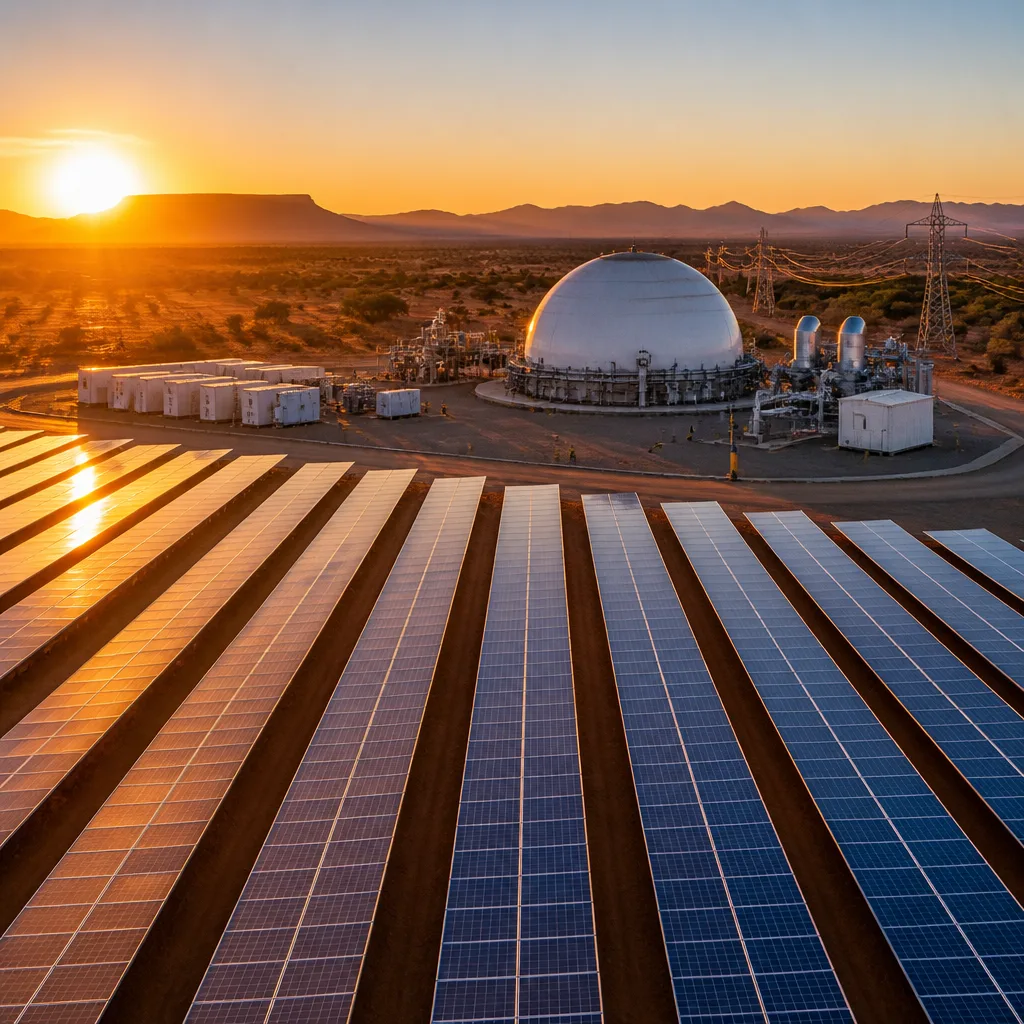
Proconics, an engineering group, has partnered with Italy’s Energy Dome to introduce a CO2-based long‑duration energy storage system to South Africa that can hold electricity for up to 18 hours. The technology is being promoted as a way to address the well‑known challenge of supplying renewable electricity through the night.
How the CO2 battery works
The system uses excess electricity during the day — typically from renewable sources — to compress and liquefy carbon dioxide into a dome at ambient temperature. When demand rises or solar generation falls, the liquid CO2 is evaporated and expanded through a turbine to produce electricity; the gas is then returned to the dome to begin the next cycle. The process is a closed loop and is designed to provide long‑duration discharge rather than the shorter bursts typical of many lithium‑ion batteries.
Why this matters for South Africa
Renewable projects in South Africa have proliferated, but the sector still faces the problem of supplying continuous power after sunset. Industry advisers have warned businesses to watch contract terms that assume cheap daytime renewable tariffs without accounting for night‑time needs. According to Discovery Green, some companies are attracted to lower daytime renewable rates but may not realise that conventional battery storage tied to such contracts often provides only up to four hours of backup.
The Energy Dome system’s longer discharge capability aims to fill that gap. Proconics CEO and founder Melvin Jones said there is growing interest in the technology from a range of players in South Africa’s energy sector.
“We are looking to bring Energy Dome’s technology into the country. There is quite a lot of interest from the Independent Power Producers (IPPs), Eskom and Sasol.”
Proven use cases and configurations
Energy Dome has deployed systems internationally that illustrate different sizing options. In Australia, for example, the company supplied a 20 MW / 200 MWh CO2 battery capable of delivering energy for about 10 hours. A similar installation has been undertaken for Google in Sardinia. The company says its technology can be configured to specific customer requirements.
| Installation | Power (MW) | Energy (MWh) | Discharge duration |
|---|---|---|---|
| Australia example | 20 | 200 | ~10 hours |
| Energy Dome concept for South Africa | Varies by customer | Configurable up to 18‑hour storage | Up to 18 hours (as advertised) |
Practical questions and implications
- Grid impact: Long‑duration storage can help shift daytime renewable output to night peaks, reducing reliance on thermal peaking plants.
- Contracting: Businesses and IPPs must assess whether proposed renewable tariffs and storage provisions match operational night‑time needs.
- Technical fit: The CO2 system is one of several storage approaches; its viability depends on project scale, location, and integration with generation assets.
Proconics positions the Energy Dome offering as attractive to both new renewable projects and the recapitalisation of older wind and solar installations. The company has not released detailed project timelines or confirmed specific South African customers beyond expressions of interest.
The arrival of a commercially available long‑duration storage option would be notable for South Africa, where intermittency and the after‑sun gap limit the extent to which renewables can replace dispatchable generation. The form and pace of any local deployments will depend on financing, grid‑connection arrangements, and how well the technology is matched to the needs of IPPs, industrial users and Eskom.
As the market evaluates alternatives, the CO2 battery adds another option to the toolbox for managing a renewable‑rich electricity system that must still meet continuous demand.










