
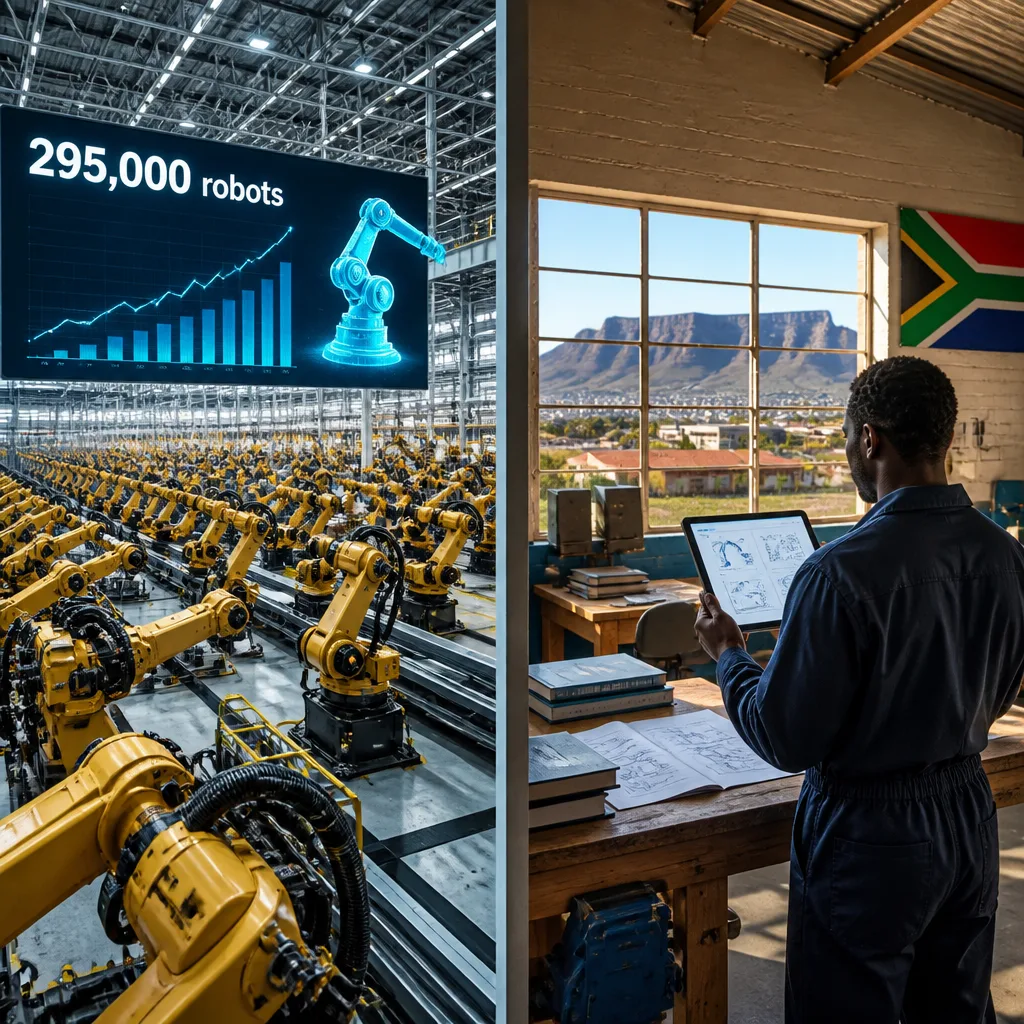
China's rapid climb to the forefront of industrial robotics is reshaping global manufacturing and presents both an opportunity and a strategic challenge for South Africa. A seminar on the "Digital Transformation of Manufacturing", organised by the Free Trade Development Board of Zhejiang Province through the BRICS Special Economic Zones Secretariat, highlighted how robotics, artificial intelligence and industrial digitalisation are being mobilised together under a long‑term national plan in China.
Scale and speed: what the numbers say
The scale of China's build‑out is striking. According to the International Federation of Robotics cited at the seminar, Chinese companies installed approximately 295,000 industrial robots in 2024, representing 54% of global installations that year. The country's operational stock of industrial robots now exceeds two million machines, and domestic manufacturers took about 57% of China’s industrial robotics market in 2024.
| Metric | Figure (2024) |
|---|---|
| Industrial robots installed in China | 295,000 |
| Share of global installations | 54% |
| Operational stock in China | >2 million |
| Domestic market share for Chinese manufacturers | 57% |
Why this matters to South Africa
For South African industries already wrestling with electricity shortages, logistics bottlenecks and skills gaps, robotics offers a potential route to higher productivity, improved safety in hazardous work such as mining, and precision in sectors like agriculture and healthcare. The seminar emphasised that robotics does not exist in isolation: it is bound up with software, sensors, connectivity and worker skills.
But there is a clear cautionary note. The seminar warned that the potential will be lost if African countries become passive consumers — merely importing completed machines — rather than building the local capabilities to integrate, adapt and regulate them. That warning has immediate policy and economic implications for South Africa.
- Skills: Robotics requires technicians, systems integrators and engineers able to maintain hardware and write or adapt control software. Without training pipelines, imported machines can become expensive paperweights.
- Local industry: Being a buyer of finished robots will capture less value than participating in supply chains for components, systems integration and after‑sales services.
- Regulation and standards: Robotics and AI raise questions about safety standards, data governance and labour market impacts that need forward planning.
Practical choices for policy and industry
South Africa faces a choice: to treat robotics as a technological inevitability to be adopted where affordable, or to actively shape how it is deployed so the country secures jobs, builds capabilities and protects consumers and workers. The seminar's account of China’s model — combining state planning, large internal demand, and sustained investment in R&D — offers a contrast to South Africa’s current industrial landscape.
Concrete policy directions that flow from the seminar’s analysis include strengthening partnerships between industry and technical colleges, creating incentives for local firms to participate in robotics value chains, and developing regulatory frameworks that address safety and data protection. These are not quick fixes; they require coordinated industrial strategy and predictable public demand to help early adopters scale.
For ordinary South Africans, the practical questions are simple: will robotics make local goods cheaper, safer and more reliable? Will it create new technical careers that replace repetitive work? Or will the country simply import machines while most of the economic benefit accrues overseas? The answers will depend on decisions taken now by industry, labour and government.
China’s robotics story is not just a distant case study. It is a reminder that technology policy, industrial strategy and skills development must move together if South Africa wants to benefit rather than be left behind.










