
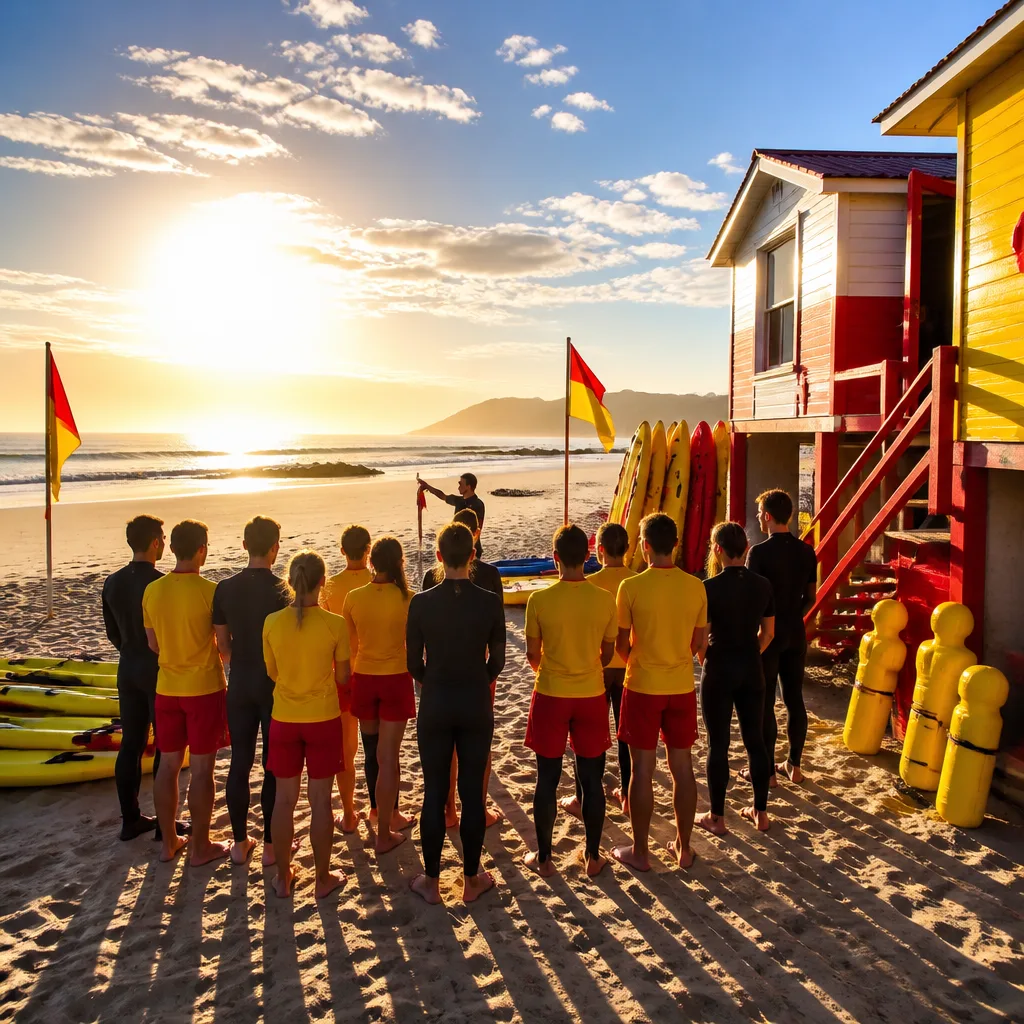
What began as one coach’s effort to preserve a hometown legacy has grown into a practical partnership that is rebuilding lifeguard capacity and leadership along the Cape coast. In a collaboration between Clifton Surf Lifesaving Club and Macassar Surf Lifesaving Club, members have exchanged skills, qualifications and opportunity since discussions started in 2023.
From a conversation to capability
Clifton coach Adie Benjamin, who grew up close to Macassar and has been connected to the club for more than 40 years, initiated the link to protect and strengthen Macassar’s surf lifesaving legacy. The two clubs, separated by about 51.2 kilometres, deliberately framed the arrangement as reciprocal rather than paternal — a sharing of resources, expertise and time.
That approach has delivered measurable results. Through Clifton’s education programme, five Macassar members qualified as lifeguards, enabling Macassar to resume active patrols. A notable outcome was the qualification in 2026 of Ridhaa Kuys as a Surf Lifesaving Instructor, a milestone that allows the partnership’s knowledge to be embedded and multiplied within the Macassar community.
“Coming from Macassar, partnering with an established club like Clifton broadened my horizons beyond what I ever thought possible,” said Ridhaa. “Being able to bring those qualifications back to Macassar and use them to help develop my home club is something I’m incredibly proud of.”
Practical gains, community impact
The tangible training outcomes are already being felt. Since qualifying as an instructor, Ridhaa has taken part in training more than 70 new lifeguards, according to the reporting. That figure demonstrates how a single instructor qualification can rapidly increase local capacity and the pool of trained volunteers available for patrols and events.
The clubs’ cooperation highlights several broader themes relevant to sport and public safety: skills transfer between established and developing clubs, the role of volunteer sport in community leadership, and the value of targeted education programmes to rebuild operational capability.
- Skills transfer: Experienced clubs sharing formal training and coaching with smaller or struggling clubs.
- Leadership development: Local instructors multiplying training within their communities.
- Community safety: Return to active patrols increases beach safety for residents and visitors.
Clubs like Clifton and Macassar operate in a voluntary landscape where funding, human resources and coastal conditions shape what is possible. This partnership demonstrates a low-cost, high-impact model: use existing education resources to empower neighbouring communities rather than replicating programmes independently.
Numbers that matter
| Metric | Value |
|---|---|
| Distance between clubs | 51.2 km |
| Years of connection to Macassar (Adie Benjamin) | 40+ |
| Macassar members qualified as lifeguards | 5 |
| New lifeguards trained since instructor qualification | 70+ |
| Partnership started | 2023 |
| Instructor qualified | 2026 |
For coastal communities, the difference between an organised patrol and no patrol can be a matter of life and death. Surf lifesaving clubs are not only sporting outfits but also first responders on the shoreline. Re-establishing patrols at Macassar, powered by local volunteers now formally qualified, strengthens public safety and creates role models for younger residents who might join surf sport or seek qualifications.
Moreover, the partnership offers a blueprint for other clubs nationwide: pairing resources, sharing instructor capacity, and deliberately building leadership within underserved communities. It also underscores the importance of preserving institutional memory in voluntary sport — coaches and volunteers who keep clubs alive for decades are an essential part of South Africa’s sporting infrastructure.
The Clifton–Macassar collaboration is modest in scale but rich in consequence. With a handful of qualified lifeguards and a new instructor teaching dozens more, this is community sport doing what it does best — solving problems from the ground up, one training session at a time.














