
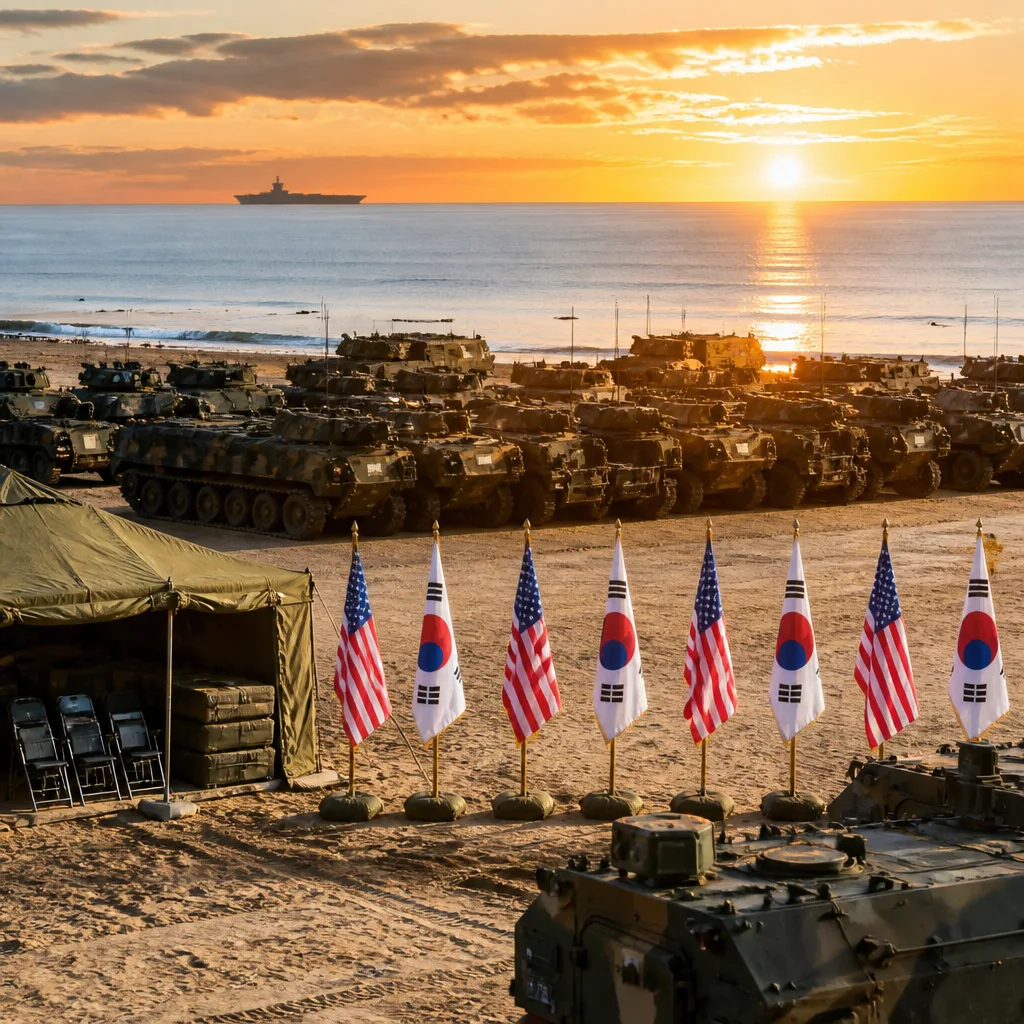
President Donald Trump announced Sunday that he has instructed the Defense Department to substantially reduce joint military exercises with South Korea, saying the annual drills send an inappropriate message to North Korea and citing Seoul’s decision not to participate in U.S. efforts involving Iran.
The exercises, planned to begin Monday, were intended to include 18,000 South Korean service members and are designed to strengthen combined defense capabilities and interagency coordination between the two countries, according to the South Korean military and U.S. accounts of the planned drills.
Administration rationale and immediate uncertainty
In public remarks, the president characterized the large-scale training as a signal that could be seen as hostile to North Korea. He also pointed to what he described as a strong personal relationship with North Korean leader Kim Jong Un and criticized South Korea for declining a U.S. invitation related to operations involving Iran.
“Based on the fact that it is too late to cancel, I have instructed Secretary of War, Pete Hegseth, to substantially reduce the Joint Military Exercises!”
It was not immediately clear what a reduced version of the exercises would entail. U.S. Forces Korea, the combined command responsible for executing the training, and the South Korean embassy in Washington did not immediately respond to requests for comment on how the drills would be scaled back or which components might be curtailed.
Regional context and reactions
The announcement follows a period of heightened activity on the Korean Peninsula. North Korea launched a ballistic missile last week toward the sea during what analysts and officials viewed as weapons testing, which Pyongyang framed as a response to the scheduled U.S.-South Korea drills. North Korea has repeatedly called such exercises a rehearsal for war and has warned of retaliation.
The timing of the president’s statement also comes after the Navy repositioned its carrier presence in the region: the USS George Washington was sent to replace the USS Abraham Lincoln in the Persian Gulf. The carrier rotation, occurring amid scrutiny of conditions aboard the Abraham Lincoln, was announced in U.S. defense briefings.
Possible implications for alliance posture
U.S.-South Korea joint exercises are a central feature of combined deterrence against North Korea and serve to maintain operational readiness across services and agencies. Reducing the scale of those drills could affect training objectives and interoperability, though specific operational impacts depend on which elements are trimmed.
South Korean officials told The Associated Press the Ulchi Freedom Shield exercise would have included roughly 18,000 South Korean troops and is intended to reinforce alliance response capabilities against a range of security threats. Officials warned that Pyongyang views these maneuvers as provocative.
- 18,000 — number of South Korean soldiers expected to take part in the planned Ulchi Freedom Shield drills, per South Korean military.
- Recent North Korean ballistic missile launch perceived as linked to upcoming U.S.-South Korea drills.
- U.S. naval carrier rotation placing USS George Washington in the Gulf while USS Abraham Lincoln returns from the region.
Officials did not provide details on which assets or activities would be curtailed. The White House message also referenced diplomacy and alliance consultations indirectly, but there was no immediate confirmation of formal discussions with South Korean leaders about altering the exercise schedule or scope.
| Item | Detail |
|---|---|
| Planned exercise | Ulchi Freedom Shield |
| South Korean participants | 18,000 |
| Recent regional activity | North Korean ballistic missile test |
The announcement is likely to prompt close scrutiny from U.S. allies and defense analysts about the message it sends to both partners and adversaries. Reductions in exercises without detailed explanation of compensating measures could raise concerns in Seoul and among regional partners about the continuity of U.S. commitments and the operational readiness of combined forces.
Requests for immediate comment from U.S. Forces Korea and the South Korean embassy in Washington were unanswered Sunday evening.

















