Texas’ shift toward a Democratic-led state government is setting up a national test for education policy, as lawmakers confront programs and classroom rules that have made the state a model for conservative policymaking across the country.
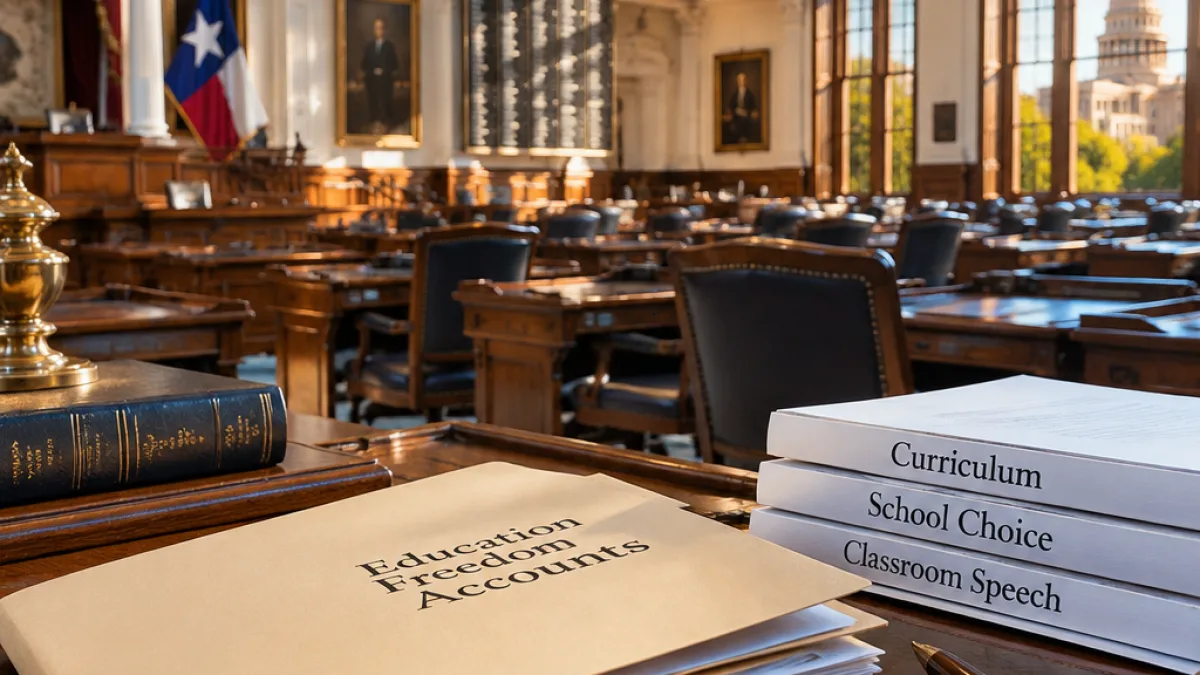
Texas has influenced education debates for decades through its approach to academic standards, accountability and school choice. More recently, it has become a prominent battleground over restrictions on discussions of race and gender, efforts to add Western civilization and classical subjects to the curriculum, and the creation of a voucher-like program known as the Texas Education Freedom Accounts.
A state with influence beyond its borders
Education policies developed in Texas have often attracted attention from conservative states. The state’s earlier focus on standards, testing and accountability helped shape a national conversation that eventually included the federal No Child Left Behind law, although that law became deeply controversial. Over time, Texas also became a leading example for states pursuing private-school choice and tighter limits on what educators can discuss in classrooms.
That record gives the state’s political transition importance beyond Austin. The question is not only whether Texas will change its own education system, but whether a new direction could weaken the influence of policies that Republican-led states have adopted over the past decade.
- Accountability: Texas helped make academic standards and school performance central national policy issues.
- School choice: Its education savings account program reflects a broader Republican push toward private-school vouchers.
- Curriculum: The state has led efforts involving race, gender, Western civilization and classical education.
What a new administration could change
Governor-elect Gina Hinojosa campaigned aggressively against the state’s voucher program, featuring her opposition in advertisements and public appearances. But she has also lowered expectations about an immediate repeal, saying that eliminating the program entirely would not be realistic while Republicans retain control of the state Senate.
That division creates a significant constraint. Even with a governor opposed to the program, the Senate’s Republican majority could make a full reversal difficult. The political reality could push the incoming administration toward attempts to modify the program rather than abolish it.
| Education issue | Position described in the source |
|---|---|
| Education savings accounts | Created this year and structured to expand over time |
| Voucher amount | $10,000 for eligible private-school tuition or homeschooling costs |
| Current target groups | Low-income and some middle-class families |
| Legislative balance | Governor-elect is a Democrat; the state Senate remains Republican |
The fight over expansion
Supporters and opponents are focused not only on the program’s existence but on its design. The accounts provide as much as $10,000 for private-school tuition or homeschooling expenses and currently target low-income families and some middle-class households. The law, however, is written to permit expansion over time, a feature that has alarmed critics even as supporters defend the program.
That built-in growth potential means the dispute could continue even without an immediate repeal effort. Supporters remain concerned that a Democratic administration could restrict the program, while opponents are watching to see whether the new government can alter its reach through legislation or administration. The source does not identify a detailed alternative proposal from Hinojosa, but it makes clear that her campaign criticism has not translated into a promise of immediate elimination.
A national policy signal
The Texas contest will be closely watched because the state has served as a testing ground for education ideas that have spread through conservative America. A change in direction could challenge the momentum behind vouchers, classroom restrictions and a more traditional or classical curriculum. At the same time, Republican control of the Senate may preserve much of the existing framework.
The result is likely to be a debate over how quickly voters’ preferences can reshape education policy when executive and legislative power are divided. Texas’ next steps may therefore matter well beyond its borders, offering either a model for revising conservative education programs or evidence that those policies can endure even after a major political shift.
“I don’t think that’s realistic to fully repeal it.”