Artificial intelligence is giving historians access to documents that have resisted examination for centuries, allowing researchers to process records that would otherwise require years or decades of specialized manual work. Recent projects in Europe demonstrate how rapidly improving document-recognition systems can help recover information from fragile or difficult-to-read sources.
A letter solved in hours
One recent effort involved a letter from 1809 connected to an order from Napoleon Bonaparte. An AI engineer decoded the document in approximately six hours, resolving a question that had remained unanswered for more than 200 years. The result illustrates one of the technology’s most immediate uses in historical research: converting material that is technically present but practically inaccessible into text that researchers can examine.
Historical documents can be difficult to study for several reasons. Some are written in old forms of language or handwriting, while others are preserved in large collections that exceed the capacity of individual scholars to transcribe. The technology described in the report does not eliminate the need for researchers, but it can reduce the time required to identify and read records, making it possible to investigate sources that might otherwise remain untouched.
Thousands of medieval pages processed
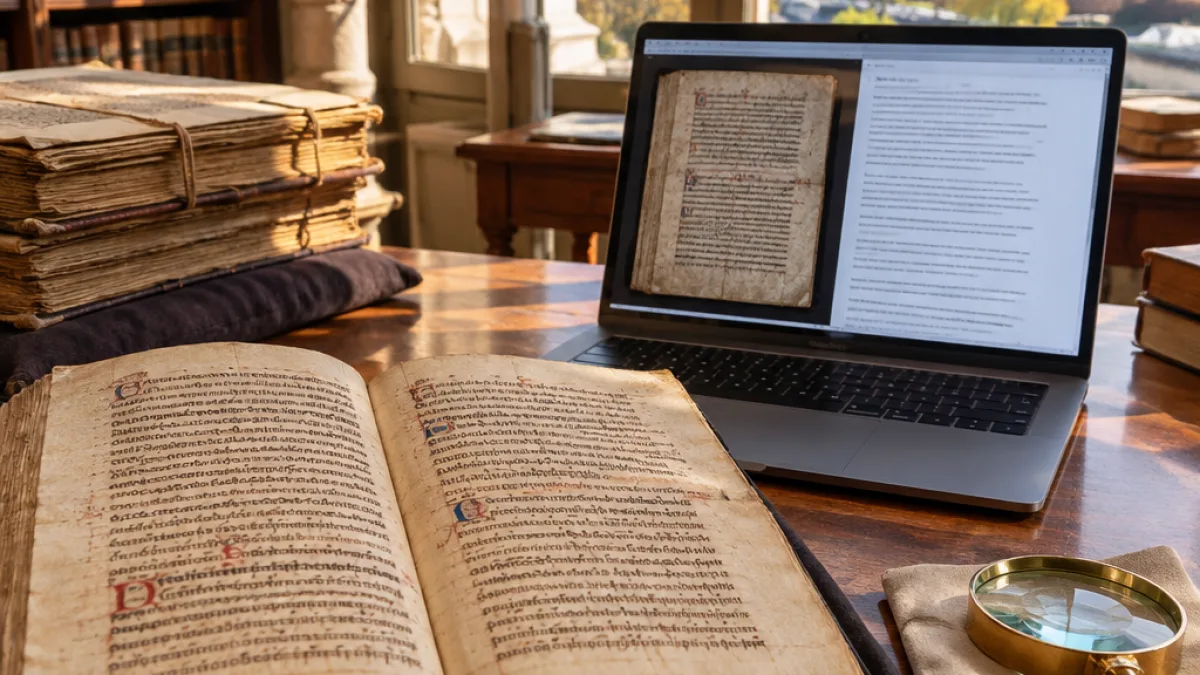
Researchers in Paris are applying similar systems to the medieval archives of Notre Dame Cathedral. Their project involves 14,600 pages in Latin, a volume of material that would be extremely demanding to process by hand. The AI system is recognizing between 88% and 94% of the characters, according to the report.
| Project detail | Reported result |
|---|---|
| Napoleon-era letter | Decoded in about six hours |
| Notre Dame archive | 14,600 Latin pages being processed |
| Recognition performance | 88% to 94% of characters |
| Traditional alternative | Manual work estimated to take decades |
The Notre Dame material is already revealing information about everyday life, construction and abandoned children, according to the report. Those subjects show the potential value of archival work beyond major political events. Administrative and religious records can also provide evidence about how communities functioned, how buildings were developed and how vulnerable people were treated.
Speed changes the scope of historical inquiry
The central change is not simply that a machine can read a particular page. By processing large collections more quickly, AI can alter which research questions scholars are able to pursue. Material that once had to be sampled selectively may become available for broader examination, while records that had been set aside because of time or staffing limits can enter the research process.
- Faster access: Researchers can review documents in hours or at a scale previously difficult to manage.
- Wider discovery: Large collections may reveal details about social and institutional life that are easily missed in limited samples.
- New limits: Recognition rates below 100% mean that scholars still need to verify and interpret the resulting text.
The reported accuracy range also underscores that AI-generated transcriptions are not automatically final historical records. A system that recognizes most characters can still produce errors, particularly when dealing with unusual handwriting, damaged pages or unfamiliar terminology. Researchers therefore remain responsible for checking the output against the original documents and determining what the text means in its historical context.
Even with those limitations, the projects show how AI is expanding access to sources that were previously available only to specialists or not realistically readable at all. The Napoleon-era letter and the Notre Dame collection represent different scales of archival work: one document answered a long-standing question, while thousands of pages are being examined for evidence about medieval society. Together, they point to a future in which technology helps historians move from isolated discoveries toward more extensive study of the world’s documentary past.