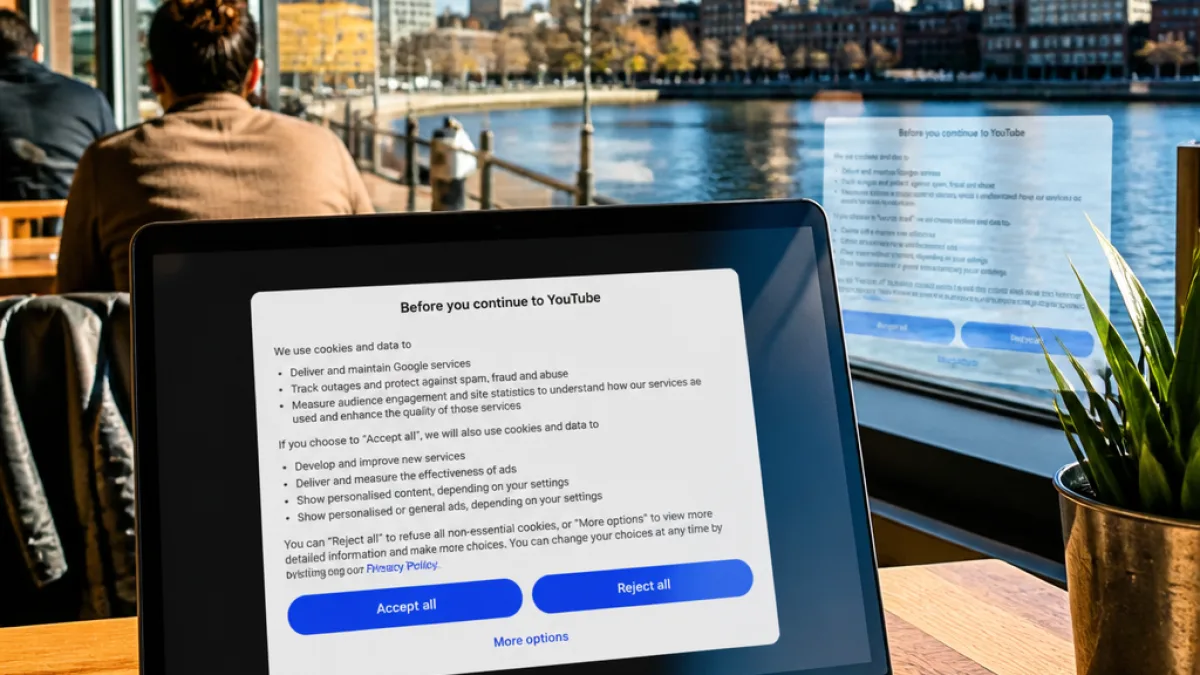
New consent language outlines options for data use on YouTube
Buffalo internet users visiting YouTube will encounter a consent prompt that explains how Google collects and uses cookies and other data, including IP addresses, to operate the service and to tailor content and advertising. The notice lays out choices for users on how their data may be used and describes the consequences of those choices for recommendations, ads and some site functionality.
The notice differentiates between the baseline data uses required to run and protect the service and optional uses that depend on a user’s choice. At a minimum, Google says it uses cookies and data to deliver and maintain Google services, track outages, protect against spam, fraud and abuse, and measure audience engagement and site statistics so the company can understand and improve how the service is used.
"If you choose to ‘Accept all,’ we will also use cookies and data, including IP addresses, to develop and improve new services, deliver and measure the effectiveness of ads, show personalized content, depending on your settings, [and] show personalized ads, depending on your settings."
The consent prompt gives users three general paths:
- Accept all: allows Google to use cookies and data not only for service operation and security but also to personalize content and ads, to develop and improve products and to tailor video recommendations and the YouTube homepage based on past activity.
- Reject all: restricts Google from using cookies or IP addresses for the optional personalization and development purposes listed by the company. Users will still receive non-personalized content and ads influenced by things such as the content currently being viewed and general location.
- More options: directs users to additional settings where they can manage privacy preferences and view further details, including links to tools at g.co/privacytools.
What the choices mean for local users and institutions
For Buffalo residents, the prompt affects everyday experiences on YouTube — from the video recommendations that appear on the homepage to the ads shown before and during videos. Under the "Accept all" option, recommendations and ads can be customized using a user’s watch history and search activity. If a user selects "Reject all," YouTube will rely on non-personalized signals such as the current video being viewed and broad geographic information to serve content and ads.
Local organizations that rely on YouTube for outreach — including small businesses, nonprofits and cultural institutions — should note that ad targeting and measurement can be influenced by the choices individual users make about personalization. The company also emphasizes that some safety and operational uses of cookies and IP addresses continue regardless of whether users accept additional personalization settings.
| Consent option | Data used | Effect on UX |
|---|---|---|
| Accept all | Service, security, analytics, personalization, ads, product development | Personalized homepage and ads; tailored recommendations |
| Reject all | Service, security, analytics; no personalization via IP/cookies | Non-personalized ads; recommendations based on viewed content and location |
| More options | Customizable; directs to privacy tools | User can fine-tune preferences |
The notice also notes that personalized content and ads can be age-appropriate where relevant. Users who want to review or change settings later are directed to Google's privacy tools at g.co/privacytools.
Practical steps for Buffalonians
Users in the Buffalo area who are unsure which option to choose can take a few practical steps:
- Use the "More options" link to review what specific uses you are enabling or disabling before making a decision.
- Visit g.co/privacytools to manage Google account privacy settings and to learn how data is used across Google services.
- Consider how personalization affects your YouTube experience: rejecting personalization reduces tailored recommendations and individualized ads but does not prevent the platform from operating or from using non-personalized signals.
As online privacy and targeted advertising remain topics of local and national attention, the consent prompt represents one touchpoint where users make active choices about how much data they want companies to use for personalization and product development. The options provided aim to balance basic service needs with user preferences for privacy and personalization.