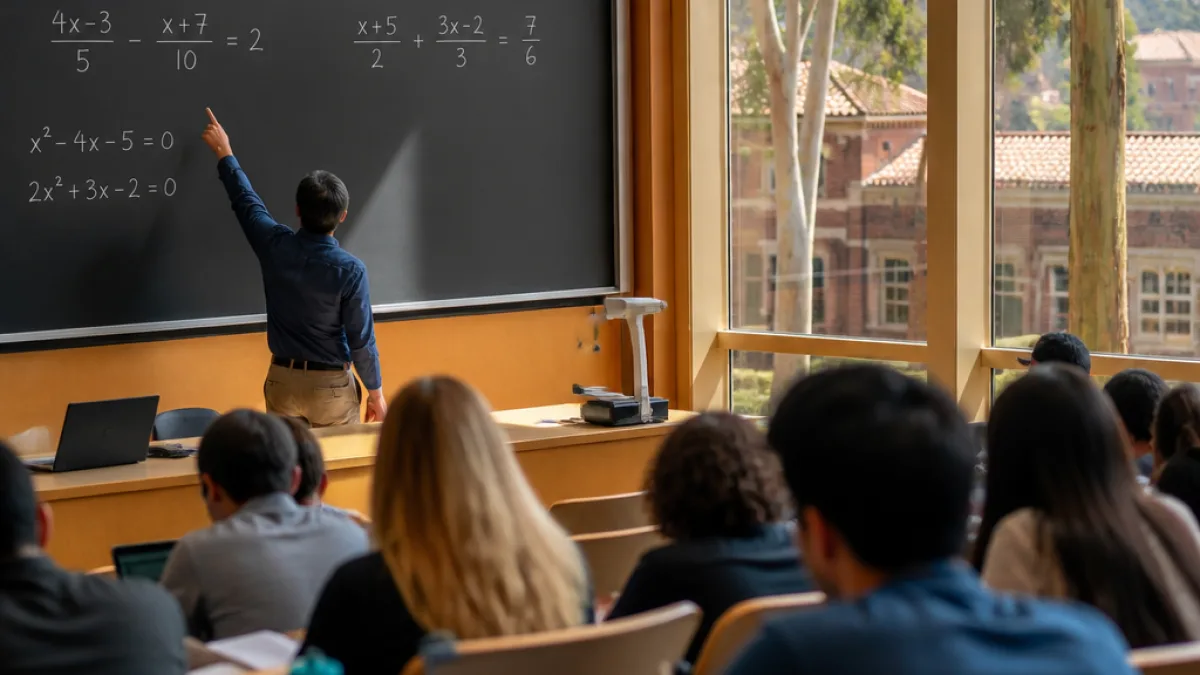
Berkeley instructor changes grading practice after AI makes correctness hard to verify
A UC Berkeley professor and 1998 Fields Medal laureate has stopped assigning grades for the correctness of homework, citing the growing use of artificial intelligence tools that can produce near-human answers to complex problems.
The change, announced in interviews with The California Post and the Daily Californian, comes from Richard Borcherds, a renowned mathematician who said the prevalence of AI-created solutions has made traditional correctness grading counterproductive. Instead of evaluating answers for accuracy, Borcherds now awards credit based on whether students submit their assignments.
“Student use of AI for homework is now widespread,” Borcherds told The California Post. “Grading for correctness just adds a huge incentive for them to use AI for homework instead of doing it themselves, and penalizes students for honesty.”
Borcherds also told The California Post that distinguishing between student-created work and AI-generated work has become increasingly difficult. "There is no easy way to tell the difference between human and AI generated work," he said, adding that while earlier AI output sometimes contained telltale errors, that is less often the case now.
What changed and why it matters locally
The professor’s shift to completion-based credit aims to remove the incentive for students to substitute AI for their own thinking and to avoid penalizing students who report using such tools. Borcherds said paying graders to evaluate answers suspected to be AI-generated is a poor use of resources.
- Policy change: Credit awarded for submission rather than correctness.
- Rationale: Widespread and improving AI makes reliable detection difficult.
- Consequence: Raises questions about assessment standards and preparation for advanced study in mathematics.
Those concerns were amplified in comments to the campus newspaper, where Borcherds suggested that continued AI improvement could reshape what human mathematicians do. "If AI continues to improve at present rate, then, in a few years, there'll be nothing human mathematicians can do that AI can't do better," he told the Daily Californian, according to his interview.
Campus, curriculum and the limits of detection
Berkeley faculty and students are confronting the same dilemmas that institutions worldwide are racing to address: how to assess authentic learning, when sophisticated models can produce plausible solutions to technical assignments, and how to structure pedagogy so students develop problem-solving skills rather than relying on tools.
Borcherds' approach represents one local, pragmatic response: reduce incentives to outsource work and preserve the integrity of in-class evaluation or other assessments that demand demonstration of understanding. He acknowledged, according to the published interviews, that he does not know a better long-term solution.
| Prior practice | New practice |
|---|---|
| Grade homework for correctness | Award credit for completion |
| Use graders to evaluate answers | Avoid paying graders to vet AI-generated responses |
Faculty on campus have a range of tools — proctored exams, in-class projects, oral exams and redesigned assignments — to deter or detect misuse, but Borcherds' public move underscores the scale of the problem for courses that traditionally rely on written homework to build skills.
Implications for students and the mathematics pipeline
Beyond grading mechanics, Borcherds expressed uncertainty about the long-term implications for the field. As AI capabilities expand, the professor questioned whether aspiring mathematicians will find the discipline holds the same promise if machines can outperform human problem solvers on a broad set of tasks.
For Berkeley students and instructors, the immediate effects are practical and pedagogical: instructors must decide whether and how to adapt assessment practices, and students must adjust to expectations that increasingly prioritize demonstrated understanding over produced answers.
As campuses nationwide continue to adapt, the conversation at Berkeley highlights a tension between protecting academic integrity and ensuring that educational practices foster genuine learning in an era of powerful AI tools.