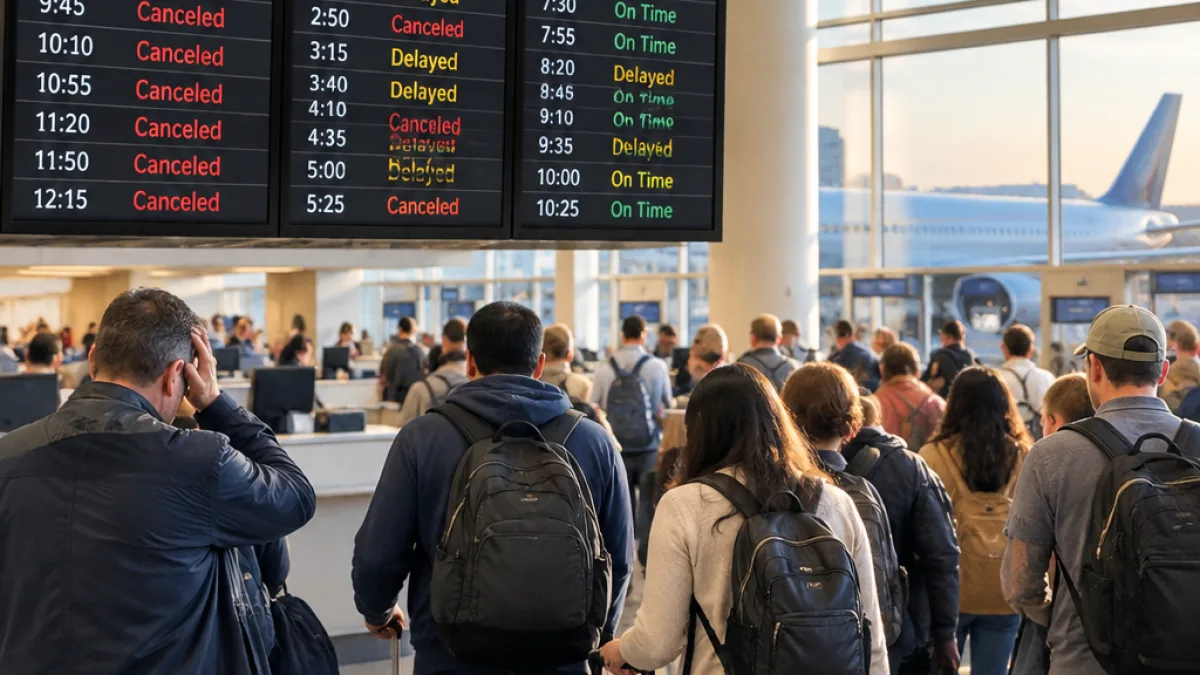
U.S. air travel began moving toward normal operations Saturday after the nation’s longest flight stoppage in 25 years disrupted airports across the country and left thousands of passengers facing cancellations, delays and rebooking. Federal officials said the system had stabilized, but warned that the effects of Friday’s breakdown would continue through the weekend.
The nationwide halt ended at approximately 8:15 p.m. Eastern time Friday, allowing some domestic flights to resume. Even after departures restarted, the backlog created by the interruption continued to affect airlines, airports and travelers. Officials expected the system to make a full recovery by Sunday, although Saturday was expected to remain a difficult travel day.
Thousands of flights remain affected
Federal Aviation Administration Administrator Bryan Bedford said the system was stable Saturday, but airlines still had substantial recovery work ahead. Of the roughly 41,000 flights scheduled for Saturday, as many as 5,000 could be canceled, according to Bedford.
The disruption on Friday was significantly larger. About 12,000 scheduled flights were unable to depart, including approximately 9,000 commercial flights. The figures illustrate how quickly a problem in the aviation system can spread through the national network, as aircraft, crews and passengers are left out of position for later flights.
| Measure | Reported figure |
|---|---|
| Flights unable to depart Friday | 12,000 |
| Commercial flights among that total | 9,000 |
| Saturday flights scheduled | 41,000 |
| Possible Saturday cancellations | 5,000 |
Officials rule out an intentional attack
Homeland Security Secretary Markwayne Mullin said there was no indication that the failure resulted from a cyberattack. He also said the disruption did not put lives at risk. Those assurances were important for passengers and the broader aviation system because the stoppage affected operations nationwide, but officials described it as a technical failure rather than an attack by a malicious actor.
Transportation Secretary Sean Duffy said a contractor had been replacing part of the system’s older copper wiring with fiber-optic wire Friday afternoon. The work contributed to an overload in the system, according to Duffy. The source material did not provide additional details about the specific component involved or explain whether the upgrade work had been completed.
Passengers told to contact airlines
Travelers whose flights were canceled have specific options. Bedford reminded passengers that airlines are required to provide either free rebooking on another flight or a full refund when a flight is canceled. Passengers were directed to contact their airlines for information about the status of their reservations and available alternatives.
- Check directly with the airline for the latest flight status.
- Ask about a no-cost replacement itinerary if the flight was canceled.
- Request a full refund instead of rebooking when that is the preferred option.
- Expect possible delays even after flights resume because of the remaining backlog.
Bedford apologized to travelers who were stranded and thanked air traffic controllers, pilots and flight attendants for managing the consequences of the breakdown. He said the most severe phase appeared to have passed, while acknowledging that airlines and aviation workers still had to resolve the accumulated disruption.
“I do think the worst is behind us, but we still do have a significant amount of recovery work to do.”
The situation remained fluid Saturday as carriers worked through canceled flights and delayed schedules. Although officials said the system was stable and anticipated a return to normal by Sunday, passengers were still advised to rely on their airlines for individual travel information rather than assume that the end of the ground stop meant all flights would operate on schedule.