
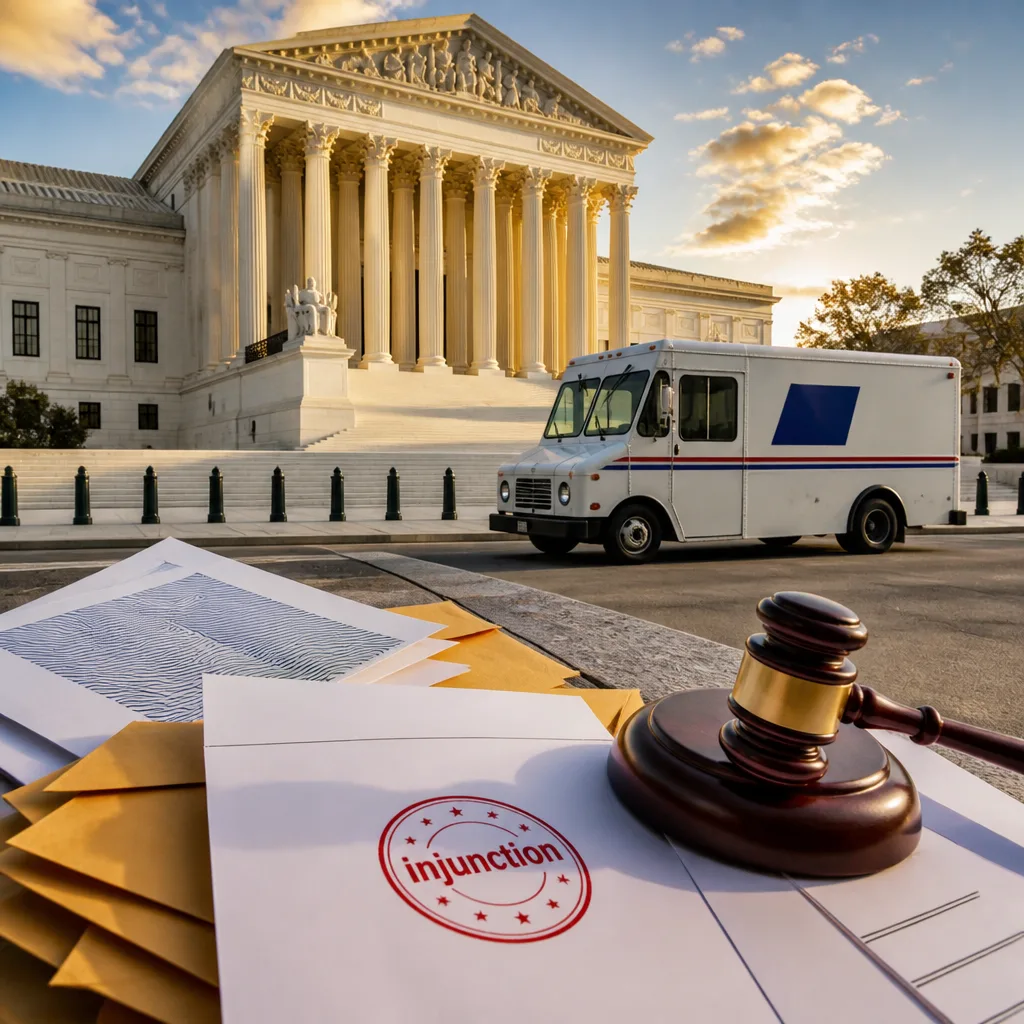
The U.S. Supreme Court on Monday declined to lift a federal injunction that bars the U.S. Postal Service from implementing President Donald Trump’s March executive order directing the agency to transmit mail‑in ballots only to voters on a national list of eligible voters.
What the court left intact
The injunction, issued earlier this month by a federal judge in Boston, remains in place after the high court’s action. The dispute arose after 21 states, including Michigan, and the District of Columbia sued to block the Postal Service from carrying out the new ballot requirements created by the executive order. The states challenged the plan after an initial Supreme Court decision found that other plaintiff states lacked standing to sue.
By maintaining the Boston judge’s preliminary injunction, the Supreme Court has kept the Postal Service from changing current procedures ahead of the upcoming elections. The decision does not foreclose future litigation or policy changes, and one Justice signaled potential openness to the broader concept under different circumstances.
Justice Kavanaugh’s concurrence and its limits
Conservative Justice Brett Kavanaugh wrote a concurring opinion that suggested election administration of this kind might fall within the Postal Service’s jurisdiction. Yet he cautioned that implementing the new rule for the imminent election cycle would run afoul of the Administrative Procedure Act because “state and local election officials do not have sufficient time to reasonably implement the rule before the elections.”
“...in violation of the Administrative Procedure Act because state and local election officials do not have sufficient time to reasonably implement the rule before the elections.”
Context and voter confidence
The court’s action comes as public trust in elections shows signs of strain in some places. A Glengariff poll of about 800 likely Michigan voters found that 74.4% of respondents said they believe the election system is fair and accurate, down from 79.4% in 2025.
The same poll reported that 85% of Republicans, Democrats and Independents trust their own county’s election results, while 48% said they do not trust other counties’ results.
| Measure | Result |
|---|---|
| Belief system is fair and accurate (2026) | 74.4% |
| Belief system is fair and accurate (2025) | 79.4% |
| Trust own county’s results | 85% |
| Don’t trust other counties | 48% |
Immediate consequences and remaining questions
The Supreme Court’s decision to keep the injunction in place preserves the status quo for now, preventing the Postal Service from redirecting ballots on the basis of a federally compiled voter list. But the concurrence from Justice Kavanaugh leaves open the possibility that the Postal Service could seek to adopt similar changes in the future under a different timeline or through a rulemaking that satisfies the Administrative Procedure Act.
The litigation remains active and carries implications for how federal agencies may interact with state and local election systems. Officials such as Ottawa County Clerk Justin Roebuck have been consulted for clarity on processes as voter confidence is monitored, reflecting the broader concern among election administrators and the public about any federal changes to long-standing local procedures.
For now, election officials and voters will proceed under existing Postal Service practices while courts weigh the legality and timing of any future changes.
- Action maintained: Boston judge’s injunction remains effective.
- Legal caveat: Kavanaugh says the APA limits immediate implementation.
- Public confidence: Polling shows a slight decline in trust among Michigan voters.