
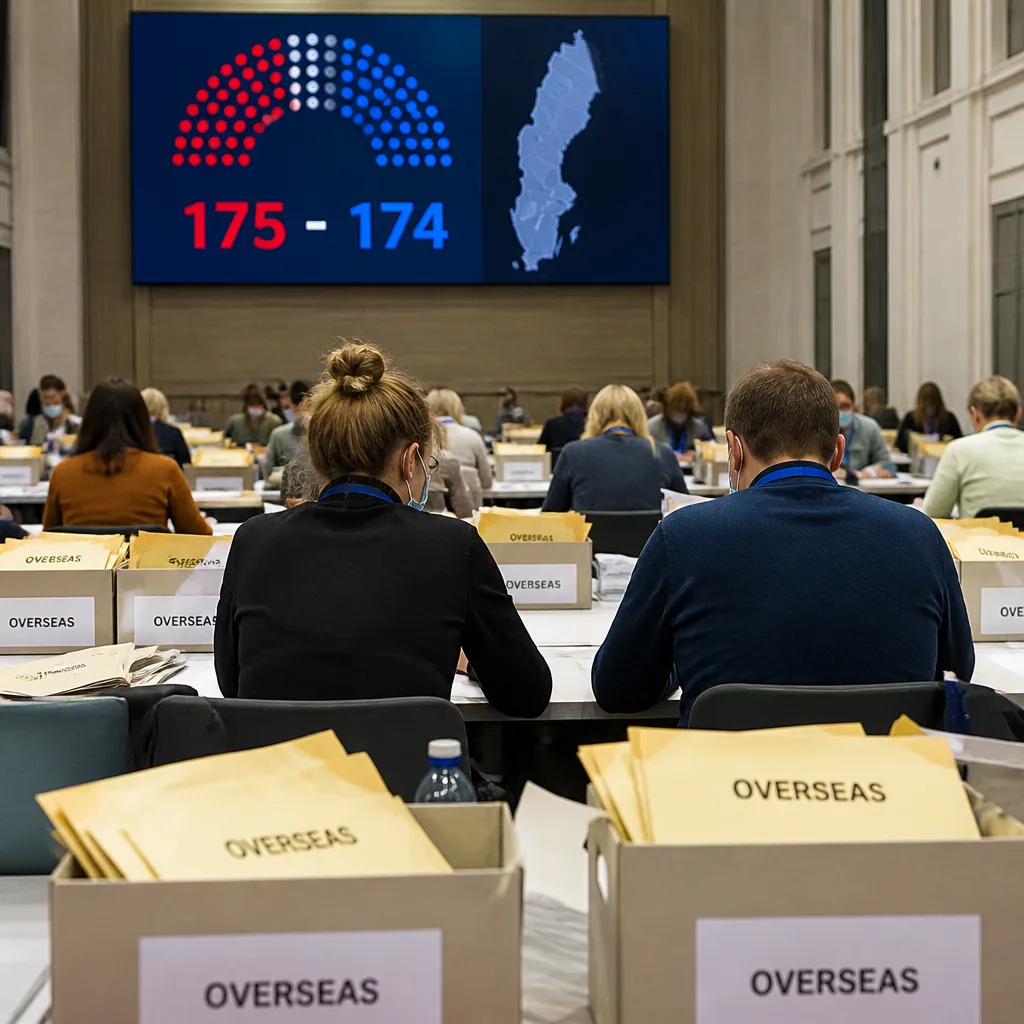
Preliminary results from Sweden’s parliamentary election show the opposition center-left bloc one seat ahead of the incumbent right-wing coalition, setting up a tense dayslong count that could decide the country’s next government and its approach to immigration and domestic security.
Count remains unfinished as overseas ballots arrive
The partial tally put the center-left bloc led by the Social Democrats on track for 175 seats out of the 349-seat Riksdag, while Prime Minister Ulf Kristersson’s governing right-wing bloc was projected at 174 seats. Thousands of district ballots and overseas votes have yet to be processed, and election officials cautioned that the final outcome may not be known for several days.
The narrow margin means a small number of ballots — particularly those cast abroad — could determine which side secures a parliamentary majority and the ability to form or block a government. The result will shape whether Sweden continues along the policy paths taken since Kristersson took office four years ago.
Stakes for immigration, law-and-order, and political alignment
At the center of the campaign were questions about migration policy and domestic security. The Kristersson government implemented a string of restrictive immigration measures and pursued aggressive action against organized crime, positions that drew both strong support and fierce criticism.
For the Social Democrats and their allies, regaining power would open a path to reverse or moderate what they describe as an erosion of Sweden’s liberal traditions. For Kristersson, retaining control would validate a tougher stance on immigration and continued cooperation with parties on the right, including the Sweden Democrats.
Role of the Sweden Democrats
The election highlighted the transformed role of the Sweden Democrats, a party with roots in extreme movements that has in recent years become a decisive factor in national politics. Prime Minister Kristersson broke with decades of mainstream exclusion by saying before the vote that he would include the Sweden Democrats in government should the right-wing bloc secure a majority.
The party’s rise underlined a broader realignment of Swedish politics: voters concerned about migration and crime have gravitated toward parties promising firm action, while more traditional center-left supporters emphasize social welfare and civil liberties.
- Projected seats: Center-left 175, Right-wing 174
- Remaining ballots: Thousands of district counts plus overseas votes
- Key issues: Immigration policy, crime, and the integration of the far-right Sweden Democrats
| Bloc | Projected Seats |
|---|---|
| Center-left (led by Social Democrats) | 175 |
| Right-wing (led by Prime Minister Kristersson) | 174 |
What comes next
Sweden’s electoral authority will continue to count outstanding ballots, including those from voters overseas, which historically have the potential to sway close contests. If the center-left maintains its slim lead and can build a working majority with allied parties, it could move to form a government. If the right manages to hold or expand its position as remaining votes are tallied, Kristersson could remain prime minister, potentially advancing further cooperation with the Sweden Democrats.
The eventual makeup of any governing coalition will determine Sweden’s policy direction on migration, criminal justice and social programs and could influence how the country positions itself within Europe on security and foreign policy questions. Observers say the immediate outcome is unlikely to change Sweden’s broadly pro-Western and pro-Ukraine orientation, but the domestic policy agenda could shift significantly depending on who secures control of the Riksdag.
Election officials and party leaders urged patience as the count continues. With such a narrow margin separating the blocs, the final chapter of Sweden’s vote may not be written until every ballot is examined.