
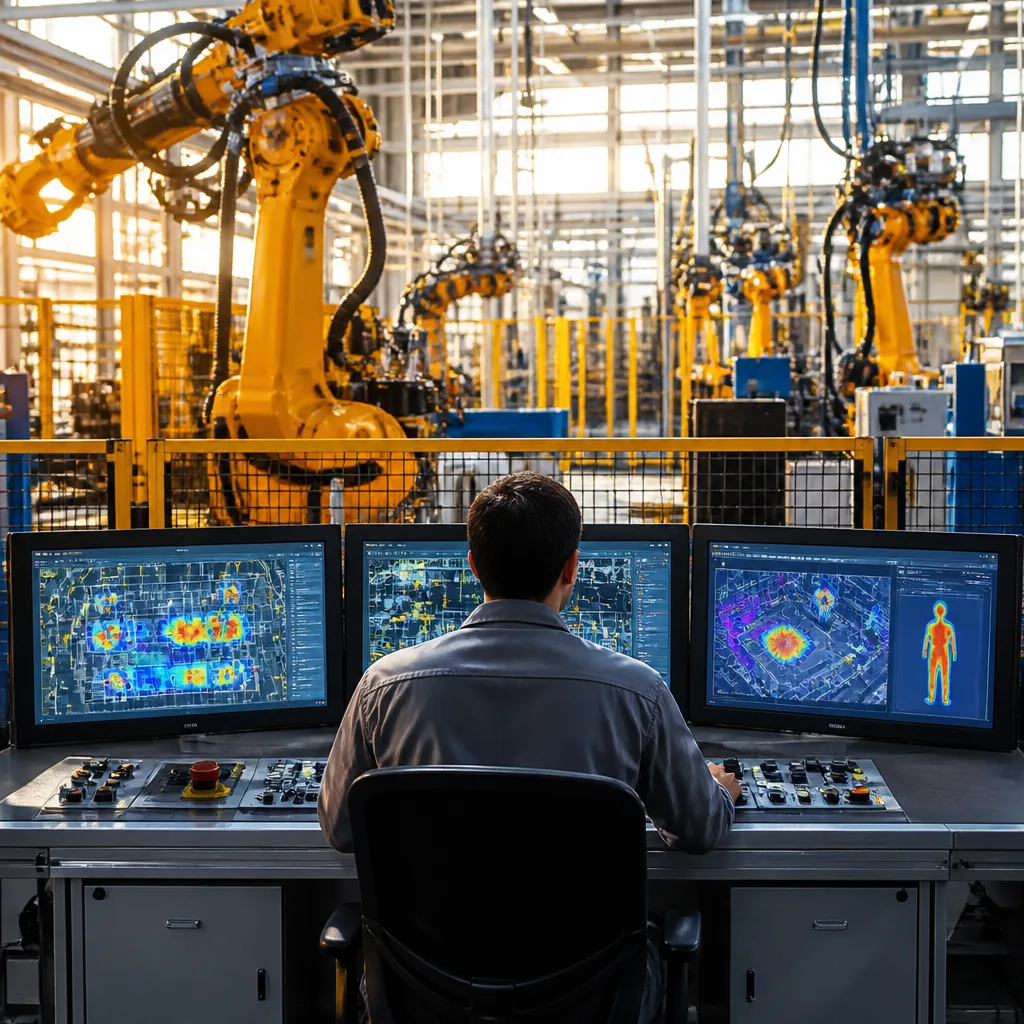
Seeing Machines Ltd., the computer vision firm known for in-cabin driver monitoring systems, has secured a development agreement to adapt its technology for industrial robotics, the company said Tuesday. The confidential deal with a major global industrial automation group will produce a proof-of-concept robotics application for factory settings, marking a push beyond the automotive sector that has been the company’s primary commercial focus.
Technology move targets human-robot interaction in factories
The project will build on Seeing Machines’ existing Perception Map software, which the company demonstrated earlier this year. Perception Map is designed to interpret human gaze, posture and likely behavior so machines can respond more safely and intuitively. That same underlying software is used in vehicles to monitor drivers’ eye and head movements and to detect distraction and fatigue.
"Human-Centred AI"
Paul McGlone, Seeing Machines’ chief executive, said the engagement illustrates how the company’s human factors expertise and artificial intelligence can be applied outside of cars. He framed the work as an effort to enable machines to anticipate risk and improve human-machine interaction in industrial environments.
Business implications and market timing
Seeing Machines has historically relied on automotive manufacturers installing its technology in new vehicle models, generating revenue tied to vehicle production and royalty schedules. By contrast, industrial robotics represents a market where demand is less dependent on automotive production timetables, potentially smoothing revenue cycles and accelerating opportunities for product deployment.
The company did not disclose the name of its customer, nor did it provide details on contract value or duration. The initial phase is explicitly scoped as a proof of concept, and the firm said it expects the work to form a foundation for additional collaborative developments in industrial automation and robotics.
What the deal signals for safety and automation
Integrating human-focused vision systems into factory robots could affect several areas of industrial operations:
- Enhanced worker safety: Tracking gaze and movement may help robots better anticipate when humans are at risk of entering hazardous areas or becoming distracted.
- Improved human-robot collaboration: Systems that interpret human intent can allow robots to adjust speed, position or behavior in shared workspaces.
- Expanded commercial pathways: Moving beyond automotive contracts may diversify revenue and reduce exposure to cyclical vehicle production schedules.
Seeing Machines’ Perception Map and its broader suite of solutions derive from the firm’s two decades of human factors research combined with AI model development. The company sells driver monitoring systems to meet regulatory and safety standards in Europe and elsewhere, where monitoring is increasingly mandated for new vehicles.
| Company | Listings |
|---|---|
| Seeing Machines Ltd. | AIM: SEE OTC: SEEMF FRA: M2Z |
Outlook and next steps
The immediate next step is delivery of the proof-of-concept robotics application for the customer’s factory automation environment. If successful, the engagement could lead to more extensive development and deployment across industrial automation projects, according to company statements. For investors and industry observers, the move will be watched as a test of whether driver-monitoring technology can be effectively repurposed for the broader safety and collaboration challenges posed by human-robot workspaces.
For now, details remain limited: the customer’s identity, financial terms and timeline were not released. The demonstration at CES earlier this year and this new contract together signal Seeing Machines’ intent to position its human-centric vision systems as a cross-industry platform rather than a product tied solely to the automotive lifecycle.















