
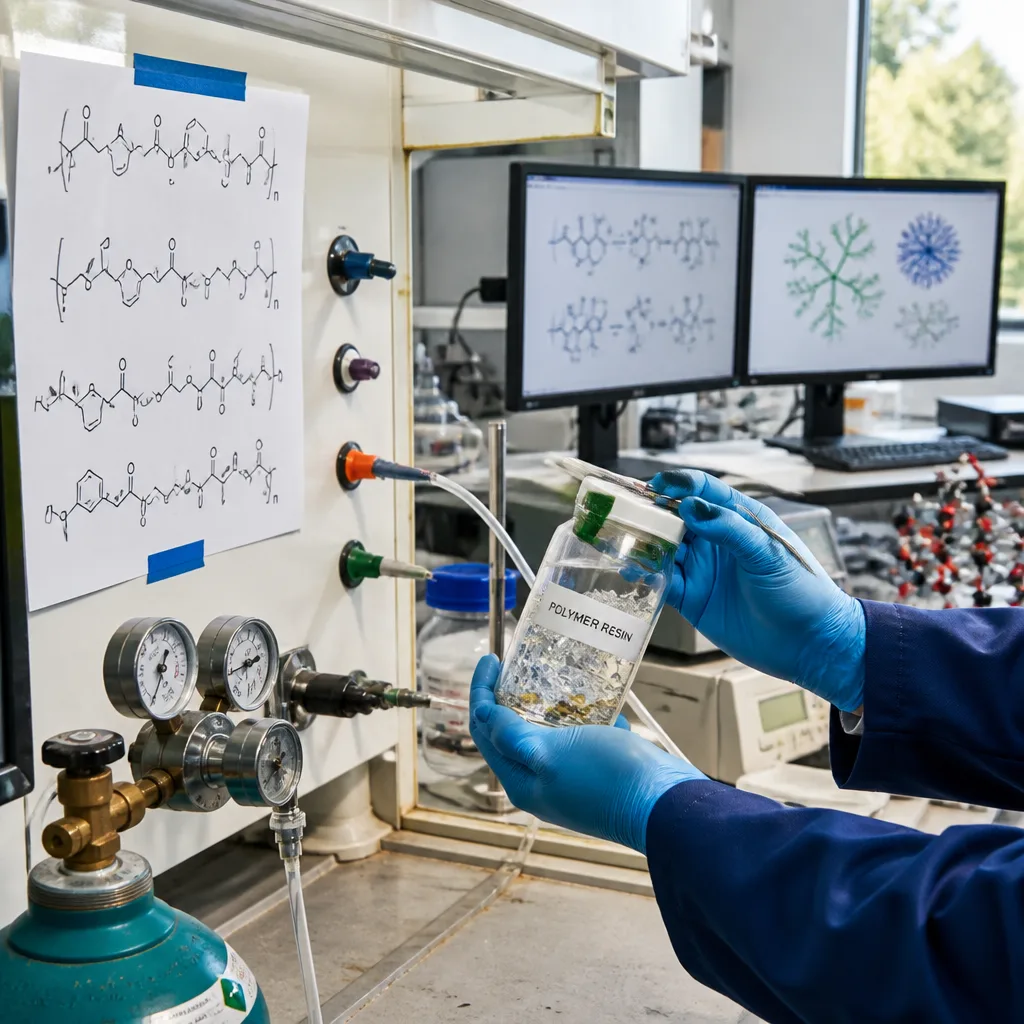
Scientists at Colorado State University have developed a laboratory method that transforms carbon dioxide into robust, recyclable plastics, offering a potential pathway to cut plastic waste while using an abundant, low‑cost carbon source.
New chemistry turns CO2 into reusable polymer building blocks
The team’s process combines carbon dioxide with a bicycloalkane molecule and an organic catalyst to produce synthetic polymers that researchers say exhibit high mechanical strength, elasticity and resistance to elevated temperatures and chemical exposure. A key design goal is recyclability: the materials are intended to be chemically recoverable so their fundamental building blocks can be reclaimed and reused at the end of their life.
The work is led by Colorado State professor Eugene Chen with postdoctoral researcher Min Zhu. The project involved scientists from Colorado State and Northwestern University and received funding from the National Science Foundation and the BOTTLE Consortium, a national initiative supported by the U.S. Department of Energy focused on new recycling and sustainable polymer technologies.
Potential advantages and context
Researchers emphasise several attributes that make carbon dioxide attractive as a raw material for polymer manufacture: it is widely available, inexpensive, odorless and non‑flammable. Those qualities, they say, make CO2 an appealing feedstock for creating materials that could displace some conventional plastics.
“There are existing processes utilizing carbon dioxide for polymer synthesis dating back to the 1960s. The challenge has been to maximize incorporation of inactive carbon dioxide into plastic products and produce the eco‑friendlier polyesters that are recyclable and deg”
The quote above reflects the historic difficulty of integrating large fractions of CO2 into durable polymer chains and producing materials that are both high performing and amenable to chemical recycling. The Colorado State team’s approach aims to address that challenge by using bicycloalkane partners and organic catalysis to incorporate CO2 more effectively into polymer backbones.
Funding and collaboration
Support for the research came from federal and consortium sources that prioritise sustainable materials and advanced recycling. The inclusion of the BOTTLE Consortium links the project to a broader U.S. Department of Energy effort to develop technologies that reduce plastic waste through chemical and biological recycling pathways.
| Item | Detail |
|---|---|
| Lead institution | Colorado State University |
| Key researchers | Eugene Chen; Min Zhu |
| Collaborator | Northwestern University |
| Funders | National Science Foundation; BOTTLE Consortium (DOE‑supported) |
| Feedstock | Carbon dioxide plus bicycloalkane |
Implications and limitations
If scalable, the technique could broaden options for producing polymers without relying exclusively on fossil‑derived monomers, while offering an end‑of‑life route through chemical recovery. That combination addresses two persistent industry challenges: finding lower‑carbon feedstocks and ensuring materials can be returned to productive use rather than landfilled or incinerated.
However, the report does not provide commercial readiness timelines, cost comparisons to incumbent plastics at scale, or lifecycle greenhouse gas analyses. Those metrics will be critical to assessing whether CO2‑derived polymers can compete economically and environmentally with existing materials when produced in industrial volumes.
The research sits amid a growing field of academic and government efforts to develop circular‑economy solutions for plastics. Federal backing through NSF and DOE‑linked programs signals continuing public investment in technologies that aim to reduce both plastic pollution and reliance on virgin petrochemical feedstocks.
- Recyclability: Materials are designed for chemical recovery of basic building blocks.
- Performance: Researchers report high strength, elasticity and thermal/chemical resistance.
- Support: Funded by NSF and the DOE‑supported BOTTLE Consortium.
Further research will need to demonstrate scale‑up feasibility, full environmental impacts and cost competitiveness before CO2‑based polymers can move from the lab into broad commercial use.
Ravi Malhotra covers technology for the national desk of WE NEWS.















