
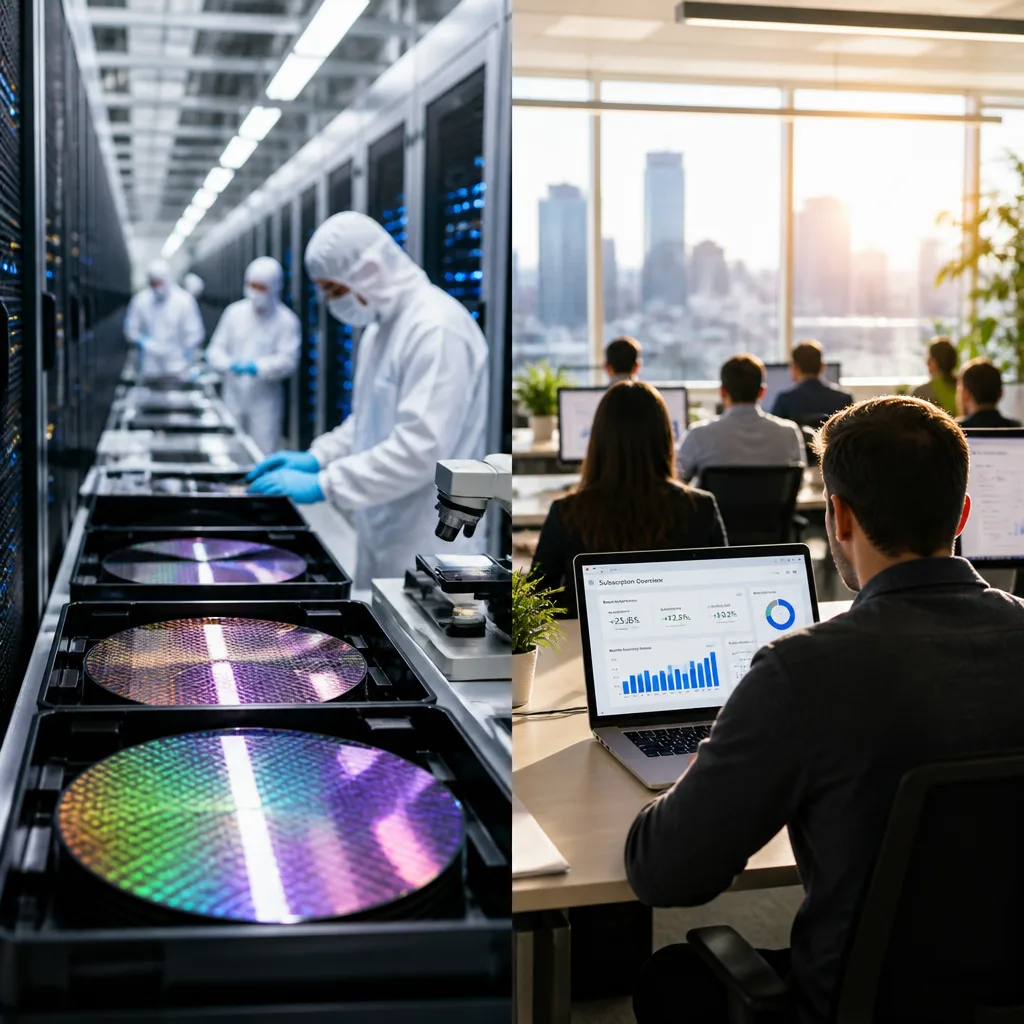
SK Hynix posted a dramatic rebound in fiscal 2025 as demand for high-performance memory surged alongside the growth of artificial intelligence infrastructure, while Monday.com continues to court organizations with a cloud-based work-management platform used by roughly 250,000 customers. Investors deciding where to place capital in the AI era face a fundamental question: favor the cyclical, volume-driven upside of semiconductor hardware or the steadier, subscription-backed returns of enterprise software.
Numbers underscore divergent business models
SK Hynix, a major supplier of DRAM and NAND flash memory that powers data centers and AI servers, reported fiscal 2025 revenue of $68.6 billion and net income of $30.3 billion, producing a net margin of 44.2%. The company ended the year with a conservative balance-sheet profile, a debt-to-equity ratio of 0.2x and a current ratio of 1.9x, and it generated $17.5 billion in free cash flow.
By contrast, Monday.com operates at the opposite end of the technology stack: a cloud software provider that offers tools for project management, customer relationship workflows and software development processes. The company lists about 250,000 customers worldwide and grows primarily through subscription sales rather than hardware cycles.
What the metrics mean for investors
The financial profile of SK Hynix highlights the leverage and scale possible for component suppliers when demand for AI-capable infrastructure accelerates. Large revenue swings are common in semiconductor markets, so strong profits and cash generation in a boom year can translate into significant capital returns, increased R&D and capacity additions — but also expose the company to inventory risk and end-market cyclicality when demand cools.
Monday.com’s subscription model implies predictable revenue streams and high customer retention if product-market fit remains strong. Enterprise software firms typically trade at premiums tied to recurring revenue and growth visibility, but they are sensitive to slowing customer acquisition, rising sales and marketing costs, and competition from larger cloud software vendors.
- SK Hynix: Large-scale exposure to AI infrastructure demand, strong 2025 profitability and cash flow, but cyclical market risk.
- Monday.com: Recurring subscription revenue and diverse workflow use cases across 250,000 customers, with steadier but potentially slower growth dynamics.
Broader consequences and context
The broader AI market amplifies both companies’ importance. Cloud providers and hyperscale data centers rely on high-density memory products to train and run generative AI models, placing semiconductor suppliers like SK Hynix at the center of capital equipment investments. If AI adoption continues to accelerate, memory demand could sustain elevated pricing and utilization, benefiting manufacturers in the near term.
Meanwhile, increasing adoption of AI and automation inside enterprises can boost the value of workflow platforms such as Monday.com, as companies seek to coordinate increasingly complex projects around data, machine learning initiatives and cross-functional teams. Software vendors that integrate AI features into collaboration and project-management tools may find new avenues for expansion without the same capital intensity of hardware producers.
Risk trade-offs for portfolio construction
Choosing between the two profiles depends on investor objectives and risk tolerance. Those seeking higher short- to medium-term upside tied to technology cycles might prefer exposure to semiconductor suppliers positioned to capture AI infrastructure spending. Investors prioritizing steady, predictable cash flows and enterprise stickiness may favor subscription software names.
Practical considerations include macroeconomic sensitivity, capital expenditure cycles, customer-concentration risks for hardware suppliers, and competitive dynamics and gross-margin sustainability for SaaS providers.
| Metric | SK Hynix (FY 2025) | Monday.com |
|---|---|---|
| Revenue | $68.6 billion | Subscription-based (customer count ~250,000) |
| Net income | $30.3 billion | Not disclosed in source |
| Free cash flow | $17.5 billion | Not disclosed in source |
Investors should weigh the cyclical amplitude of semiconductor demand against the predictability of SaaS revenue, and consider diversification across both hardware and software exposures to participate in different parts of the AI-driven technology stack.















