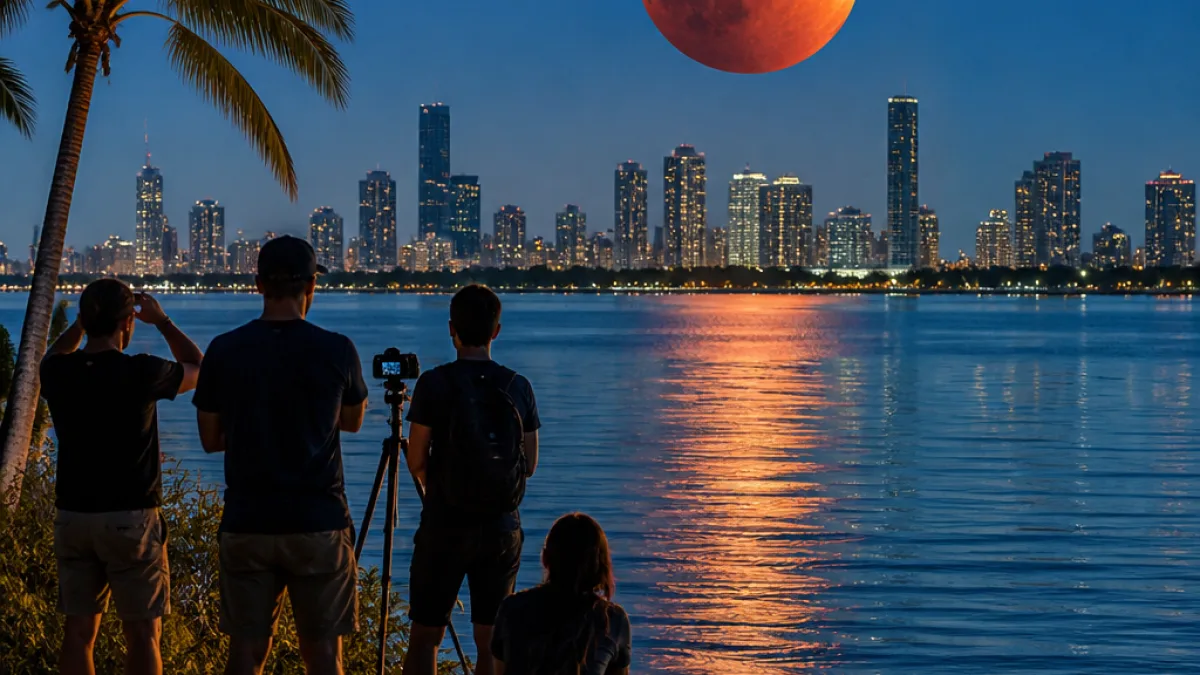
Residents across Florida should plan to head outside late on Aug. 27 and into the early morning of Aug. 28 to catch a striking partial lunar eclipse that will obscure nearly the entire lunar disk. The event will coincide with the full moon commonly called the Sturgeon Moon, delivering a deep shadowed appearance that can appear reddish where the Earth's atmosphere bends sunlight into the lunar surface.
How much of the moon will be covered
Observers in Florida will not see a total eclipse. Still, the Earth's umbral shadow will fall across roughly 93–94% of the moon's face for most locations, producing a dramatic sight as the lunar disc darkens and the shaded portion takes on a coppery tone. Exact coverage varies slightly by location inside the state and by local horizon conditions.
Best times to look: example schedule for Miami
Timing varies by city, but here are the key event moments for Miami, based on publicly available astronomical calculations. All times are Eastern:
| Stage | Time (ET) |
|---|---|
| Penumbral eclipse begins | 9:23 p.m., Aug. 27 |
| Partial eclipse begins | 10:33 p.m., Aug. 27 |
| Maximum eclipse | 12:12 a.m., Aug. 28 |
| Partial eclipse ends | 1:51 a.m., Aug. 28 |
| Penumbral eclipse ends | 3:01 a.m., Aug. 28 |
Where in Florida will have the best view
Most of the state should see the main phases of the eclipse, but coastal observers on the Atlantic side may have less time to view the entire event because the moon will sit lower near the horizon. Westward locations and inland areas with darker skies and minimal light pollution will generally offer clearer, longer views.
- Head away from bright city lights for the most dramatic contrast.
- Check the weather — clouds can obscure the eclipse entirely.
- No special eye protection is needed to watch a lunar eclipse; you can look at the moon safely with the naked eye.
What you'll actually see
During the partial phase, the dark region of the Earth's umbra will advance across the lunar surface, leaving a crescent of the illuminated moon visible while the rest grows progressively dusky. The shaded portion often appears reddish or copper-toned because Earth's atmosphere scatters shorter-wavelength light and bends longer-wavelength (red) light into the shadow. That same atmospheric filtering is why people sometimes call eclipsed moons "blood moons."
Practical tips for viewers and photographers
For casual viewing, no equipment is necessary; the eclipse will be plainly visible to the unaided eye. Binoculars will bring out surface detail and deepen the color contrast. Amateur photographers can capture good images with a camera on a tripod and a telephoto lens; longer exposures will be needed to record the darker portions of the moon. Because the event spans several hours, bring warm clothing if you plan to stay outside into the early morning.
Where to find updated local times
Exact start and end times differ slightly by town and county. Local astronomical societies, planetariums and sites that provide interactive sky charts can supply times specific to your exact location. Also verify conditions with local weather forecasts because cloud cover is the single biggest factor that could hinder viewing.
This late-August partial lunar eclipse offers Florida residents a chance to see an impressive celestial spectacle without needing special glasses or equipment. With clear skies and a bit of planning, many people across the state can watch most of the moon pass into Earth’s shadow and enjoy the Sturgeon Moon as it takes on a dramatic hue.