
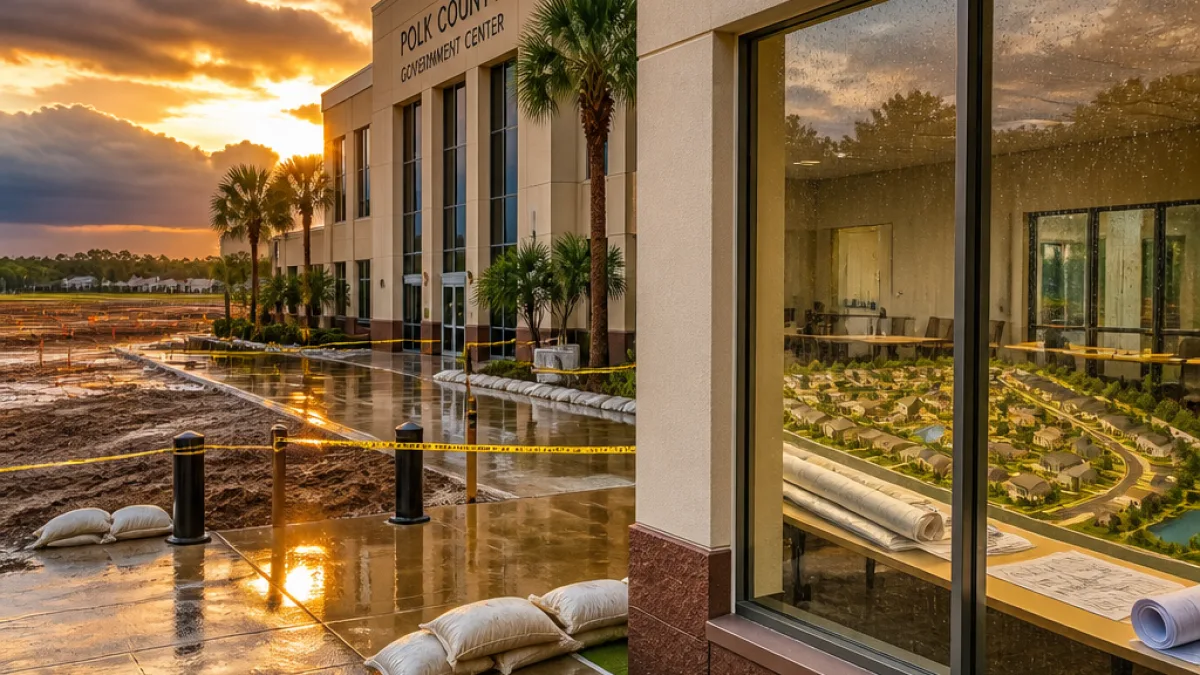
Florida lawmakers enacted a law last year that county officials and climate advocates say has significantly curtailed local governments’ ability to strengthen rules governing growth, stormwater management and other community protections. Local leaders say the measure, SB 180, is already complicating efforts to address flooding and other climate-driven concerns in fast-growing inland counties.
What the law does
SB 180, adopted in 2024 and retroactive to Oct. 1 of that year, bars localities from enacting regulations that are more "burdensome or restrictive" than existing state standards. The statute was framed by supporters as an emergency measure to streamline hurricane recovery. But its language reaches beyond short-term rebuilding, effectively freezing local rule changes during its effective period.
The law includes a built-in expiration: it is scheduled to lapse in 2027 — unless another qualifying natural disaster triggers a reset of the recovery period, extending the preemption once again.
Local officials report limits on adapting to risk
Polk County officials, who represent communities along Central Florida’s I-4 corridor, say the law has hamstrung efforts to update their comprehensive plan and building rules after severe flooding during Hurricane Milton in 2024. Some neighborhoods experienced prolonged inundation; in places it took weeks for standing water to recede.
Officials had hoped to consider stronger local standards, such as requiring larger stormwater retention ponds in new developments, after seeing the damage inland flooding can cause. Under SB 180, those kinds of additions could be prohibited because they would exceed state requirements.
That concern is amplified in Polk and other inland counties that are among the nation’s fastest-growing areas. Lower housing prices compared with larger metro markets have driven new construction and population growth, increasing the stakes for local planning decisions.
Advocates raise alarms about broader consequences
Beyond stormwater, critics warn that the statute constrains local governments in domains that touch public health, environmental justice and climate adaptation. Preemption laws like SB 180 transfer authority from local officials who interact daily with residents to state-level lawmakers, opponents say, limiting the ability to tailor rules to neighborhood needs.
"I see it as a freedom issue," said Raymer Maguire, director of campaigns and policy at the CLEO Institute, a Miami-based climate education and advocacy organization.
Maguire and others contend that as the Legislature continues to adopt preemption measures, municipalities and counties will be less able to respond to local conditions such as sea-level rise, flooding patterns and development pressures.
How the law operates in practice
Key features of SB 180 as reported by local officials include:
- Retroactivity: rules are frozen back to Oct. 1, 2024.
- Comparative standard: local regulations may not be "more burdensome or restrictive" than state rules.
- Sunset provision: the law is set to expire in 2027 unless a new disaster resets the recovery clock.
Local planners say the practical effect is a reluctance to propose stronger protections for fear of legal conflict or state intervention.
Which communities are affected
The law reaches beyond coastal counties. While Florida’s shoreline often attracts attention for hurricane and surge risks, inland counties such as Polk — historically known for citrus production but now a growth magnet — face their own vulnerabilities to intense rainfall and flooding. County leaders say housing demand and rapid development increase pressure to update standards tailored to local flood patterns.
| Issue | Local concern |
|---|---|
| Stormwater | Need for larger retention ponds to manage heavy rainfall |
| Growth management | Tools to shape development intensity and infrastructure capacity |
| Public health & environment | Restrictions on local protections tied to environmental justice and resilience |
Political and legal context
Preemption — when a higher level of government overrides a lower one — is not a new tool in Florida politics. But county officials and government-watch groups say the pace and scope of recent preemption laws have accelerated, raising concerns about diminished local authority. Supporters argue that statewide consistency can aid recovery and economic activity, while opponents say it can prevent communities from responding to unique local challenges.
As communities plan for future storms and continued population growth, the debate over SB 180 underscores a broader tension in Florida governance: who gets to set the rules for safety, growth and resilience — Tallahassee or the local governments on the front lines?
State and local leaders will confront that question in the months ahead as counties attempt to update comprehensive plans and as lawmakers consider further changes to the preemption framework.

















