
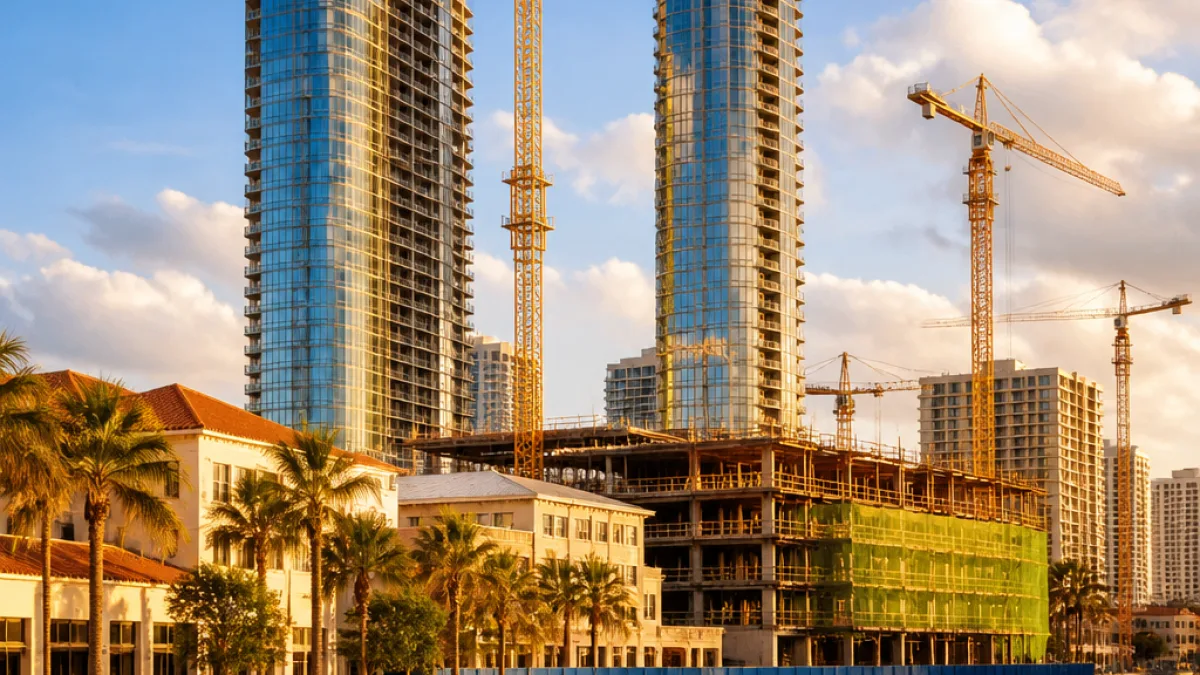
Fort Lauderdale is seeing a notable influx of New York developers and Wall Street financing as firms pursue large-scale condo, rental and mixed-use projects that together are transforming the downtown footprint.
New players, large footprint
According to reporting that tracks recent deals in the city, nearly half of Fort Lauderdale’s downtown development footprint — about 4.6 million square feet — is now tied to New York firms. That marks a big shift from activity in recent years: New York builders made up roughly 13% of completed projects between 2021 and 2024, and their presence has expanded sharply since then.
- 4.6 million sq. ft. tied to New York firms in downtown Fort Lauderdale
- New development includes luxury condos, rental towers and mixed-use projects
- Developers are marketing Fort Lauderdale as a less costly, less hectic alternative to Miami
Major projects and developers
Several prominent New York developers are among the entrants. Dependable Equities co-founders Isaac Schlesinger and Simon Dushinsky — known for luxury condos in Brooklyn — are pursuing three developments in the city. Their largest listed project, Ombelle at 300 Northeast Third Ave., is a two-tower development totaling 754 units, with completion expected around 2028. One tower was reported to be approximately 45% presold at the time of reporting.
Ombelle is also slated to include what would be Fort Lauderdale’s first Equinox fitness club, signaling a push toward higher-end amenities. Other New York-led efforts include more than 250 condos and a rental building in Flagler Village by developer Miki Naftali’s firm.
“For some people, Miami became too hectic, too busy, too noisy. So Fort Lauderdale is a fantastic city for those that just want one notch down,”
— Miki Naftali, on why buyers and renters might choose Fort Lauderdale over Miami.
What this means locally
Developers and brokers cite a narrowing price gap between Fort Lauderdale and Miami as part of the appeal. Market data cited in the reporting put the median sale price of a Fort Lauderdale home at roughly $70,000 less than Miami’s median, down from a gap near $120,000 a year earlier. That dynamic is driving demand for new, higher-end product that still undercuts Miami prices.
For residents, the wave of projects will have multiple local effects. New inventory could ease shortages in some segments of the housing market, but much of the reported development is luxury-oriented, which may not lower prices for entry-level buyers. Large mixed-use projects can bring retail, dining and gym options and generate construction and service-sector jobs, while also increasing traffic and altering neighborhood character.
Numbers at a glance
| Metric | Reported figure |
|---|---|
| Downtown development tied to New York firms | 4.6 million sq. ft. |
| Share of completed projects (2021–2024) from New York builders | ~13% |
| Ombelle units | 754 units |
| Ombelle presold (one tower) | ~45% |
| Median price gap vs. Miami | $70,000 (Fort Lauderdale lower) |
City planners, neighborhood groups and the business community will be watching construction timetables, zoning approvals and infrastructure needs as projects move forward. Larger developments commonly require traffic studies, public notices and, in some cases, city commission action — processes that provide residents opportunities to weigh in.
Local officials have promoted Fort Lauderdale’s walkable downtown, waterfront access and growing urban amenities as assets. Developers are now betting those qualities, combined with relatively lower prices, will draw buyers and renters seeking a middle ground between Miami and smaller South Florida cities.
As these projects rise, the shape of Fort Lauderdale’s urban core is likely to change substantially over the next several years, bringing new residents, services and economic activity — and raising questions about affordability, public infrastructure and neighborhood character that city leaders and residents will have to address together.
















