The Department of the Interior on Friday released a two-year operating plan for the Colorado River that requires significant reductions in water deliveries to the three lower-basin states, setting off a new phase in efforts to manage a shrinking river system as Lake Mead and Lake Powell sit at record low levels.
Mandatory reductions set for lower-basin states
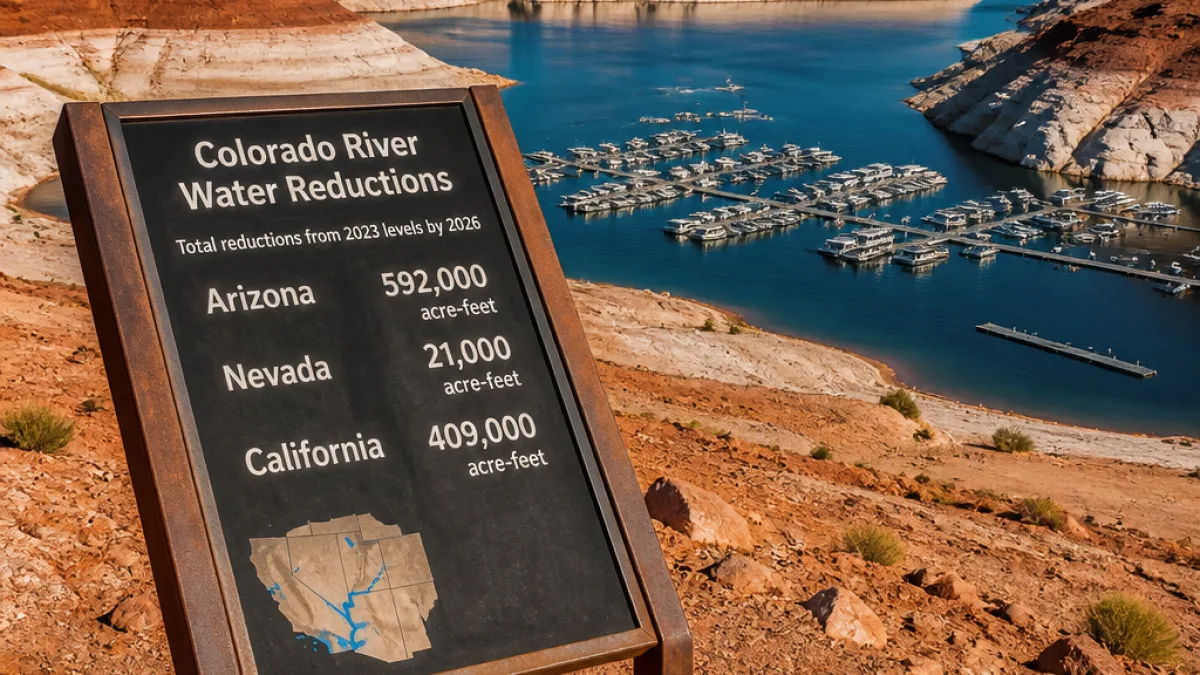
The plan spells out specific cuts for Arizona, California and Nevada for the period through 2028. Under the guidance, Arizona faces the largest curtailment at 760,000 acre-feet, California will see a cut of 440,000 acre-feet, and Nevada will take a reduction of 390,000 acre-feet — 50,000 acre-feet less than California’s reduction.
| State | Planned reduction (acre-feet) | Approx. percentage reduction* |
|---|---|---|
| Arizona | 760,000 | ~27% |
| California | 440,000 | ~10% |
| Nevada | 390,000 | ~16% |
*Percentage figures are those outlined by water-policy experts following the plan’s release.
Upper-basin states spared mandatory cuts for now
The two-year plan follows a broader 10-year operating framework the Bureau of Reclamation published in July, which established the process that would lead to these two-year reductions. That framework included a provision requiring adjustments every two years. For this first interval, the plan imposes no mandatory reductions on the upper-basin states — Utah, Colorado, Wyoming and New Mexico — even as reservoir elevations continue to decline.
Officials and experts respond
Sarah Porter, director of the Kyl Center for Water Policy at Arizona State University, described the scale of the reductions: she said the cuts equate to about a 27% reduction for Arizona, 10% for California and 16% for Nevada. Porter also noted that for many users in Arizona who receive Colorado River water, the effective reduction will be substantially larger.
“In Arizona, that means people who use Colorado River water are taking a 50% cut,”
Tom Buschatzke, director of the Arizona Department of Water Resources, told CNN the reductions reflect prior discussions among the lower-basin states and could have been worse. "It could have been draconian," he said. "I would like the reductions for Arizona to be zero but that’s not the reality we’re facing. It’s a pretty good outcome."
Why the cuts were deemed necessary
The Interior’s action comes amid a prolonged drought and sustained overuse that have driven the West’s two largest reservoirs to unprecedented lows. The declines present risks to both water deliveries and hydroelectric power generation that millions depend on. Interior officials and water managers have argued that mandatory reductions are now required to stabilize storage levels and limit the chance of catastrophic shortfalls.
What this means for Colorado and the region
Although Colorado is an upper-basin state and is not assigned mandatory reductions in this two-year cycle, the plan represents a shift in federal management of the river that could influence future allocations and negotiations. Reservoir levels and downstream deliveries are interconnected across the basin, and federal guidance that sets formal cuts for some states signals a willingness to impose additional constraints if basin storage continues to fall.
- Water managers will need to implement and enforce the new delivery reductions for lower-basin water districts and users.
- States and water providers will likely pursue additional temporary or voluntary conservation measures to meet obligations.
- Future two-year cycles could extend cuts or expand mandatory action to other states if reservoir levels do not improve.
Outlook and next steps
The plan covers deliveries through the end of 2028 and represents the first formal application of the two-year adjustment process. Federal and state officials will monitor reservoir storage, inflows and demand closely over the coming months to evaluate whether further reductions are needed. For now, the Interior’s decision places the immediate burden on Arizona, California and Nevada while leaving the upper basin unchanged — a development that could shape negotiations and water planning across the West in the years ahead.
As the West adjusts to the new operating rules, water users and public officials will be watching reservoir readings and federal guidance for signs of whether the unprecedented declines in Lake Mead and Lake Powell can be slowed or reversed.