
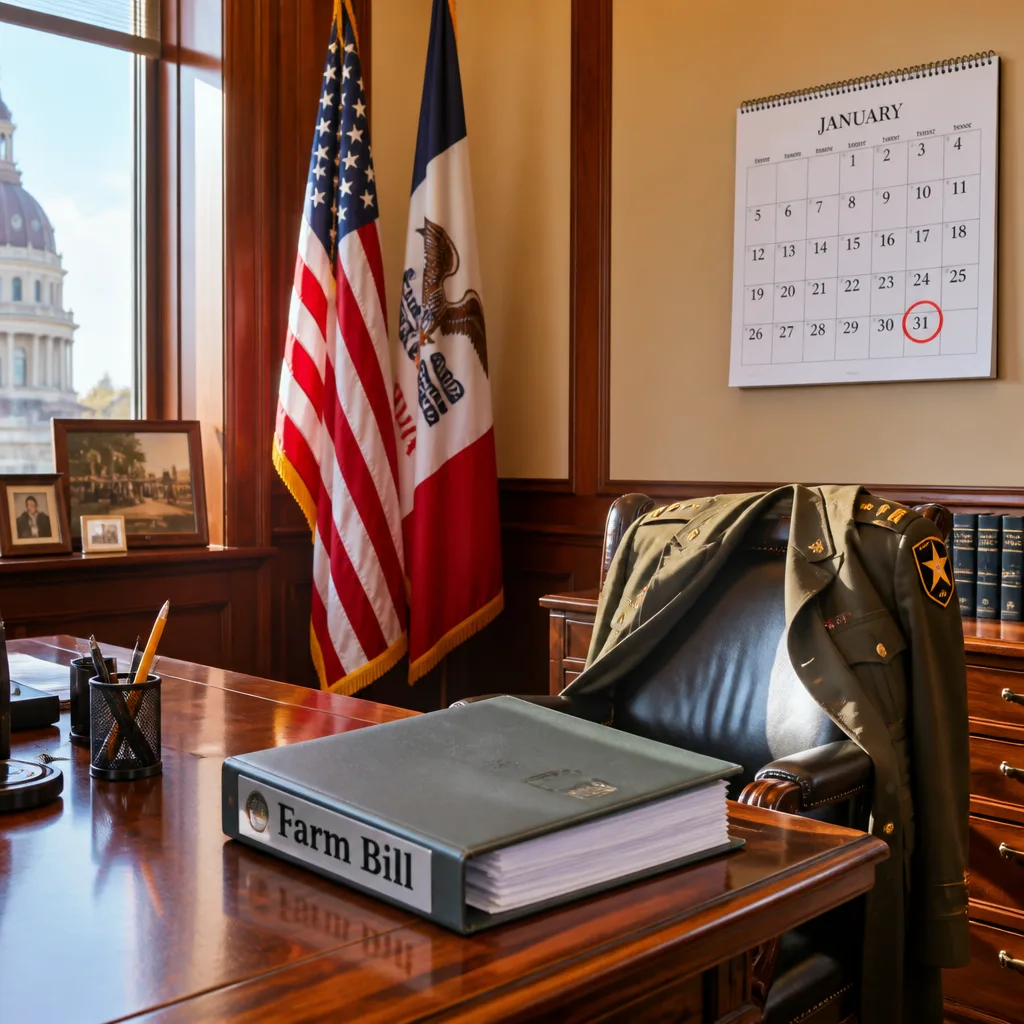
DES MOINES, Iowa — U.S. Sen. Joni Ernst said one of her top goals in the closing months of her second and final term is to secure passage of a long-delayed federal farm bill that she says is vital to Iowa agriculture and related businesses.
Farm bill remains unfinished
The comprehensive agriculture package, which historically has been renewed every five years, has not been reauthorized for nearly four years. The last full farm bill expired in 2023, and Congress has funded farm policy through a series of one-year extensions.
Ernst, a Republican who announced she would not seek a third term in line with a 2014 pledge to serve only two terms, said getting a new bill "reauthorized and over the finish line" is a "huge priority."
"We have not had it reauthorized in a number of years, and this is incredibly important to our Iowa farmers, every business out there that’s engaged in agriculture," Ernst said.
Negotiations hinge on nutrition and cost-sharing
Lawmakers have repeatedly clashed over major elements of the farm bill, notably how to fund nutrition programs that make up the largest portion of the legislation. Debates have centered on proposals that would shift some food assistance costs from the federal government to the states, and on how long any implementation delay should be.
- Nutrition programs remain the largest spending component of the farm bill.
- Proposals under discussion include moving a greater share of food assistance costs to states.
- Members of Congress are divided on whether to delay such changes and, if so, whether the delay should be one year or two years.
Those disputes have contributed to the multi-year stalemate and left farmers, nutrition providers and states operating under temporary fixes rather than the five-year certainty Congress typically provides.
Ernst’s other priorities: defense and military policy
Ernst identified military issues as her second major focus during the remainder of her Senate service. A former lieutenant colonel in the Iowa Army National Guard, she has worked on military sexual assault and harassment reforms and has pushed for timely passage of the National Defense Authorization Act, the annual bill that funds the armed services.
During her tenure, Ernst publicly disclosed that she was sexually harassed while serving in the Guard and has been an advocate for overhauling processes for investigating such claims. She said the NDAA remains a priority as the country confronts evolving security challenges.
Implications for Congress and Iowa
Ernst’s drive to complete a farm bill carries consequences on multiple levels. For Iowa—one of the nation’s leading agricultural states—failure to enact a multi-year bill would prolong uncertainty for crop insurance, commodity supports and the allied businesses that depend on predictable federal policy.
At the national level, the continued impasse keeps nutrition funding and food-assistance policy in flux and could force states and providers to prepare for a range of federal changes. The disagreement over cost-sharing and transition timelines illustrates how partisan and policy differences can slow a major, routine piece of legislation.
| Item | Detail |
|---|---|
| Last full farm bill | Expired in 2023 |
| Current funding approach | Annual one-year extensions |
| Congressional tradition | Five-year farm bill renewals |
As Ernst prepares to depart the Senate in January, her efforts to shepherd the farm bill and press defense priorities reflect the closing phase of a two-term career shaped by military service and agricultural policy. How negotiators resolve the nutrition dispute and other sticking points will determine whether she can claim those legislative wins before leaving office.