
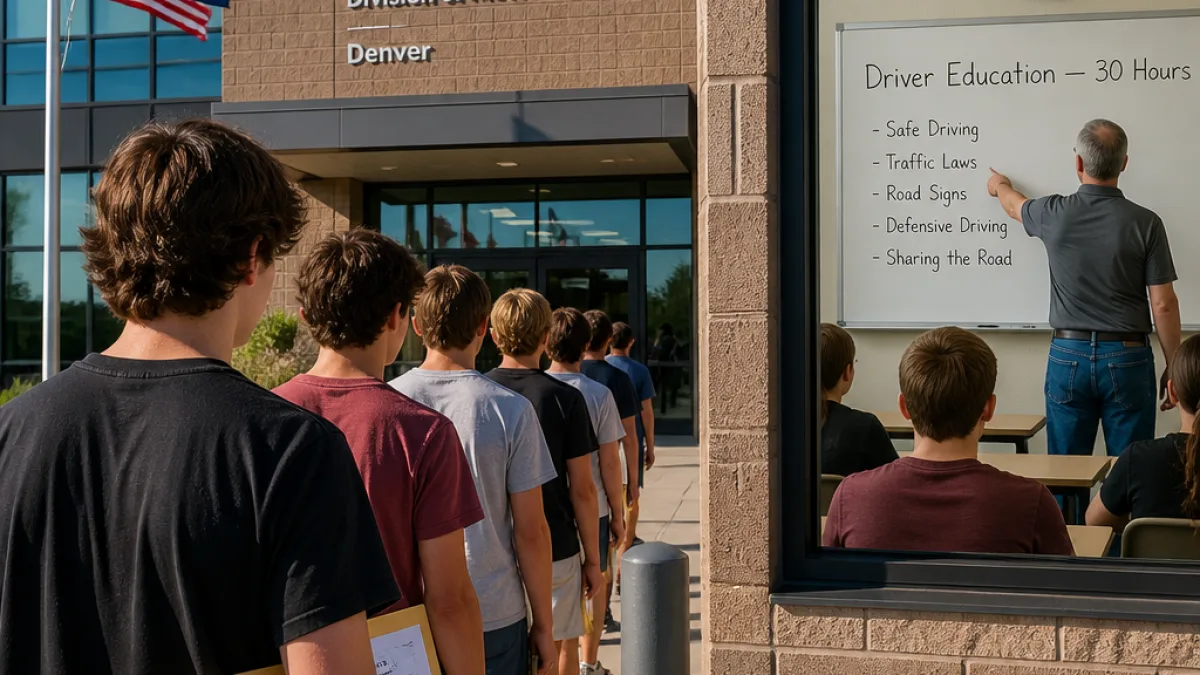
Colorado this week finalized changes to permit and driver education rules that will require most teenagers to complete a minimum of 30 hours of approved driver education before obtaining an instruction permit beginning Jan. 1, 2027.
What the law changes
The legislation, enacted as House Bill 24-1021, updates the Department of Revenue’s instruction-permit requirements. Under the new rules:
- Minors aged 15 to 17 must complete a 30-hour driver education course approved by the Department of Revenue; courses may include an online component.
- Applicants who are 18 or 19 years old must either complete the same 30-hour course or a shorter 4-hour prequalification driver awareness program approved by the department.
- Minors under 21 seeking a motorcycle instruction permit must complete a motorcycle safety instruction program approved by the Colorado State Patrol.
Who may supervise permit driving
The law also clarifies who is authorized to supervise a minor learning to drive under a permit. The following people are eligible to act as a permit supervisor, provided they hold a valid Colorado driver’s license:
- The minor’s parent or stepparent
- The minor’s grandparent who holds power of attorney
- An individual age 21 or older who signed the affidavit of liability
- The minor’s foster parent who signed the affidavit of liability
- An approved driver education instructor
- An alternate permit supervisor age 21 or older appointed by the person who signed the affidavit
- If the minor is a foster child, an individual authorized to supervise the foster child
Temporary licenses and administrative details
The act authorizes the Department of Revenue to issue a temporary driver’s license or temporary minor driver’s license. A temporary license will be valid for up to one year unless the department extends it. The temporary license becomes invalid immediately when the holder is issued a permanent license or if a permanent license is refused for good cause.
| Age | Requirement before permit |
|---|---|
| 15–17 | Complete a 30-hour Department of Revenue–approved driver education course |
| 18–19 | Either complete a 30-hour course or a 4-hour prequalification driver awareness program |
| Under 21 (motorcycle) | Complete a Colorado State Patrol–approved motorcycle safety instruction program |
Local training providers prepare
Driving schools across the state, including private providers in the Denver-metro area such as the Affordable Driving School in Parker, have already begun adjusting schedules and curricula to meet the new 30-hour requirement. Course offerings are expected to include blended formats using classroom, in-person behind-the-wheel and approved online materials.
Instructors say the longer, standardized instruction period is intended to give new drivers more time to learn rules, hazard perception and behind-the-wheel skills before solo driving. School officials and the Department of Revenue will provide guidance on approved curricula and instructor qualifications in the months ahead.
Why it matters
The law reflects growing attention at the state level to teen driving safety. Requiring more structured instructional hours aims to ensure that new drivers receive both classroom education and practical training on traffic laws, defensive driving, and situational awareness.
For families, the change creates a planning consideration: teens and their guardians will need to schedule and complete the required hours before applying for an instruction permit after Jan. 1, 2027. The temporary license option gives some administrative flexibility, but it does not replace the training requirement.
Parents and guardians should confirm that programs are approved by the Department of Revenue before enrollment. Additional procedural details, including the list of approved courses and instructors, will be posted by the department as the effective date approaches.
The new mandate represents a statewide policy shift intended to standardize early driver education and, officials say, to reduce crashes involving novice drivers by better preparing them for real-world driving conditions.















