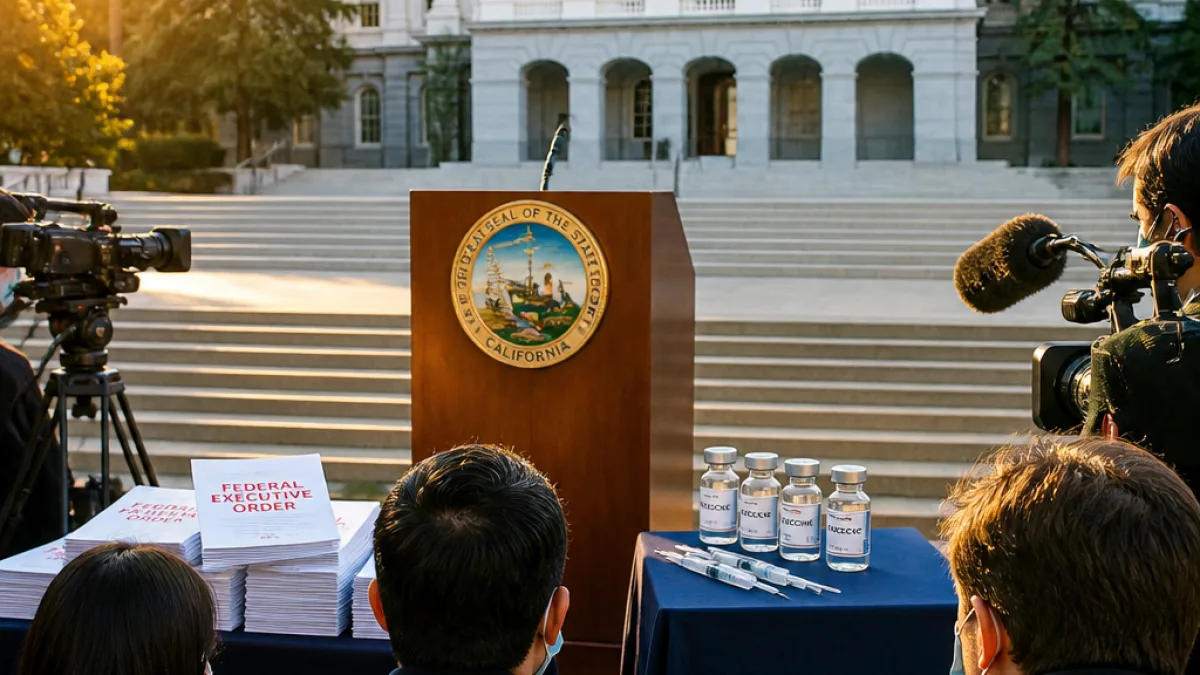
California public health officials announced they will not adopt the Trump administration’s new federal guidance aimed at overhauling childhood vaccinations, saying the state will instead rely on established pediatric guidance and regional public-health partnerships.
State rejects federal shift on routine immunizations
The executive order issued this week directs federal agencies to pursue changes that include reducing the number of vaccine-preventable diseases children are routinely immunized against and separating the combined measles, mumps and rubella vaccine — commonly given as the single MMR shot — into three separate injections. National pediatric groups quickly criticized the policy.
"There is no new evidence to justify significant changes to childhood immunization guidance," said Dr. Andrew D. Racine, president of the American Academy of Pediatrics. "Dozens of studies involving millions of people show there is no link between vaccines and autism, and yet federal leaders continue to promote this outdated, disproven idea to scare families. Today's executive order will do nothing to support families of children with autism or advance understanding of the condition."
In response, the California Department of Public Health said it will no longer rely on federal guidance for routine vaccines and will continue to follow the American Academy of Pediatrics' recommendations. Grant Boyken, a CDPH spokesperson, emphasized the state’s commitment to science-based policy.
"The recent federal executive order does not change California's current immunization recommendations or school and child care vaccination requirements," Boyken said in a statement. He added that the department is continuing to follow AAP guidance as part of the West Coast Health Alliance, "ensuring the most current science-based safety and benefits of immunization."
What the federal order would change
According to reporting from AAP News cited by public-health officials, the federal directive would reduce the number of diseases covered by routine childhood immunizations from 18 to 11 and would authorize breaking the MMR vaccine into three separate shots rather than the single combination dose currently used in the United States.
- Decrease in routine vaccine-protected diseases: from 18 to 11, per AAP News.
- Proposal to split the MMR combination into three individual injections.
- Federal administration framing the order as an overhaul of childhood vaccine guidance.
California’s alignment with pediatric and regional partners
California has signaled it will rely on pediatric expertise and a regional coalition to guide immunization policy. The state is part of the West Coast Health Alliance, a collaboration with several neighboring states established to coordinate public-health recommendations and align them with current medical research, the CDPH statement said.
Public-health officials and pediatric groups argue that decades of research support the safety and efficacy of current childhood vaccination schedules. The American Academy of Pediatrics described the executive order as "dangerous," saying it risks undermining public confidence in vaccines and will not advance understanding or support for families affected by autism.
Local implications and what parents should know
For California families, the immediate consequence is clarity: current state immunization recommendations and school and child-care vaccination requirements remain in effect, CDPH said. Parents and guardians seeking guidance should consult their child's health care provider or the American Academy of Pediatrics for the most up-to-date, science-based vaccine schedules.
Public-health officials note that changing routine immunization strategies can have broad effects on disease control, school attendance rules and provider supply chains. Any move to separate combination vaccines into multiple injections could require additional clinic visits and vaccine doses, a logistical concern for pediatric practices and public clinics.
| Authority | Position |
|---|---|
| Federal executive order | Directs reduction of routine vaccine protections and splitting MMR |
| California Department of Public Health | Will ignore federal guidance; continue following AAP and West Coast Health Alliance |
| American Academy of Pediatrics | Strongly opposes changes; calls order "dangerous" and lacking new evidence |
Health officials in California say their top priority remains protecting children and communities from vaccine-preventable diseases using guidance grounded in peer-reviewed research and national pediatric expertise.
Further developments are likely as federal and state agencies respond publicly; families should monitor communications from CDPH, local health departments and pediatric providers for any operational changes affecting vaccines at clinics and in schools.
(Reporting from Sacramento.)