
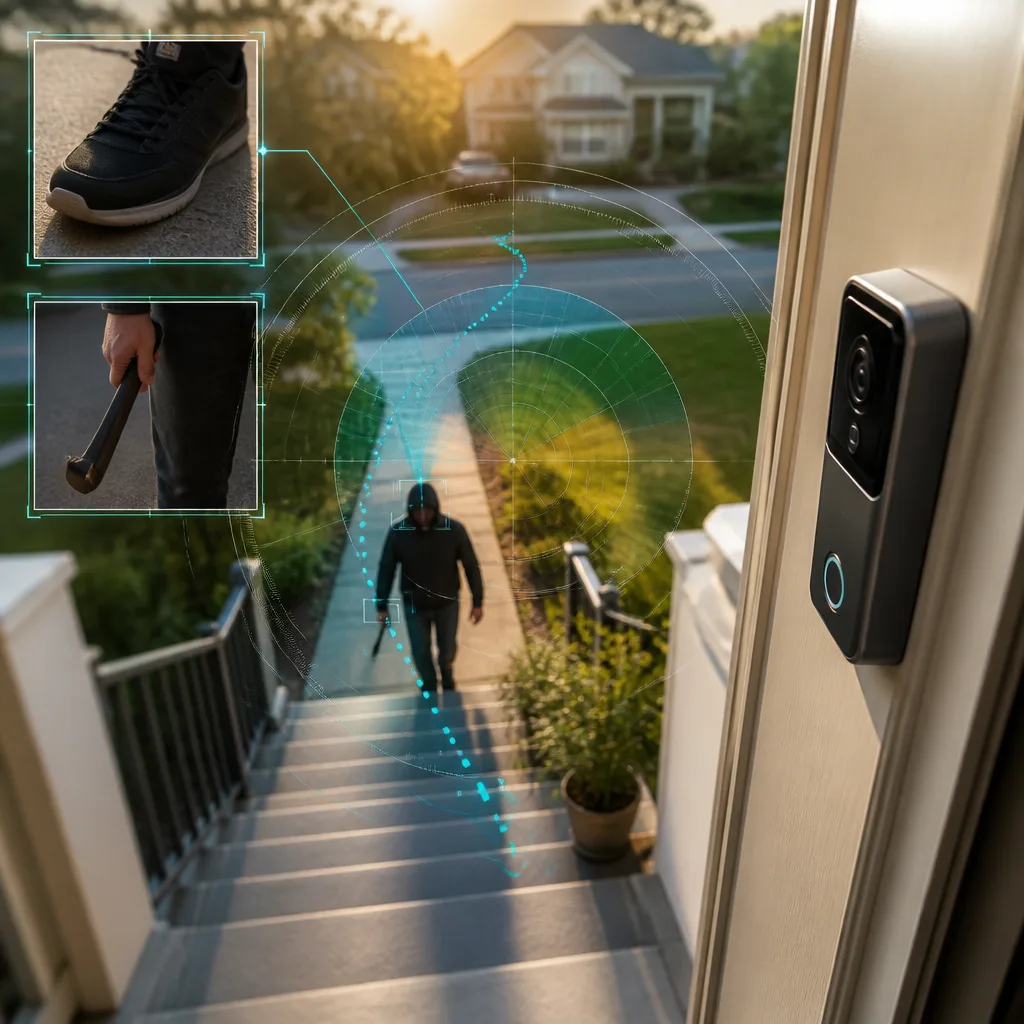
Consumer doorbell systems are evolving into sophisticated surveillance platforms that combine radar motion tracking, high-resolution imaging and artificial intelligence to detect and describe people and objects outside homes, according to recent reporting. The features — once confined to specialized security installations — are being marketed for domestic use, raising questions about privacy, normalisation of biometric monitoring and the contrast between private and public-sector access to similar technology.
What the devices can do
New models add hardware and software capabilities that go beyond recording a visitor walking up a porch. Among the functions discussed in reporting are:
- Radar-based motion tracking that produces a trace of a person’s movement laid over an aerial view.
- 4K camera hardware that improves detail and zoom, along with enhanced mixed-light performance for low-light scenes.
- AI-powered features that generate contemporaneous audio descriptions of events — for example, identifying a vehicle or a person with a child — and group related detections into single notifications.
- Remote biometric capabilities that include facial recognition-style identification and the ability to read vehicle license plates at close range.
“The [Pro] has radar-based motion tracking, which gives you a trace of a person’s movement overlaid on an aerial view. The 4K camera significantly improves fine detail and the zoom, but it is the lower mixed-light performance that is night and day better than previous models.”
Manufacturers are also offering features that allow users to program notifications — including excluding specific individuals — and to flag “unusual events” such as a car driving past or a person holding a child. Some devices include infra-red modes to detect movement in poorly lit streets.
Normalisation and social consequences
Observers describe this product evolution as part of a wider trend: the normalisation of ambient biometric surveillance. Technologies that once required significant infrastructure are now easily installed and integrated into home automation systems. That creates a divergence in everyday exposure to surveillance where private homes may possess more advanced monitoring capabilities than some public institutions.
The reporting highlights a paradox: households can equip their doorsteps with tools capable of continuous monitoring and automated description, while some public policing contexts lack comparable capabilities. That disparity raises questions about who controls data flows, how identifications are made and whether private surveillance will increasingly supplement or substitute for government monitoring.
Practical considerations for users and communities
Adoption of these devices brings practical trade-offs. On one hand, detailed detection and recording can deter trespassing and help homeowners document incidents. On the other hand, the presence of automated recognition and the potential to identify pedestrians and vehicles could affect neighbors, passersby and public life in ways that are difficult to foresee or manage through existing norms.
Key considerations for communities and consumers include:
- How long recordings and derived metadata are retained and who can access them.
- Whether and how devices share alerts, imagery or identification data with third-party services or law enforcement.
- Potential biases or errors in AI descriptions that could misidentify people, objects or activities.
| Feature | Intended Benefit | Potential Concern |
|---|---|---|
| Radar motion tracking | Precise movement detection | Persistent monitoring of public sidewalks |
| AI audio descriptions | Quick situational awareness | Automated labeling of private activity |
| License plate reading | Vehicle identification for security | Tracking of drivers and visitors |
The net effect is a shift in where and how biometric surveillance is deployed. As these features become more mainstream, they will likely influence debates over privacy protections, data governance and acceptable public behavior — conversations that are becoming increasingly urgent as powerful sensors move from specialized settings into everyday homes.
For policymakers, technologists and citizens, the immediate challenge is to reconcile consumer demand for security with the broader societal implications of ubiquitous, automated monitoring. The current trajectory suggests that households will continue to acquire more capable surveillance tools, whether or not public institutions match those capabilities.
That divergence — between private deployment of advanced monitoring and the capacities available in public settings — is a central theme of the reporting and a key factor shaping how communities experience safety, privacy and accountability in the years ahead.















