
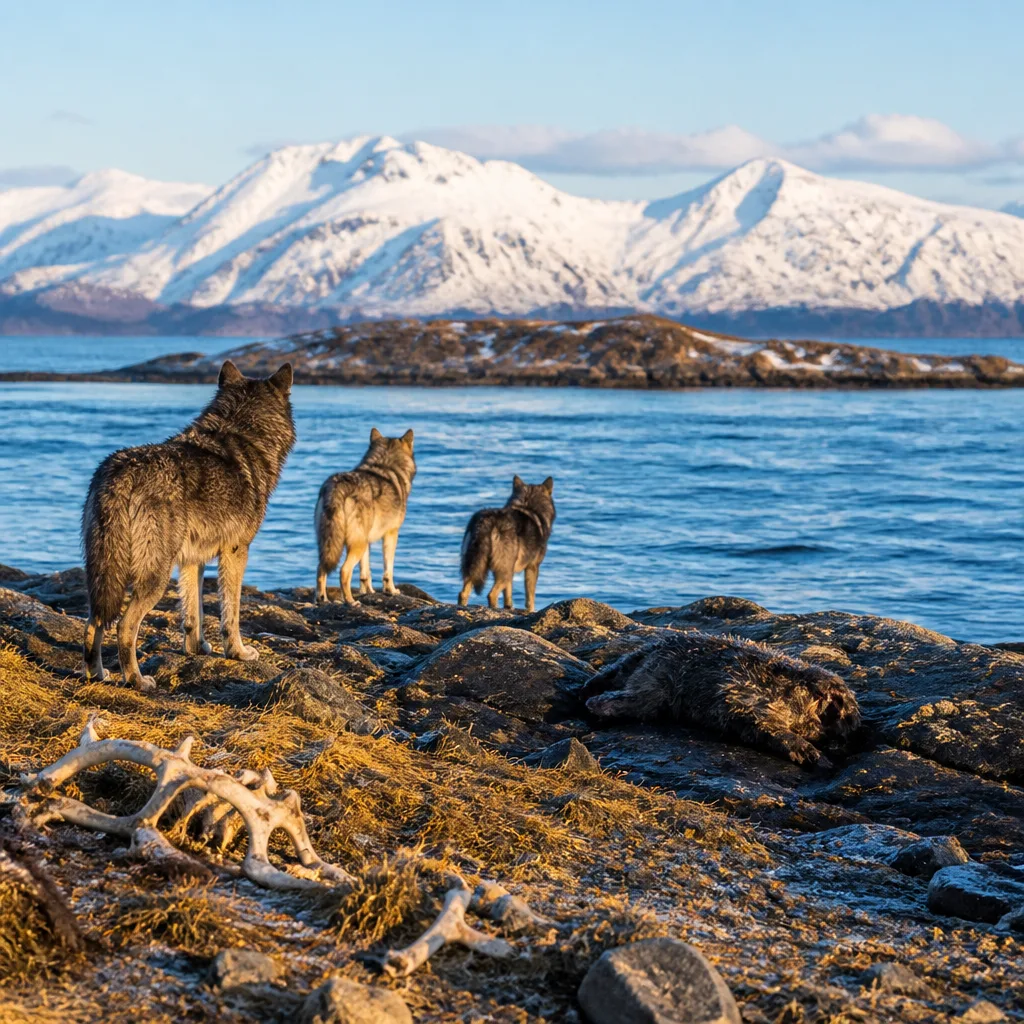
Wolves that colonised a small Alaskan island in 2013 drastically reduced the resident deer population and, rather than abandoning the site, altered their feeding behaviour to exploit marine mammals — notably sea otters — researchers report. The finding documents an unusual cross-ecosystem shift in which a terrestrial apex predator consumes another top predator from the near-shore environment.
Natural experiment on Pleasant Island
Pleasant Island, a frigid, uninhabited landmass of about 20 square miles separated from the mainland by roughly 1.5 kilometres of water, presented scientists with an unexpected natural experiment when wolves established themselves there in 2013. The island previously supported a substantial deer population, estimated at roughly 120–200 animals before the wolves’ arrival.
Field biologists from the Alaska Department of Fish and Game and collaborating universities set out to document predator–prey dynamics and the consequences for both species. Early results were stark: sustained predation after colonisation corresponded with a dramatic collapse of the deer population, which researchers concluded had effectively disappeared from the island.
Dietary shift documented with GPS collars and scat analysis
To establish what wolves were eating, researchers combined GPS collar tracking with conventional diet analysis of wolf scats. In 2015, deer constituted the dominant component of wolf diets — representing about 75% of dietary items identified. By 2017 the wolves’ diets had changed substantially; the animals remained on the island and began consuming an increasing proportion of marine-derived prey, including sea otters.
“This provided a great opportunity to study predator–prey dynamics of wolves and deer,” said Gretchen Roffler, a wildlife research biologist with the Alaska Department of Fish and Game.
Researchers emphasise that the switch is ecologically notable because both wolves and sea otters are high-level predators in their respective domains. As Taal Levi, an associate professor involved in the work, observed, the situation represents a top predator feeding on another top predator — a relatively rare interaction that blurs the boundary between terrestrial and marine food webs.
Consequences and conservation context
The dietary flexibility shown by the wolves has several implications. First, it challenges simple predictions that terrestrial predators will abandon islands where their primary prey has been exhausted. Second, it highlights how cross-ecosystem resource use can stabilise predator populations even after local extirpation of a principal prey species.
The study also intersects with broader management debates. The Alexander Archipelago wolf and related subspecies have been the subject of conservation petitions in the United States; in August 2023 the U.S. Fish and Wildlife Service decided that listing the subspecies under the Endangered Species Act was not warranted. Understanding how wolves use alternative food sources is therefore relevant to assessments of population resilience and potential human impacts.
Finally, the wolves’ consumption of sea otters raises questions about how predator additions or redistributions can cascade through ecosystems, affecting species that were not originally considered part of the terrestrial predator’s diet. Sea otters themselves are key near-shore predators whose presence or absence can structure kelp forest ecosystems and other marine communities.
Key takeaways from the study
- Wolves colonised Pleasant Island in 2013, and soon after deer numbers collapsed.
- Diet analysis showed deer made up approximately 75% of wolf diet in 2015; by 2017 wolves had shifted substantially to marine prey, including sea otters.
- The shift demonstrates rare cross-ecosystem predation, with implications for conservation and ecosystem management.
Although the long-term trajectory of the island’s communities remains to be tracked, the case of Pleasant Island underscores the capacity of large carnivores to adapt their foraging strategies in response to local prey depletion. For managers and ecologists, the episode is a reminder that predator additions or recoveries can produce unexpected interactions, sometimes traversing the land–sea boundary.
| Year | Primary dietary source (wolves) |
|---|---|
| 2015 | Deer (~75%) |
| 2017 | Marked shift to marine prey, including sea otters |









