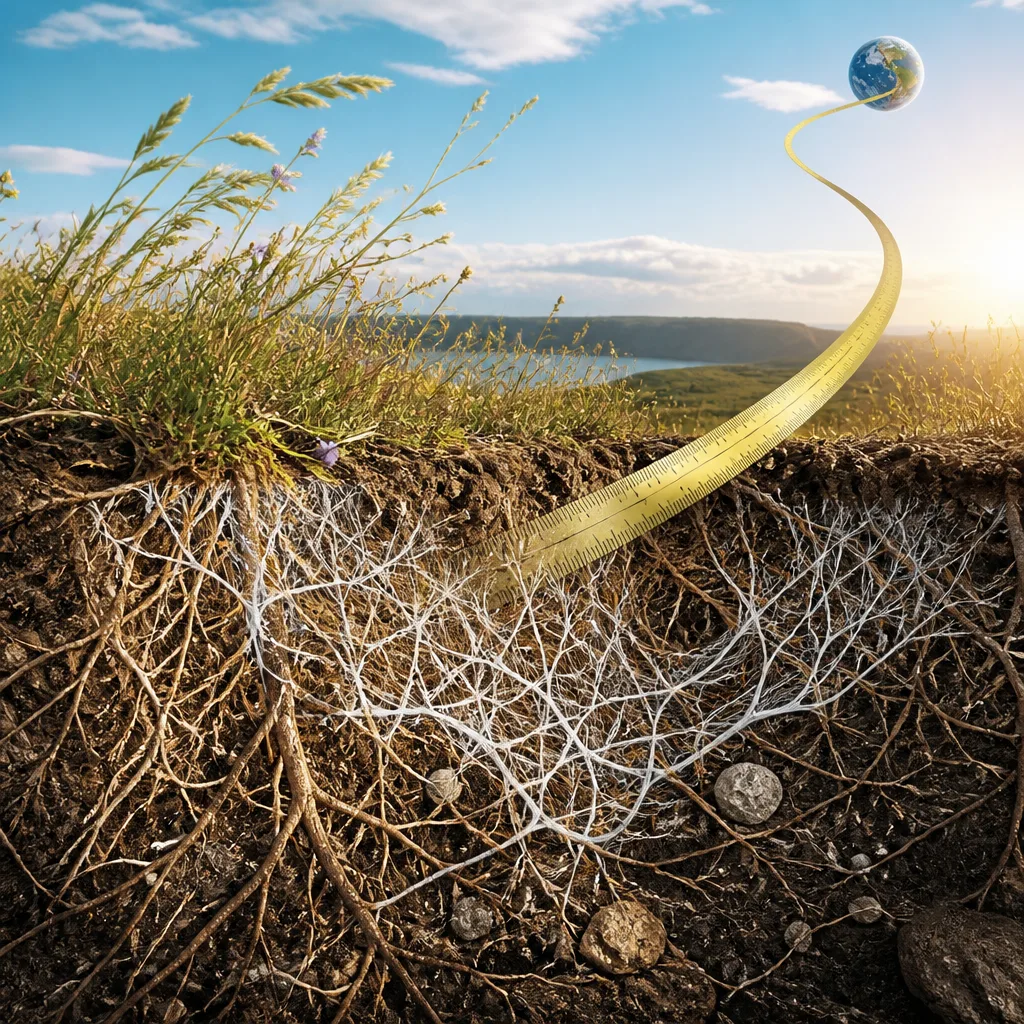
A global team of scientists has produced the first large‑scale estimate of the total extent of arbuscular mycorrhizal (AM) fungal networks in the planet’s topsoil, concluding that the combined length of these filamentous structures amounts to roughly 621 trillion miles. Using previously published measurements and a machine‑learning model, the authors say the length is so vast it would reach the distance to Pluto and back tens of thousands of times if laid end to end.
How the estimate was produced
The researchers compiled a global database of AM fungal density and biomass drawn from high‑resolution imaging and fieldwork published in earlier studies. Those point measurements were then scaled up with a machine‑learning approach to produce spatially explicit estimates across the world’s topsoil. The result is a headline number designed to convey the enormity of subterranean fungal networks that have co‑evolved with plants for some 475 million years.
The study emphasises that AM fungi form symbiotic partnerships with plant roots, exchanging soil nutrients for carbon produced by photosynthesis. Because these fungi produce extensive hyphal networks rather than large visible fruiting bodies, their presence is easy to miss despite their functional importance to ecosystems.
Put in planetary context
To help readers grasp the scale, the authors compared the combined fungal length to familiar astronomical distances. The estimated 621 trillion miles of hyphae equates to a line that would span the sun–Pluto distance — about 3.6 billion miles — roughly 172,500 times.
| Measure | Distance |
|---|---|
| Combined AM fungal networks (estimated) | 621 trillion miles |
| Sun to Pluto (approx.) | 3.6 billion miles |
| Equivalent number of sun–Pluto spans | ~172,500 |
Why it matters
The finding is not merely a curiosity of scale. AM fungi play a central role in plant nutrition and soil ecology: their hyphae extend the functional reach of plant roots, mobilise phosphorus and other minerals, and link plants chemically and physically to the wider soil environment. By providing a quantitative estimate of the networks’ spatial extent, the study supplies a framework for assessing how much biological activity and carbon exchange might be mediated underground.
There are wider conversations in the literature about whether non‑animal organisms such as fungi exhibit behaviours that resemble intelligence or problem‑solving. Some researchers interpret coordinated fungal responses to environmental changes as evidence of complex information processing. The new global scale estimate has renewed interest in those debates because it highlights how pervasive and interconnected fungal structures are across landscapes.
- Scale: The AM hyphal network is estimated at 621 trillion miles in the topsoil.
- Method: A global dataset of density/biomass combined with machine‑learning upscaling.
- Implications: Relevance for plant nutrition, soil carbon cycling and hypotheses about fungal cognition.
It is important to stress the inherent uncertainties in such an exercise. Any large‑scale extrapolation depends on the representativeness of input data and the assumptions built into the machine‑learning model. Local variation in soil type, climate, land use and sampling methods will all affect estimates of fungal biomass and hyphal length. The authors present the figure as a best‑effort synthesis, not a precise measurement.
For policy and research, the value of this work lies in setting a quantitative baseline. If AM networks are as pervasive as the estimate suggests, then understanding their role in sequestering carbon, supporting plant communities and mediating soil resilience becomes even more urgent. The study provides a target for more detailed regional sampling, validation with independent methods and experiments to determine how much ecological function is tied to network structure.
Whatever the final numbers prove to be after further scrutiny, the paper succeeds in one crucial task: it forces us to look beneath our feet and recognise that a hugely extensive, mostly invisible biological infrastructure is supporting life aboveground. That subterranean web may be less alien than it sounds, but its scale and significance are only just being measured.