
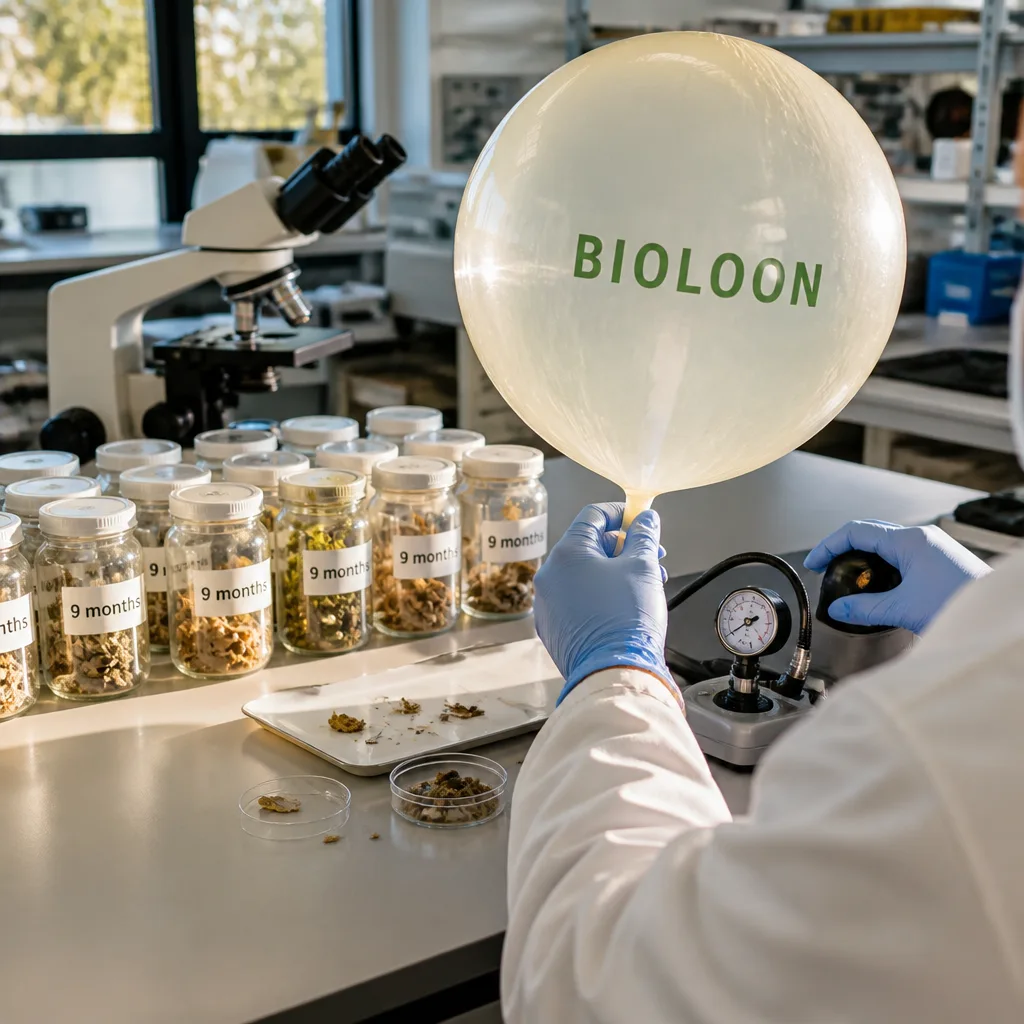
Scientists at Imperial College London have developed what they describe as the world's first fully biodegradable party balloon, saying the new product could significantly reduce the threat balloon litter poses to marine wildlife.
Innovation driven by concern over wildlife and litter
The balloon, named Bioloon, was developed as part of research that received partial funding from a commercial party planner concerned about the environmental impact of decorative balloons. Researchers say the new design will biodegrade within nine months and is no more expensive than a standard balloon. They also report it is easier to inflate.
Conventional balloons are, according to the research team, treated with chemical processes to make them strong and elastic. Those treatments, the researchers say, prevent full degradation and can allow toxic chemicals to leach into the environment as the material fragments.
"For our balloon, however, we use a process that joins the biodegradable materials together without any additives, so it's able to break down fully."
The work was led in part by Juliana Cumming, a 29-year-old PhD researcher at Imperial, who explained the team used a different joining method that avoids the additives responsible for preventing breakdown in traditional balloons.
Wildlife risk and campaign context
Campaigners and conservation scientists have been warning about the risk posed to seabirds and other marine animals by balloon debris. The research group cited a recent study that found balloon fragments are the form of marine debris most likely to cause fatality in seabirds, with birds ingesting balloon fragments reportedly 32 times more likely to die than those that ingest hard plastic.
High-end party planner Charlotte Melia, who partly funded the research, told the team that widespread use of elaborate "balloon arches" and similar decorations — often popularised by influencers and celebrity events — had caused her to question the environmental cost of those trends. She described seeing thousands of popped balloons after an event as the spur to back the project.
- Biodegradation: Bioloon — nine months; standard balloons — can take years
- Cost: Bioloon — reported to be comparable to standard balloons
- Usability: Bioloon — described as easier to inflate
| Feature | Bioloon | Standard balloon |
|---|---|---|
| Reported biodegradation time | 9 months | Can take years |
| Relative cost | No more expensive | — |
| Inflation effort | Easier to inflate | More effort (treated for strength/stretch) |
Implications and unanswered questions
The announcement addresses a specific and visible source of litter and could influence both consumer choices and event-industry practice. If the material performs as described at scale, it may reduce one of the debris types shown to have a disproportionate lethal impact on seabirds.
However, the release leaves several practical questions open. The researchers report the new production method avoids additives that impede degradation, but independent testing and broader lifecycle analysis would be needed to confirm environmental benefits across manufacturing, transport and disposal. It is also unclear how quickly the product will reach commercial retailers, what certifications it will seek, or whether it can meet demand from large-scale events without reverting to conventional materials.
This development adds to a growing list of product-level innovations intended to lower the ecological footprint of popular consumer items. Policymakers and campaign groups that have called for curbs on balloon releases may see the advance as an extra incentive to press for regulation or procurement standards that favour biodegradable alternatives.
For now, the team at Imperial has offered a technical solution to a visible problem: making festive decorations less hazardous to wildlife while keeping them affordable and easy to use. The next stage will be independent verification, commercial scaling and monitoring whether the material performs as hoped when it reaches the mass market.









