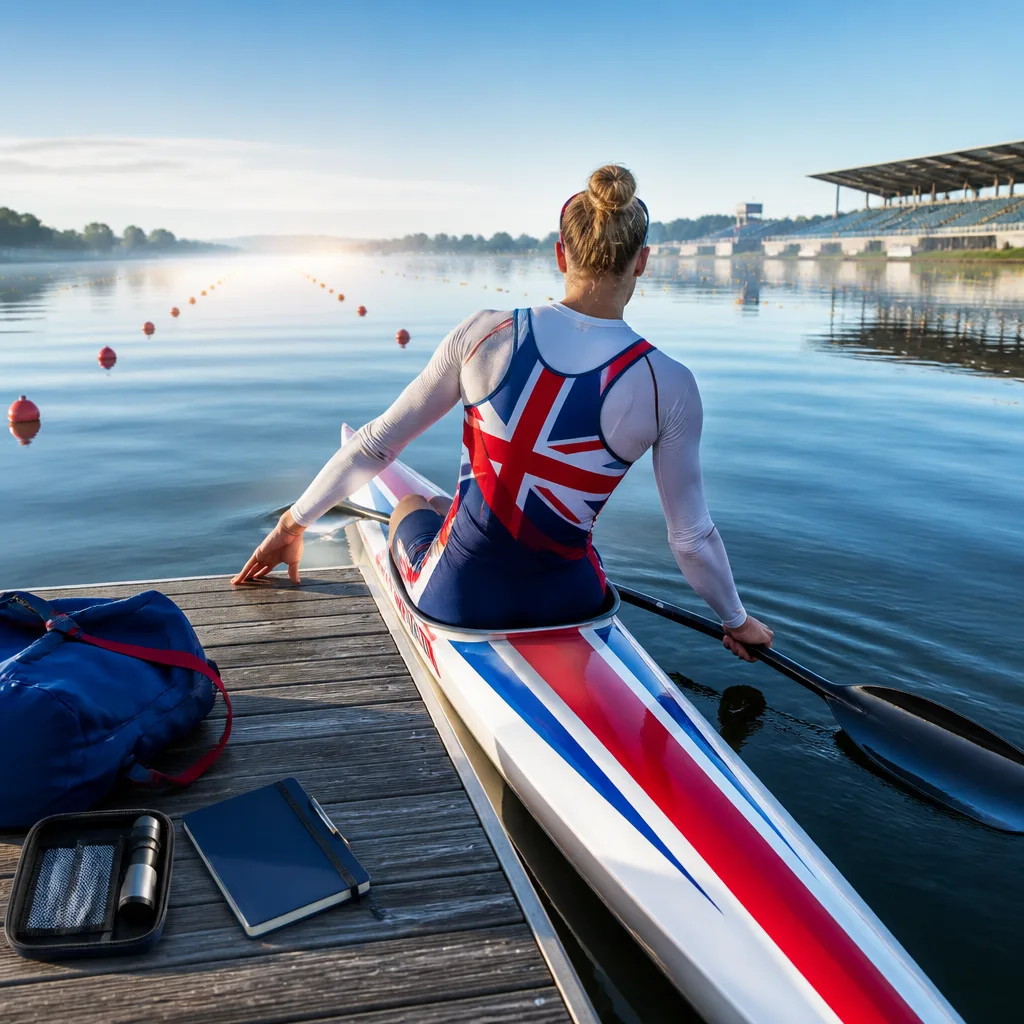
Beth Gill, a former world champion and prominent member of Great Britain’s canoe squad, will compete at the ICF Canoe Sprint and Paracanoe World Championships in Poznań from 26-30 August, using the event as a performance marker on the pathway towards LA 2028.
Elite sport and scientific study
Now 30, Gill combines training with academic work. She is undertaking a PhD in microbiology at the University of Nottingham, and bases her on-water preparation at the National Water Sport Centre at Holmepierre Pont. Her research and engagement with environmental agencies have become a central part of how she frames her role as an athlete.
“Microbiology is something that we can’t see, we can’t see it in the waterway… If it gets a young person into science, that's magical for me,”
That blend of laboratory research and elite training informs Gill’s public messaging. She has worked with the Environment Agency to help highlight river pollution and its implications for waterways — turning an invisible scientific problem into something she hopes inspires broader interest and action.
Competition goals and team context
Gill is looking to extract the best possible performances from each outing rather than prematurely projecting to the Olympic cycle, a strategy she says helps preserve focus. The athlete, who won the World Championship in 2022 and secured victory at a 2025 World Cup, said the right mindset is calmness and confidence: deliver the best performance available and the longer-term outcomes follow.
- Event: ICF Canoe Sprint and Paracanoe World Championships, Poznań — 26-30 August
- Athlete age: 30
- Academic study: PhD in microbiology, University of Nottingham
- Training base: National Water Sport Centre at Holmepierre Pont
She forms part of a British cohort that includes established Paralympic and world medallists, providing both depth and experience inside the squad. Named team-mates cited in relation to the squad include Emma Wiggs, Charlotte Henshaw, and 2024 Paralympic silver medallists Hope Gordon and Jack Eyers. Gill’s domestic and international life is further entwined with the sport; her partner, Dan Johnson, is a national team paddler competing in the K1 1000m.
Approach to performance and longer-term targets
Gill is attempting to resist the temptation to look too far ahead to LA 2028, stressing incremental improvement. “LA 2028 is exciting to think about but it’s so easy to jump straight to that outcome,” she said, emphasising the importance of steady progress, measured performances and enjoying the process.
Her stated outlook is grounded in a principle common among elite athletes: control the controllables. By concentrating on preparation, calmness and daily improvement, she aims to maximise the likelihood of hitting peak performances at the right moments.
| Year | Achievement |
|---|---|
| 2022 | World Champion |
| 2025 | World Cup winner |
As the World Championships approach, Gill’s dual profile — elite paddler and scientist — offers an angle beyond medals alone. Her environmental engagement is a reminder that modern athletes often carry responsibilities as communicators and role models, particularly on issues that intersect with their sport.
For British canoeing, the Poznań regatta provides both an opportunity to consolidate current form and to assess the team’s longer-term prospects ahead of the next Olympic cycle. For Gill personally, it is another chance to translate disciplined training and academic curiosity into results on the water while continuing to use her platform to highlight river health and encourage interest in science among young people.